
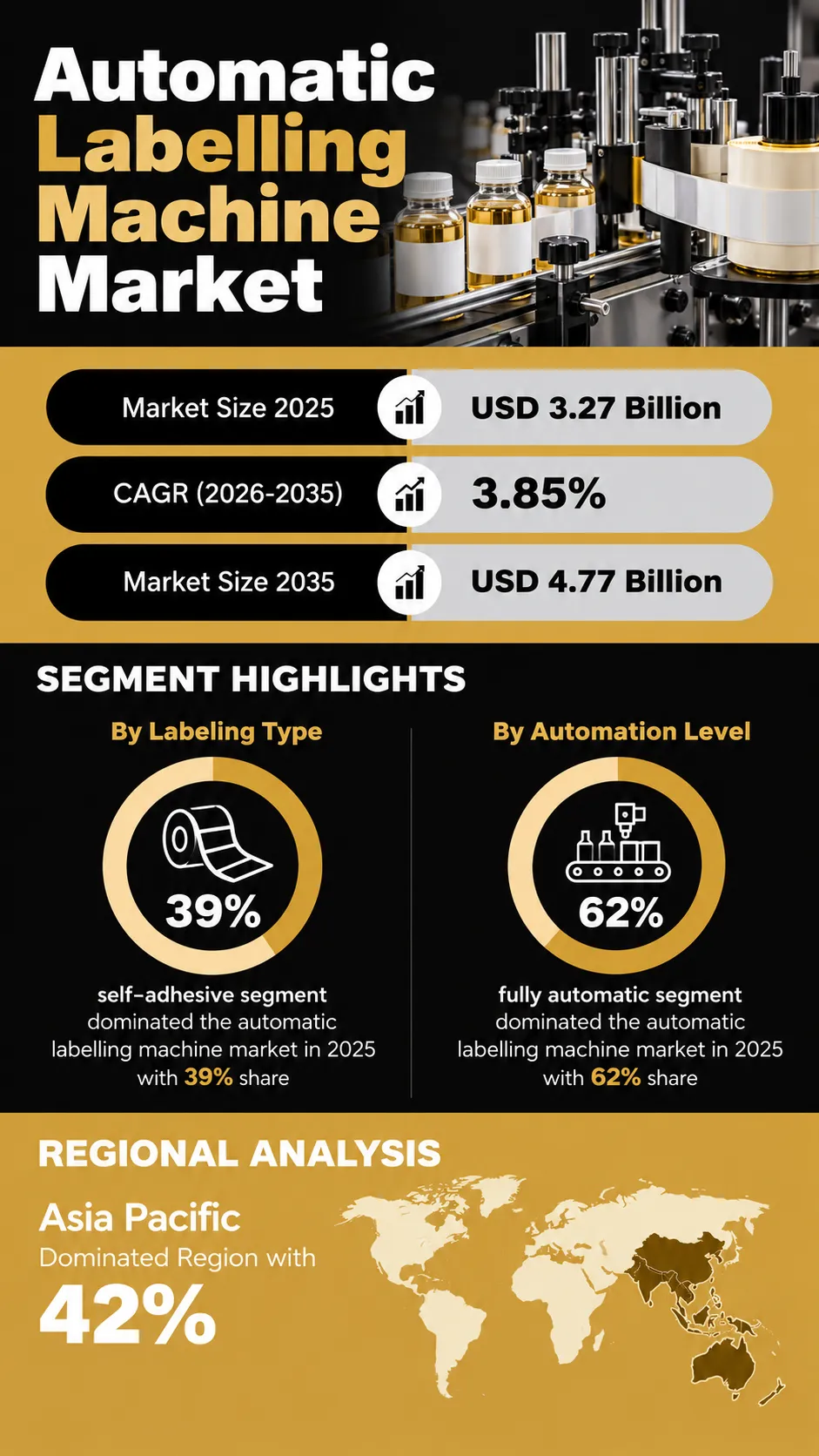
The global Automatic Labelling Machine Market is on a steady growth path through 2035, as manufacturers upgrade aging equipment and regulators tighten product traceability requirements. “According to a recent study by SNS Insider, the global Automatic Labelling Machine Market size valued at USD 3.27 billion in 2025, is anticipated to grow to USD 4.77 billion by 2035, registering a CAGR of 3.85% over the 2026-2035 forecast period.”
Labelling equipment does not get much attention compared to flashier packaging technology, but it has quietly become one of the more software-driven categories in the industry, vision inspection, IoT connectivity, and RFID encoding are now standard conversation points in equipment purchasing decisions that used to focus almost entirely on speed and mechanical reliability.
Regulatory pressure, more than any single consumer trend, is what is pushing manufacturers toward more sophisticated labelling systems, particularly in pharmaceuticals where serialization rules leave little room for equipment that cannot verify what it just printed.
To Get Detailed Insights on the Automatic Labelling Machine Market – Request a Sample Report
Serialization Compliance Reshapes Equipment Specifications
Pharmaceutical and food manufacturers are increasingly specifying labelling equipment capable of encoding, printing, and verifying unique product identifiers in a single pass, a requirement that barely existed on most purchasing checklists a decade ago.
This shift is pushing equipment makers to build more sophisticated software and vision-inspection capability directly into labelling hardware rather than treating those as optional add-ons.
Suppliers who can demonstrate reliable serialization compliance out of the box are increasingly winning contracts over competitors offering labelling speed or cost advantages alone.
Key Market Findings Highlight High-Growth Segments
Self-adhesive labels contributed maximum revenue shares to the Automatic Labelling Machine Market, accounting for 39%, on account of their application suitability in glass, plastic, and metal containers.
The shrink sleeve label was the fastest growing labeling material, with a CAGR of 6.20%, driven by demand from beverage and personal care products manufacturers seeking to implement 360° branding solutions.
In terms of end-user industry, food & beverage dominated with 38% market share in 2025, while pharmaceuticals was the fastest growing end-user segment, with a CAGR of 6.90%.
Fully automatic machines remained dominant at 62% share, but semi-automatic systems are growing fastest, at a 5.80% CAGR, as smaller manufacturers running variable batch sizes adopt automation for the first time.
Traceability and Placement Precision Anchor Competitive Positioning
Manufacturers are increasingly evaluating labelling equipment on traceability capability and placement precision rather than speed alone, particularly in regulated industries.
Investment in servo-driven mechanisms and vision inspection is becoming a clearer competitive differentiator among equipment makers, while suppliers without that capability increasingly compete only on price in less regulated end-user categories.
This divide is likely to sharpen further as more industries adopt pharmaceutical-style traceability requirements.
Asia Pacific Leads as Latin America Accelerates Fastest
Asia Pacific holds the largest share of global market revenue, anchored by the region's massive packaged goods manufacturing base and continued shift from manual to automated labelling. Latin America, meanwhile, is growing fastest, propelled by rapid expansion of packaged food, beverage, and personal care manufacturing across Brazil and Mexico.
Europe holds a steady, mature share as well, shaped by strict labelling regulation and consistent replacement demand for recyclable-material-compatible equipment.
Leading Companies Drive Innovation and Competition
Competition in this market centers on serialization capability, placement precision, and integration flexibility nearly as much as on raw labelling speed, with major players investing in software and vision-inspection technology to differentiate.
Some of the major companies that operate in the global automatic labelling machine market are Krones AG, FUJI Seal International Inc., HERMA GmbH, SATO Holdings Corporation, ProMach Inc., Avery Dennison Corporation, Label-Aire Inc., Accutek Packaging Equipment Co. Inc.
An SNS Insider Analyst Santosh Bhul commented, “Labelling equipment has quietly become one of the more technically demanding parts of a packaging line, manufacturers now expect it to place a label precisely, verify what it printed, and feed that data back into plant systems, all without slowing down production. Suppliers who can deliver that level of integration are the ones winning the replacement and upgrade cycle driving this market forward.”
About the Author

Get in touch




