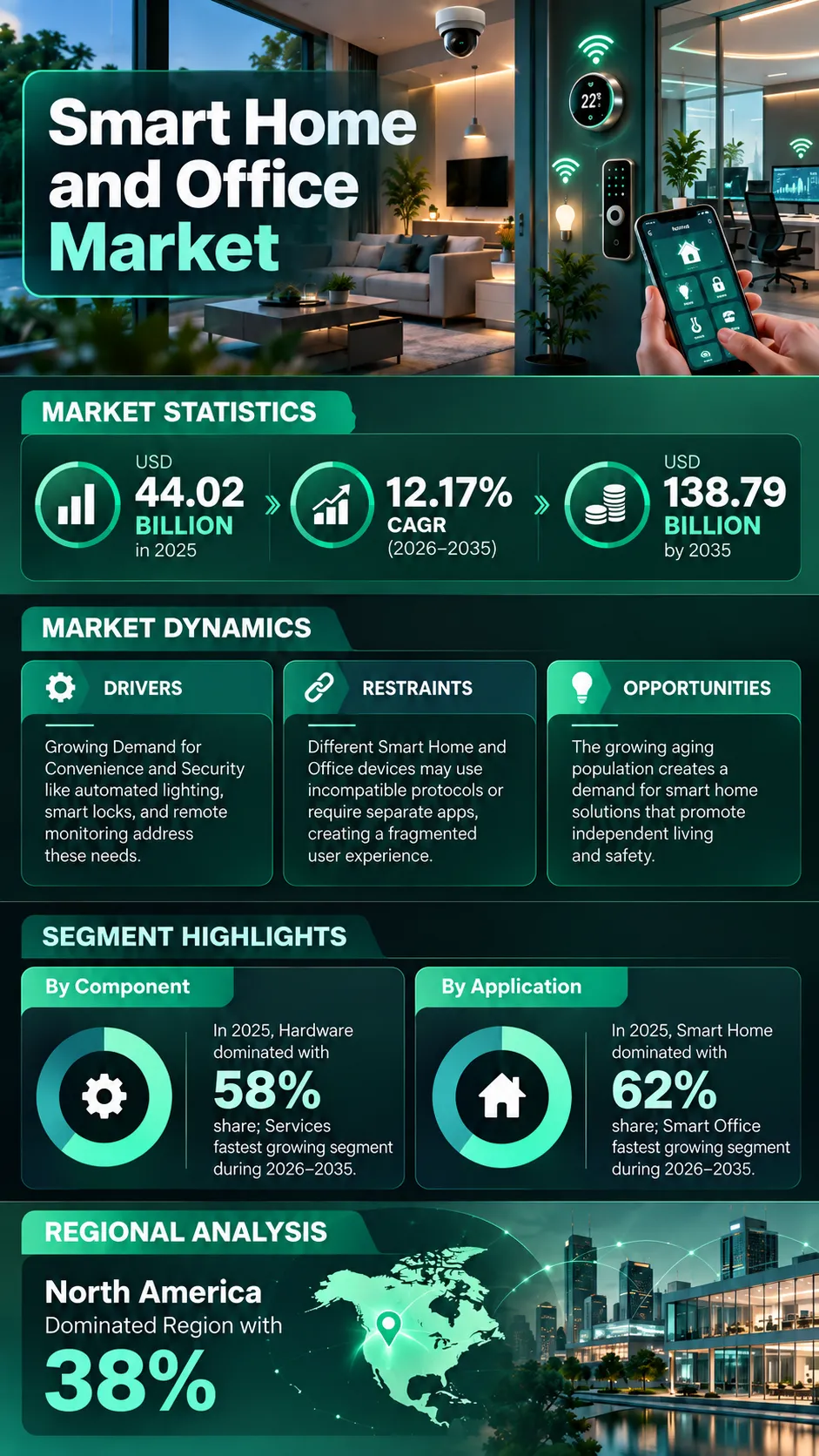
The global Smart Home and Office Market is entering a strong growth phase as consumers and businesses increasingly adopt connected technologies to improve security, energy management, convenience, and workplace efficiency. “According to a recent study by SNS Insider, the global Smart Home and Office Market size valued at USD 44.02 billion in 2025, is anticipated to grow to USD 138.79 billion by 2035, registering a CAGR of 12.17% over the 2025–2035 forecast period.”
With the advent of rapid digitalization, the approach towards designing and managing commercial and residential settings is also transforming. There is integration of smart lights, smart security systems, smart climate management systems, and voice-controlled smart gadgets due to consumers’ demands for greater control via smartphones and centralized applications.
The growing connectivity in the IoT world, urbanization, and increasing purchasing power of consumers are aiding such trends. Similarly, there is usage of connected technology in workplaces to streamline the processes, decrease energy consumption, and offer flexible workspaces.
To Get Detailed Insights on the Smart Home and Office Market – Request a Sample Report
Connected Living and Workplace Automation Create New Growth Opportunities
Demand for smart environments will be boosted by the increasing focus on convenience, security, and efficiency of resources. Lighting systems, access controls, surveillance systems, and sensors provide users with the ability to control their property from afar and minimize the need for any manual operations.
The business sector will see increasing demand due to the modernization of office spaces, which will involve hybrid working models and efficient management of buildings. Services including professional installation, integration, maintenance, and consulting are becoming increasingly important as well.
One more opportunity is being offered by the aging population, as technologies like voice controls, automated lighting, fall detection, and remote monitoring can help people live independently while keeping the caregiver aware of the situation in the household.
Key Market Insights Highlight Shifting Demand Patterns
By component, hardware segment accounted for 58% of global market revenue in 2025, supported by widespread deployment of connected security systems, lighting products, thermostats, speakers, and other smart devices. Services are projected to be the fastest-growing segment through 2035 as consumers and businesses increasingly require installation, integration, customization, and ongoing maintenance.
Based on application, smart homes segment was estimated to hold 62% of market revenue in 2025, driven by demand for residential automation, security, and energy savings. Smart offices are expected to record the fastest growth as companies invest in connected workplaces that support hybrid operations, collaboration, automation, and energy management.
By device type, smart security and surveillance systems held 36% of market revenue in 2025, reflecting rising demand for connected cameras, alarms, and access-control solutions. Smart HVAC and energy management systems are projected to experience the fastest growth as property owners seek greater energy efficiency and lower operating costs.
In terms of connectivity, Wi-Fi dominated with 54% of market revenue in 2025 due to its broad compatibility and established infrastructure. Zigbee is projected to be the fastest-growing connectivity segment, supported by its low power requirements and reliable mesh-networking capabilities.
Interoperability and Intelligent Energy Management Shape Industry Development
Smart environment evolution is now more concerned about building up ecosystems than building individual gadgets. Interoperability is one of the issues that have to be taken into account in view of the fact that various communication protocols and applications may pose some difficulties during installation and routine maintenance.
Thus, manufacturers are shifting towards greater interoperability and building platforms. At the same time, the development of intelligent HVAC controls, automated lighting, occupancy sensors, and energy management systems is getting momentum.
North America Leads Market with 38% Share as Asia Pacific Grows at a 14.85% CAGR
The share of North America in terms of revenue from the global market is expected to stand at 38% in 2025 owing to its high technology adoption, digital infrastructure, consumer purchasing power, and availability of leading technology and building automation companies.
The Asia-Pacific region will hold the highest CAGR of 14.85% throughout the forecast period. Growth is driven by urbanization, rising middle class, smart cities initiatives, and increased adoption of connected consumer electronic devices in countries such as China, India, Japan, and South Korea.
Another region that stands to benefit from its energy efficiency initiatives and sustainable buildings is Europe, while Latin America and the Middle East & Africa regions are slowly making their way owing to their connectivity and smart infrastructure.
Industry Participants Focus on Ecosystem Expansion and AI Integration
The competitive landscape remains active as technology companies, electronics manufacturers, building-automation providers, and security specialists expand connected-device portfolios and strengthen ecosystem integration. Artificial intelligence, cloud platforms, wireless connectivity, and automated energy management are becoming important areas of product development and differentiation.
Key companies operating in the global Smart Home and Office Market include Amazon.com, Inc., Google LLC, Apple Inc., Samsung Electronics Co., Ltd., LG Electronics Inc., Siemens AG, Schneider Electric SE, Honeywell International Inc., Johnson Controls International plc, ABB Ltd., Bosch (Robert Bosch GmbH), Cisco Systems, Inc., Intel Corporation, Microsoft Corporation, Panasonic Corporation, Legrand SA, Lutron Electronics Co., Inc., Crestron Electronics, Inc., ADT Inc., and Resideo Technologies, Inc.
An SNS Insider analyst Sushant Kadam commented, “The convergence of IoT, AI, wireless connectivity, and intelligent building management is creating a broader ecosystem for smart environments. As consumers and enterprises place greater emphasis on security, energy efficiency, automation, and independent living, demand for integrated smart home and office solutions is expected to continue expanding.”About the Author

Get in touch