
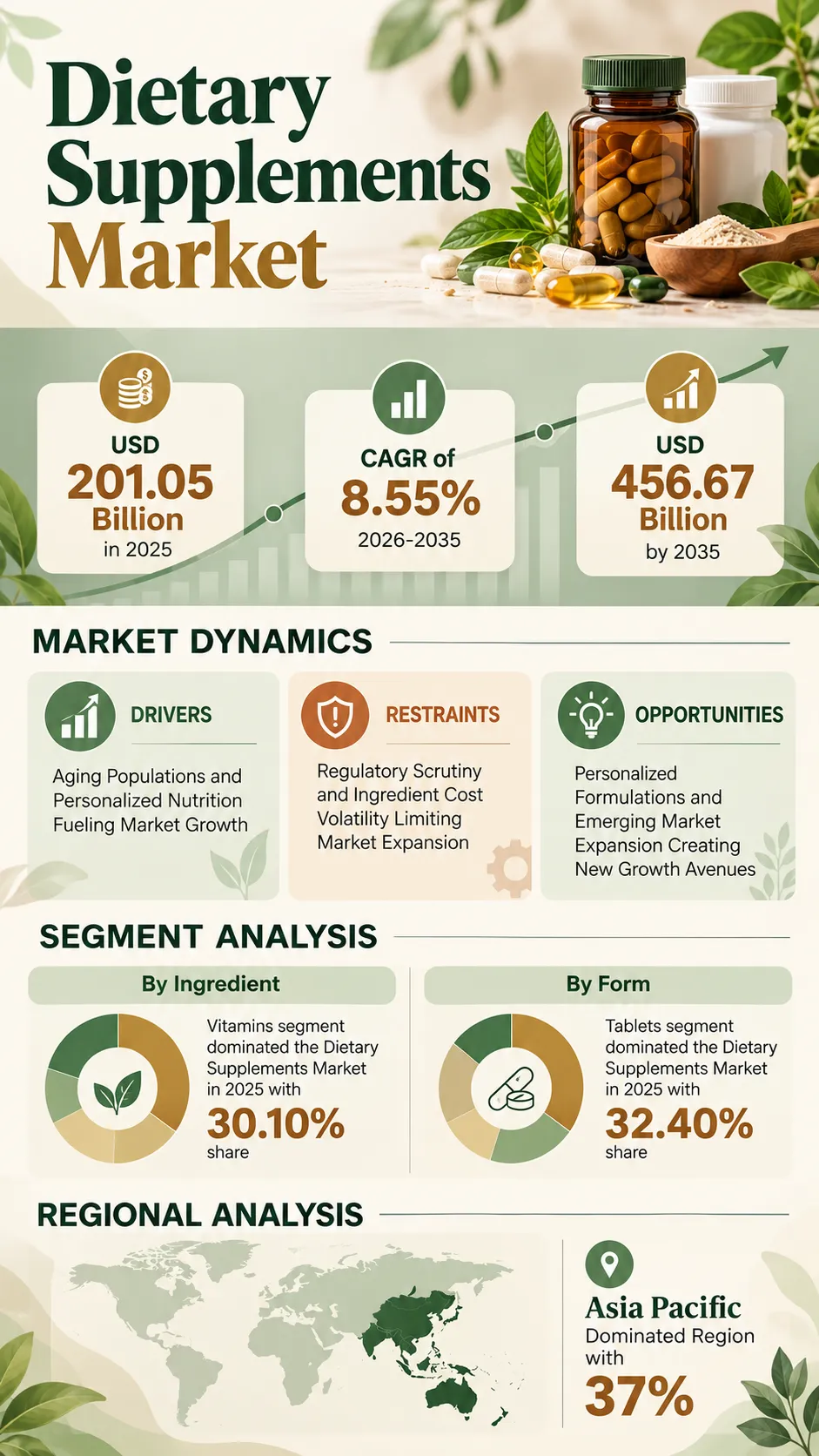
The global Dietary Supplements Market is set for substantial growth through 2035, as personalized nutrition technology and rising health consciousness continue reshaping how consumers approach supplementation. “According to a recent study by SNS Insider, the global Dietary Supplements Market size valued at USD 201.05 billion in 2025, is anticipated to grow to USD 456.67 billion by 2035, registering a CAGR of 8.55% over the 2026-2035 forecast period.”
A daily multivitamin used to be about as personalized as buying a loaf of bread, one formula, sold to everyone, regardless of age, genetics, or actual nutritional gaps. That is changing quickly, as genetic testing, biomarker analysis, and AI-driven formulation tools make it possible to build a supplement regimen around an individual's actual data rather than population averages.
Major supplement companies are responding by acquiring personalized nutrition technology rather than building it from scratch, betting that speed to market matters more right now than owning every piece of the underlying data science.
To Get Detailed Insights on the Dietary Supplements Market – Request a Sample Report
Personalization Technology Reshapes Product Development
Where supplement formulation once relied almost entirely on population-level nutritional guidelines, brands are increasingly incorporating genetic testing, biomarker data, and even wearable health tracking data into how they design individual products.
This shift is changing what counts as a competitive advantage in the category, since clinical and data science capability is becoming as important a differentiator as ingredient sourcing or manufacturing scale used to be.
Acquisitions of personalized nutrition technology companies by established supplement brands are becoming a common way to accelerate this transition rather than building comparable capability internally.
Key Market Findings Highlight High-Growth Segments
Vitamins held the largest share of the Dietary Supplements Market in 2025, at 28.20%, reflecting how deeply embedded vitamin supplementation already is in everyday consumer health habits.
Botanicals are the fastest-growing ingredient category, expanding at a 10.60% CAGR, pulled forward by consumer preference for plant-derived formulations and growing interest in adaptogens and functional mushroom extracts.
By form, tablets led with 34% share in 2025, while softgels are growing fastest, at a 9.80% CAGR, as consumers favor easier swallowing and formats suited to oil-based ingredients.
OTC supplements remained dominant at 75.60% share, but prescribed supplements are climbing fastest, at a 9.60% CAGR, as physicians increasingly recommend clinically formulated products for specific health conditions.
Clinical Evidence and Personalization Anchor Competitive Positioning
Brands are increasingly being asked to back up their claims with genuine clinical evidence rather than marketing copy alone, particularly as regulatory scrutiny intensifies across major markets.
Investment in personalization technology and clinical substantiation is becoming a genuine competitive differentiator among larger players, while smaller brands without that investment increasingly compete only on price in commodity ingredient categories.
This divide is likely to sharpen further as consumers grow more sophisticated about evaluating supplement claims.
Asia Pacific Leads as Latin America Accelerates Fastest
Asia Pacific holds the largest share of global market revenue, anchored by China's massive consumer base and rapidly expanding cross-border e-commerce access to supplement products. Latin America, meanwhile, is growing fastest, propelled by rising disposable incomes and rapid expansion of e-commerce distribution across Brazil and Mexico.
North America holds a close second-largest share, supported by a highly developed direct-to-consumer supplement industry and a large aging population that consistently drives above-average supplement spending.
Leading Companies Drive Innovation and Competition
Competition in this market is playing out across personalization technology, clinical substantiation, and distribution reach nearly as much as on traditional brand marketing, with major players investing heavily in data science capability.
Some of the major companies that operate in the global dietary supplements market are Pfizer Inc., Bayer AG, Glanbia plc, Abbott Laboratories, Archer Daniels Midland Company, Herbalife Nutrition Ltd., Haleon plc, Amway Corporation.
An SNS Insider Analyst Santosh Bhul commented, “Dietary supplements have moved well past the one-size-fits-all multivitamin era, brands now need genuine clinical evidence and increasingly personalized formulation to win consumer trust, and the companies capturing the fastest-growing parts of this market are the ones investing in data science capability rather than relying on marketing alone. As aging populations and health consciousness both keep rising globally, personalization is becoming the clearest differentiator in an increasingly crowded category.”
About the Author

Get in touch




