
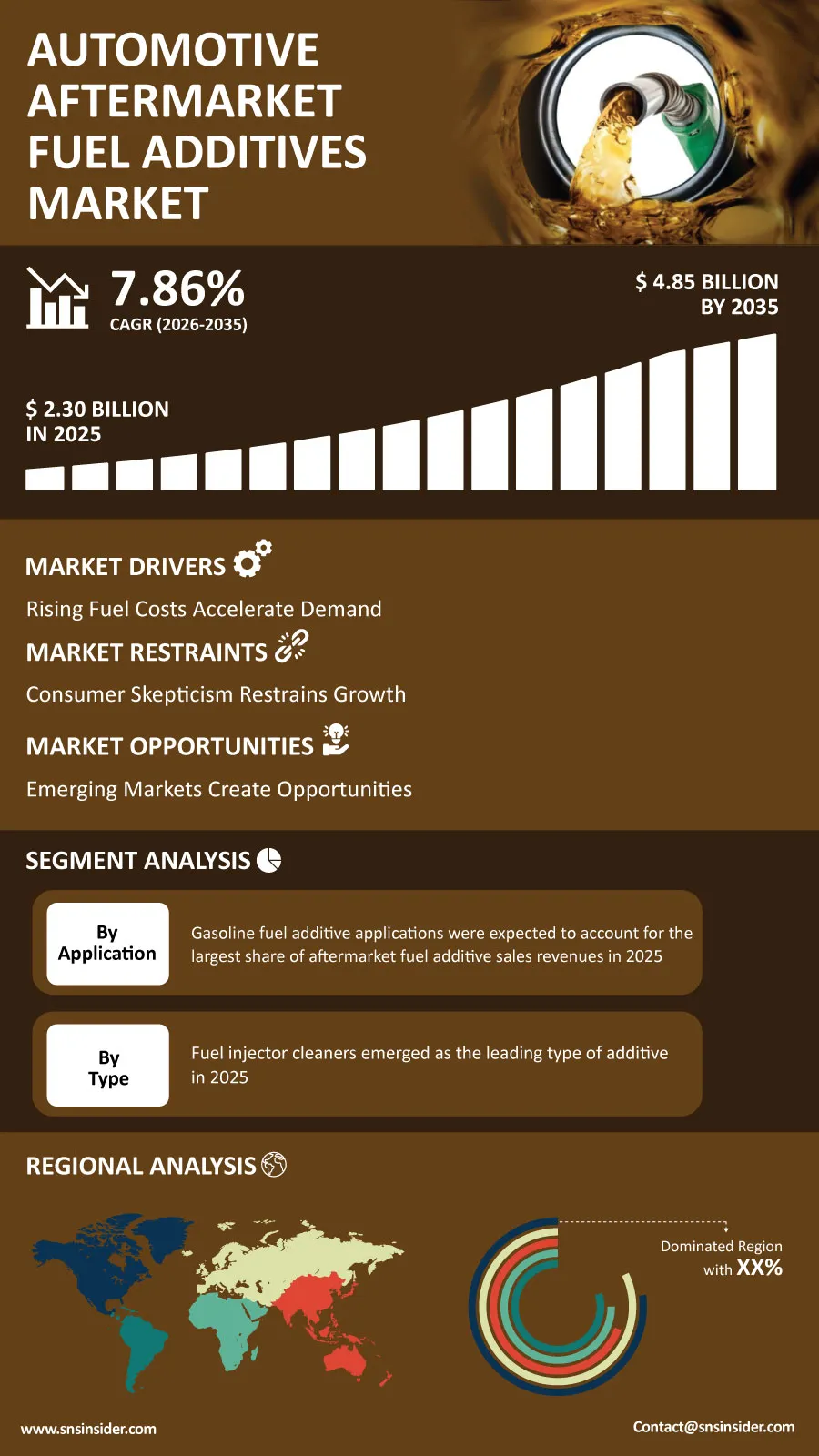
The worldwide Automotive Aftermarket Fuel Additives Market is registering growth as consumers and fleet managers choose to go for maintenance options that are economical in terms of improving engine performance, fuel efficiency, and emission reduction. “According to a recent study by SNS Insider, the global Automotive Aftermarket Fuel Additives Market size valued at USD 2.30 Billion in 2025, is anticipated to grow to USD 4.85 Billion by 2035, registering a CAGR of 7.86% over the 2026–2035 forecast period.”
Increasing amounts of aged passenger and commercial cars all around the world keep generating a consistent need for fuel system cleaners, combustion boosters, and engine protectants. With vehicles being in use for longer periods of time, consumers are becoming more interested in buying preventive maintenance products that improve their engine operation while minimizing maintenance expenses. Fuel efficiency and environmental regulations are additional factors motivating the application of modern fuel treatments.
The manufacturers are also diversifying their product range by developing additives that have multi-purpose capabilities for performing tasks such as injector cleansing, corrosion protection, fuel stabilization, and combustion optimization in one product itself. Such developments are enhancing the customer’s value, while simultaneously improving the engine reliability.
To Get Detailed Insights on the Automotive Aftermarket Fuel Additives Market – Request a Sample Report
Expanding Vehicle Parc and Preventive Maintenance Trends Create Long-Term Growth Opportunities
As the number of high-mileage vehicles in the global automobile industry increases, there are a lot of opportunities for companies that manufacture aftermarket fuel additives. Fuel additives have become an economical way for drivers to maintain the optimal performance of their fuel systems and engines without spending large sums on repairs.
Moreover, there has been an increased demand for fuel additives that are specially designed for use in ethanol-based fuels, hybrid engine systems, and low-quality fuels. The development of biodegradable chemicals and other technologies is expected to provide additional opportunities as a result of tightening government regulations on automotive emissions.
Key Market Insights Highlight Shifting Demand Patterns
On the basis of application, Gasoline commanded the maximum market share in 2025 because of the prevalence of gasoline-driven passenger cars in major markets. Diesel applications are expected to grow significantly in the coming decade until 2035, which will be driven by the growing commercial fleet and increased need for heavy duty engine cleaners.
On the basis of product type, Fuel Injector Cleaners were the top revenue generators in 2025 because of their use in cleaning engines for fuel savings and improved engine performance. The Cetane Improvers will grow the fastest because of the adoption of performance enhancing additives among the commercial fleet.
By vehicle type, Passenger Cars commanded the maximum market revenue share in 2025, whereas Two-Wheelers will grow at the fastest rate in the forecast period till 2035, especially in Asia Pacific where two wheelers are critical to transportation needs.
Product Innovation and Sustainable Chemistry Drive Industry Development
Fuel additive research continues to evolve and is changing the dynamics of the market. Fuel additive companies continue to produce additives with improved detergency, low toxicity, and treatment that offers improved efficiency of combustion as well as deposit prevention.
Additionally, the adoption of digital retail channels is changing how customers get access to quality automotive products. The fast adoption of online retail sales, subscription model, and online automotive marketplaces has helped these fuel additives gain more customers.
North America Led Fuel Additives Market in 2025; Asia Pacific to Record Fastest Growth Through 2035
North America was able to sustain its dominance in the global industry during 2025 owing to its large number of old vehicles, advanced auto aftermarket facilities, and customer consciousness towards preventive maintenance of their vehicles. The U.S. will continue to show high growth potential with its advanced retail sales chain and introduction of fuel additives.
The Asia Pacific region is anticipated to be the highest growing regional market during 2035 owing to increased vehicle ownership and sales of two-wheelers, improved automobile retail sales chains, and increased consumer awareness towards engine maintenance.
Industry Participants Strengthen Distribution and Product Innovation
The competition among fuel additives for the automobile aftermarket sector is mainly centered around formulation efficiency, growth in distribution networks, and environmental production of products. Major manufacturers keep on developing fuel systems technology, OEM validation, and environmentally friendly chemical formulas in order to establish themselves in the market.
Key companies operating in the global Automotive Aftermarket Fuel Additives Market include Chevron Corporation, BASF SE, Afton Chemical Corporation, Infineum International Limited, The Lubrizol Corporation, TotalEnergies Additives & Special Fuels, Innospec Inc., Clariant AG, BG Products Inc., Lucas Oil Products Inc., Red Line Synthetic Oil Corporation, Liqui Moly GmbH, Royal Purple LLC, Gold Eagle Co., Millers Oils Ltd., STP Products Company, Ashland Inc., Cerion Energy, Evonik Industries AG, and Rislone Engine Treatment.
An SNS Insider analyst Himanshu Sharma commented, "As vehicle ownership continues shifting toward longer service life across global markets, preventive maintenance products such as aftermarket fuel additives are becoming increasingly valuable for consumers seeking affordable performance improvements and fuel savings. Companies investing in advanced formulations, sustainable chemistry, and broader distribution networks are well positioned to benefit from long-term industry growth."
About the Author

Get in touch




