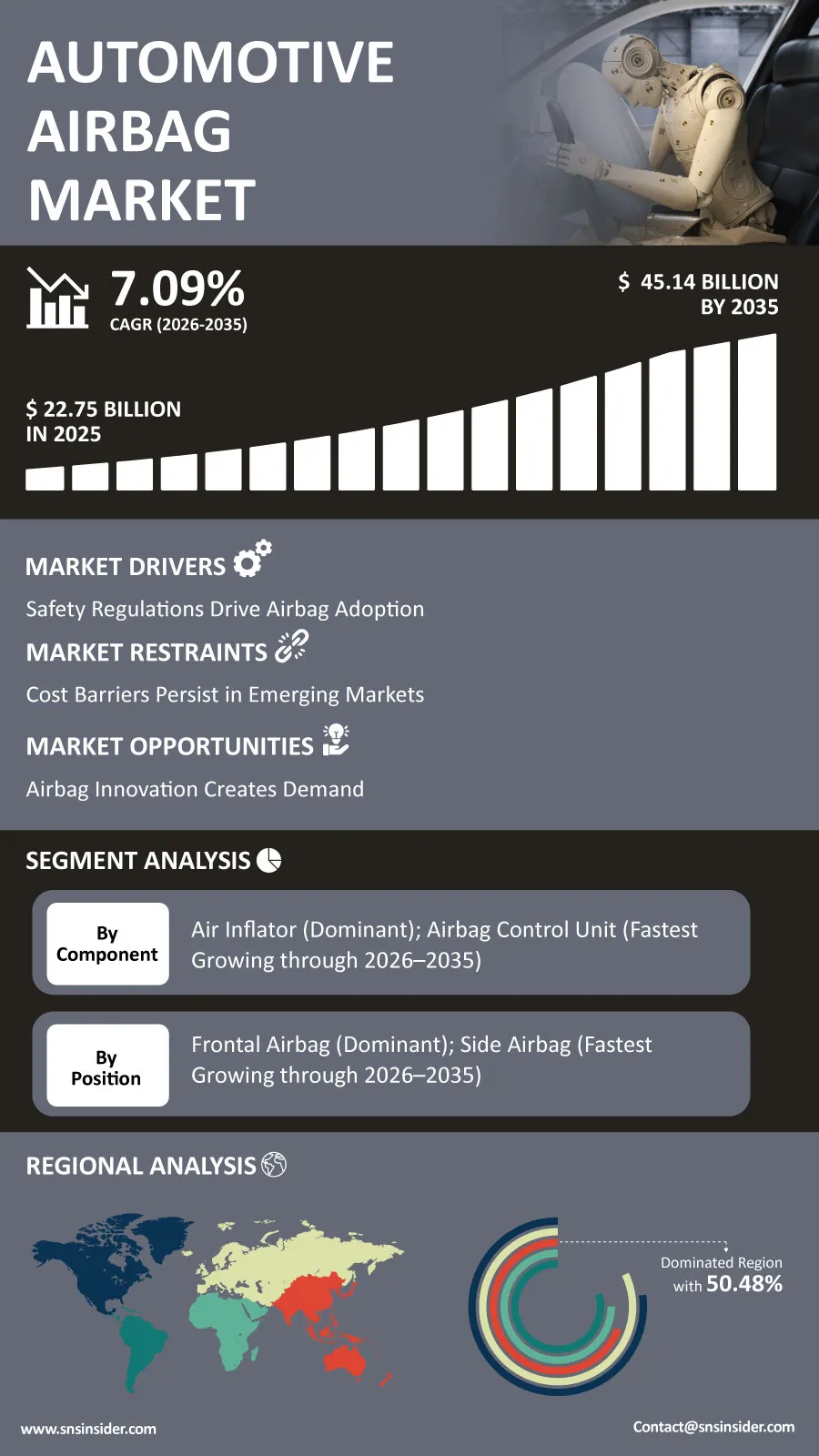
The global Automotive Airbag Market is expected to witness sustained growth over the coming decade as governments strengthen vehicle safety regulations and automakers increase investments in advanced occupant protection technologies. “According to a recent study by SNS Insider, the global Automotive Airbag Market size valued at USD 22.75 billion in 2025, is anticipated to grow to USD 45.14 billion by 2035, registering a CAGR of 7.09% over the 2026–2035 forecast period.”
Due to the increased awareness of the need to reduce road deaths, passive safety is gaining more importance among car makers around the world. Airbags have become more advanced as they have shifted from simple front bags to more sophisticated designs, such as side, curtain, knee, and center airbags to protect passengers in different crash situations. With more people attaching importance to safety while buying vehicles, car manufacturers have been increasing the number of airbags in their cars.
The speedy development of electric cars and mobility systems for the future is transforming product development approaches as well. The designs of the vehicle keep changing, which calls for advanced restraints that can efficiently respond to new crash dynamics.
To Get Detailed Insights on the Automotive Airbag Market – Request a Sample Report
Advanced Vehicle Safety Technologies Continue to Create Growth Opportunities
Innovative technologies related to intelligent safety solutions integrating airbags with smart sensor and electronic control modules and the ability of predicting collision are getting more popular among the leading global automotive manufacturers. This helps increase the effectiveness of these systems while improving protection of drivers and passengers.
With the increasing popularity of connected and autonomous vehicles, opportunities are arising for implementing advanced airbag systems into new vehicles. Due to changing the cabin arrangement, manufacturers are designing special airbag systems that will be able to protect passengers in any position within the cabin.
Another trend is related to the increasing production of electric vehicles. Due to their particular arrangement of batteries, special airbag systems should be developed to ensure passenger safety.
Key Market Insights Highlight Evolving Demand Across Vehicle Categories
Passenger vehicles accounted for 64.56% of total Automotive Airbag Market revenue in 2025, supported by strong global vehicle production and widespread implementation of mandatory safety regulations across leading automotive markets.
Commercial vehicles are expected to register the fastest growth throughout the forecast period as governments extend safety requirements to trucks and buses while logistics operators prioritize driver protection and fleet safety.
By distribution channel, original equipment manufacturers (OEMs) represented 76.43% of market revenue during 2025 due to long-term production agreements and factory-installed airbag systems. Meanwhile, the aftermarket segment is forecast to expand at the fastest pace with a 7.88% CAGR, supported by rising vehicle replacement cycles and growing awareness regarding airbag maintenance.
Frontal airbags continued to generate the highest revenue among positioning segments owing to their universal installation across modern passenger vehicles. Side airbags are projected to experience the strongest growth as manufacturers expand occupant protection technologies across additional vehicle categories.
Among components, air inflators maintained the leading market position because they remain essential to every airbag deployment system. At the same time, airbag control units are anticipated to witness the fastest expansion as electronic safety systems become increasingly intelligent and responsive.
Innovation and Regulatory Compliance Drive Industry Priorities
Automobile companies are working on incorporating high technology electronics, light weight material and intelligent deployment systems in order to increase the safety performance of cars in crashes without adding unnecessary weight to the vehicle. Research on the development of more robust fabrics, quick inflation systems and sensor fusion technologies will assist automobile companies to develop safe cars without reducing their efficiency.
On the other hand, there are increasing regulations for better test procedures in order to ensure passenger safety in different types of crashes. The changing regulation is motivating suppliers to work towards innovation in the field and developing closer cooperation with international auto companies.
As vehicles have become more complex, the airbags are expected to be used increasingly in automotive safety plans which will include both passive and active safety technologies.
Asia Pacific Accounted for 50.48% Market Share in 2025; North America Forecast to Expand at the Fastest CAGR by 2035
The Asia-Pacific region was responsible for 50.48% share of the global revenue of Automotive Airbag Market in 2025 due to large scale manufacturing of automobiles, increased number of vehicles in operation, and implementation of road safety regulations in nations, such as China, Japan, India, and South Korea.
The North American region is estimated to witness the fastest growth till 2035 owing to the continued implementation of various advanced safety systems in passenger and electric vehicles. Strict regulatory compliance and rising penetration of self-driving technology and premium safety systems among consumers will drive growth in the region.
Europe also remains an important contributor as vehicle manufacturers continue investing in advanced restraint technologies designed to meet increasingly rigorous safety standards while supporting next-generation electric mobility platforms.
Industry Participants Accelerate Next-Generation Safety Innovation
Competition across the Automotive Airbag Market continues to intensify as leading manufacturers focus on intelligent restraint systems, lightweight materials, electronic safety integration, and advanced crash sensing technologies. Strategic investments in research, manufacturing expansion, and partnerships with global automotive OEMs are expected to shape the competitive landscape throughout the forecast period.
Key companies operating in the global Automotive Airbag Market include Autoliv, ZF Friedrichshafen AG, Takata Corporation, Hyundai Mobis, Denso Corporation, Continental AG, Robert Bosch GmbH, Toyoda Gosei Co., Joyson Safety Systems, Key Safety Systems, Nihon Plast, TRW Automotive, Ashimori Industry Co., Delphi Technologies, Faurecia, Flex-N-Gate Corporation, Magneti Marelli, Neaton Auto Products, Toyota Boshoku, and Aptiv PLC.
An SNS Insider analyst Santosh Bhul commented, "Increasing global emphasis on vehicle safety, expanding adoption of electric vehicles, and continuous advancements in intelligent restraint technologies are creating long-term opportunities for automotive airbag manufacturers. Companies investing in innovation, regulatory compliance, and next-generation occupant protection systems will be well positioned to capture future market growth."
About the Author

Get in touch