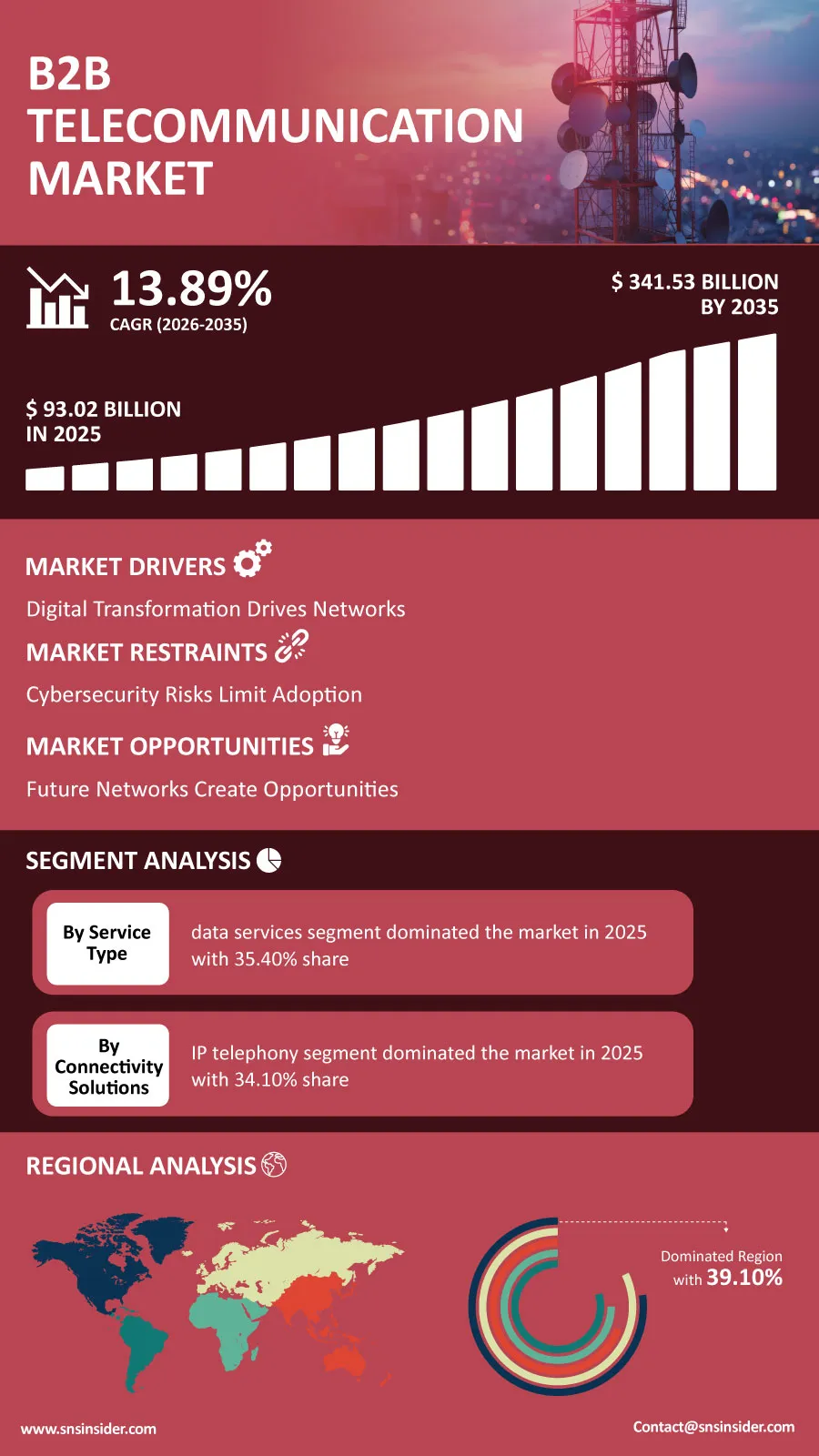
The global B2B Telecommunication Market is entering a new phase of expansion as organizations prioritize resilient digital infrastructure to support evolving business operations. “According to a recent study by SNS Insider, the B2B Telecommunication Market size valued at USD 93.02 billion in 2025, is anticipated to grow to USD 341.53 billion by 2035, registering a CAGR of 13.89% over the 2026–2035 forecast period.”
Communication systems within various industries are becoming more modernized as companies look to increase efficiency, collaborate better, and connect with customers. Modern investments within cloud-based communication systems, intelligent networking, and software-defined infrastructure are revolutionizing how enterprises think about connectivity. As businesses become more reliant on digital systems, telecom companies are offering a wider range of products that will cater to enterprise demands.
As enterprises adopt 5G technology, edge computing and artificial intelligence within network management, this is giving further impetus to the market’s momentum. Increased demand from enterprises in relation to high bandwidth applications, remote employees, and connected devices is fueling a constant demand for telecommunication services.
To Get Detailed Insights on the B2B Telecommunication Market – Request a Sample Report
Enterprise Connectivity Investments Create Long-Term Growth Opportunities
Organizations are accelerating investments in digital communication infrastructure to improve agility while reducing operational complexity. Businesses are increasingly replacing legacy communication systems with integrated cloud-based platforms that support voice, messaging, collaboration, and secure data exchange through a unified environment.
The expansion of enterprise IoT deployments, smart manufacturing facilities, and connected supply chains is generating additional opportunities for telecom service providers. Reliable, low-latency communication networks have become essential for supporting automation, predictive maintenance, and real-time operational visibility across multiple industries.
Continuous innovation in software-defined networking, managed services, cybersecurity, and network virtualization is also opening new revenue opportunities. Service providers are focusing on value-added enterprise solutions that combine connectivity with analytics, security, and cloud integration to strengthen long-term customer relationships.
Key Market Insights Highlight Shifting Demand Patterns
Based on service type, data services accounted for 35.40% of global market revenue in 2025 due to increasing enterprise dependence on cloud applications, digital workflows, and high-speed data transmission. Cloud communication services are projected to register the fastest growth through 2035 as organizations continue migrating communication workloads to scalable cloud environments.
By enterprise size, large enterprises represented 52.40% of market revenue in 2025, supported by significant investments in digital transformation and global communication infrastructure. The small enterprises segment is expected to witness the fastest expansion as affordable cloud-based communication solutions become more widely accessible.
In terms of connectivity solutions, IP telephony held 34.10% market share in 2025 owing to its flexibility, lower operating costs, and seamless integration with enterprise systems. The wireless communication segment is forecast to grow at the fastest pace as mobile workforces and connected business environments continue expanding. The IT & technology sector remained the leading industry vertical with 34.20% share, while healthcare is expected to record the strongest growth over the forecast period. Cloud-based deployment led with 48.60% market share, whereas hybrid deployment is projected to grow most rapidly.
Intelligent Networks and Cloud Technologies Accelerate Industry Transformation
Enterprise communication technology is changing rapidly and moving away from the conventional connectivity solutions. There have been deployments of AI by telecom providers to manage traffic, enhance cyber security and increase reliability of services. Intelligent analytics can also predict maintenance and optimize networks.
On the other hand, SD-WANs, edge computing and cloud communication platforms help companies to design adaptable communication architecture that will be able to support their increasingly digital business models.
North America Held 39.10% of the B2B Telecommunication Market Share in 2025; Asia Pacific Projected to Register the Fastest 15.22% CAGR Through 2035
The North American region dominated the global market revenue share in 2025 by accounting for 39.10%, driven by the development of highly advanced digital infrastructure, enterprise cloud usage, and investments in future communication technology infrastructures. The availability of telecom players and consistent modernization activities in the region are contributing towards regional dominance.
The Asia-Pacific region is predicted to show the fastest growth rate of 15.22% during the period 2026-2035. Digital transformation activities, expansion of 5G networks, rise in startup environments, and enterprise-level adoption of cloud communication services are generating huge business opportunities in the region. Government activities for digital economies are contributing towards better long-term market prospects.
The region of Europe is still benefiting from enterprise digital transformation activities and investments in secure communication infrastructures, whereas Latin America and the Middle East and Africa regions are developing at a steady pace with advancements in broadband infrastructures and smart cities.
Industry Participants Focus on Intelligent Enterprise Communication Platforms
Competition remains intense as leading telecom providers strengthen enterprise portfolios through investments in cloud communications, network virtualization, cybersecurity, managed services, and next-generation connectivity technologies. Companies are expanding strategic partnerships and infrastructure investments to address growing enterprise demand for secure, scalable, and intelligent communication solutions.
Key companies operating in the global B2B Telecommunication Market include AT&T Inc., Verizon Communications Inc., Deutsche Telekom AG, Telefonica S.A., Vodafone Group PLC, Orange Business Services, BT Group, Tata Communications, NTT Communications Corporation, Telstra Corporation Limited, Singtel, Reliance Jio Infocomm, Comcast Business, Lumen Technologies, Masergy, Huawei Technologies Co., Ltd., Amdocs Ltd., Cisco Systems, Inc., Comarch S.A., and Bharti Airtel.
An SNS Insider analyst Sakshi Kale commented, "As enterprises accelerate digital transformation, demand for intelligent, secure, and cloud-enabled communication infrastructure will continue to reshape the global B2B telecommunication landscape. Providers investing in AI-driven networking, 5G capabilities, and integrated enterprise services are expected to capture significant long-term growth opportunities."
About the Author

Get in touch