
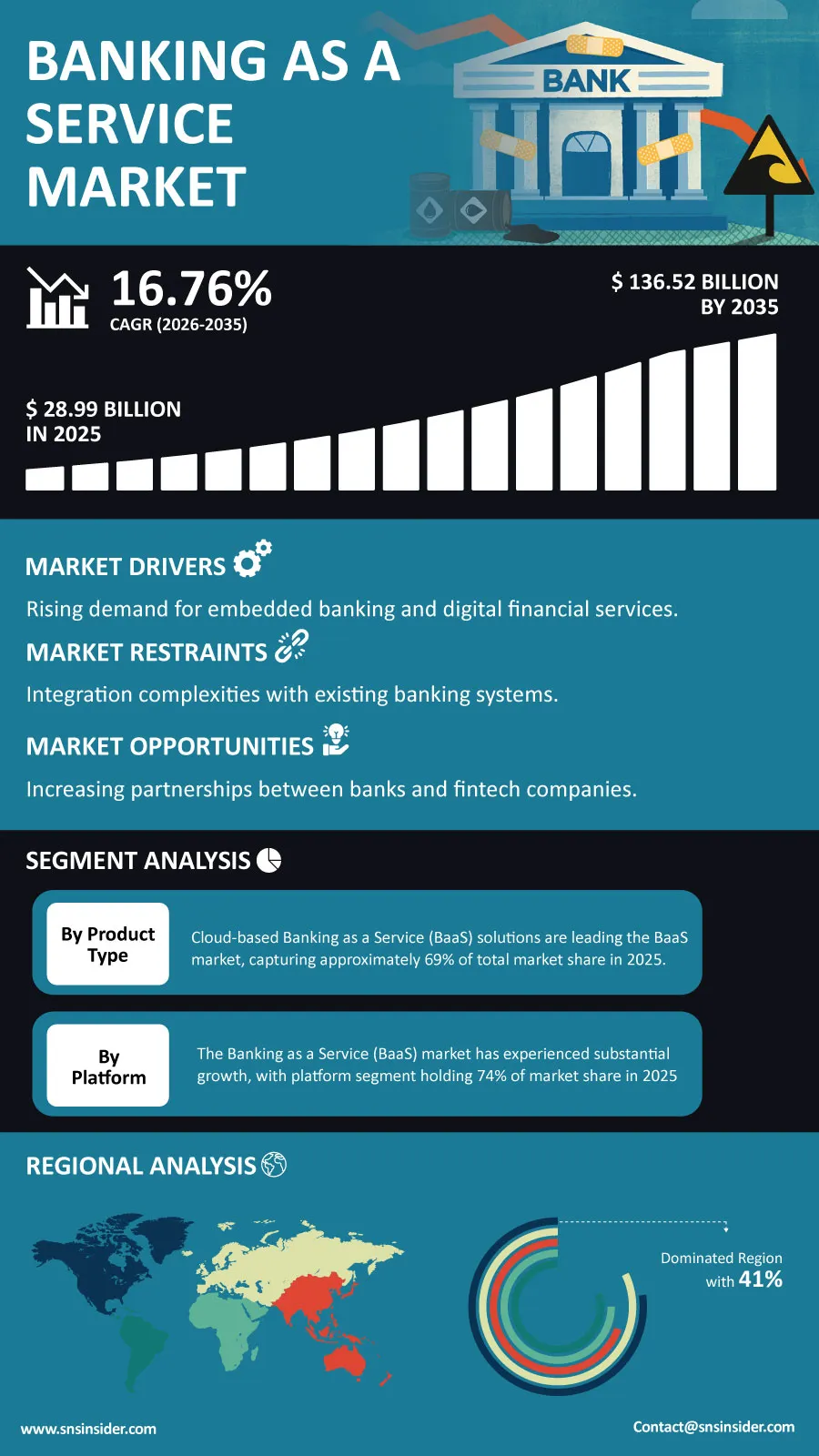
The global Banking As a Service (BaaS) Market is entering a new phase of growth as financial institutions, fintech companies, and digital enterprises accelerate investments in embedded finance and cloud-based banking infrastructure. “According to a recent study by SNS Insider, the global Banking As a Service Market size valued at USD 28.99 billion in 2025, is anticipated to grow to USD 136.52 billion by 2035, registering a CAGR of 16.76% over the 2026–2035 forecast period.”
Financial institutions are now leveraging the use of Banking as a Service to revolutionize their processes and reduce the time it takes to develop products. With the desire of firms to incorporate payments, financing, digital wallets, and accounts into their platforms, BaaS has emerged as a core component of future financial ecosystems.
Cooperation between conventional banks and tech firms is also transforming the industry landscape. Open APIs, cloud architecture, and real-time financial offerings allow organizations to roll out new products efficiently while increasing efficiency and engaging customers through retail, commercial, and corporate banking.
To Get Detailed Insights on the Banking As a Service Market – Request a Sample Report
Embedded Finance Adoption Creates New Growth Opportunities
The fast pace of growth of the embedded finance still presents plenty of opportunities within the framework of Banking as a Service. Many retailers, software developers, health-care providers and e-commerce platforms embed financial functionalities straight into the apps and allow customers to make payments right from those platforms.
Another trend is the development of infrastructure built for API-first banking that allows to significantly shorten the implementation period and ensure better scalability. Contemporary Banking as a Service platforms help companies launch digital payment solutions, virtual accounts, loan products and money management services with much smaller infrastructure needs compared to the traditional banking infrastructure.
Moreover, progress in cloud computing, artificial intelligence and automation makes fraud prevention, compliance control, user onboarding and transaction processing easier.
Key Market Insights Highlight Evolving Industry Trends
Based on product type, cloud-based Banking as a Service solutions accounted for nearly 69% of market revenue in 2025, supported by strong demand for scalable digital infrastructure and lower deployment costs. Hybrid and on-premises deployments are expected to witness steady adoption among organizations with specialized compliance and security requirements.
By platform, the BaaS platform segment represented approximately 74% of global revenue in 2025 due to rising demand for integrated API platforms that simplify banking service deployment. Platform-based ecosystems are expected to remain the fastest-growing area as financial institutions continue expanding digital service offerings through fintech partnerships.
Across end-use industries, financial institutions, fintech providers, and enterprise software companies continue increasing investments in embedded banking capabilities to improve customer experiences, accelerate innovation, and diversify revenue opportunities.
Digital Banking Innovation Accelerates Market Transformation
Technology is making continuous changes in the Banking as a Service industry as well. Organizations within this industry are using technologies like artificial intelligence, machine learning, cloud-native solutions, and analytics to make their processes automated and give quick and customized services to customers.
These organizations are also enhancing their cybersecurity skills along with growing digital banking across the globe. These organizations are spending on things like identity verification, encryption, fraud prevention, and regulatory compliance solutions for their customers.
North America Held 41% of the Banking As a Service Market Share in 2025; Asia Pacific Projected to Register the Fastest CAGR Through 2035
The share of North America in the global Banking as a Service market was estimated at around 41% in 2025 owing to the developed fintech environment, high level of adoption of cloud computing technologies, and collaboration between banks and technological companies. The further development of embedded finance, digital payments, and API-based financial services will maintain the leading position of the region on the market.
The Asia Pacific region is forecasted to show the highest growth rate until 2035 with rapid digitization of the banking services in such countries as China, India, Singapore, Australia, and others due to the governmental efforts aimed at the promotion of financial inclusion, digital payments, and fintech innovations.
The European region plays an important role in the industry development due to the open banking and supportive regulation, whereas the Latin American and MEA regions develop their digital financial infrastructure.
Industry Participants Expand Embedded Finance Capabilities
Competition within the Banking as a Service market continues to intensify as technology providers and financial institutions invest in cloud banking platforms, embedded finance capabilities, and API ecosystems. Strategic collaborations, product innovation, and digital transformation initiatives remain central to competitive positioning as companies respond to increasing enterprise demand for flexible financial infrastructure.
Key companies operating in the global Banking As a Service Market include Green Dot Bank, Solarisbank, PayPal Holdings, Inc., Fidor Solutions AG, Moven Enterprise, The Currency Cloud Ltd., Treezor, MatchMove Pay Pte Ltd., Block, Inc., Bnkbl Ltd., ClearBank, Railsr, Marqeta, Inc., Tink AB, Finastra, Temenos, Plaid, BBVA Open Platform, 10x Banking, and Synctera.
An SNS Insider analyst Sakshi Kale commented, "Banking as a Service is rapidly becoming the foundation of digital financial innovation as embedded finance, cloud-native banking platforms, and fintech collaboration reshape how financial services are delivered. Organizations investing in scalable API infrastructure, regulatory technology, and secure digital banking ecosystems will be well positioned to capture future growth opportunities."
About the Author

Get in touch




