
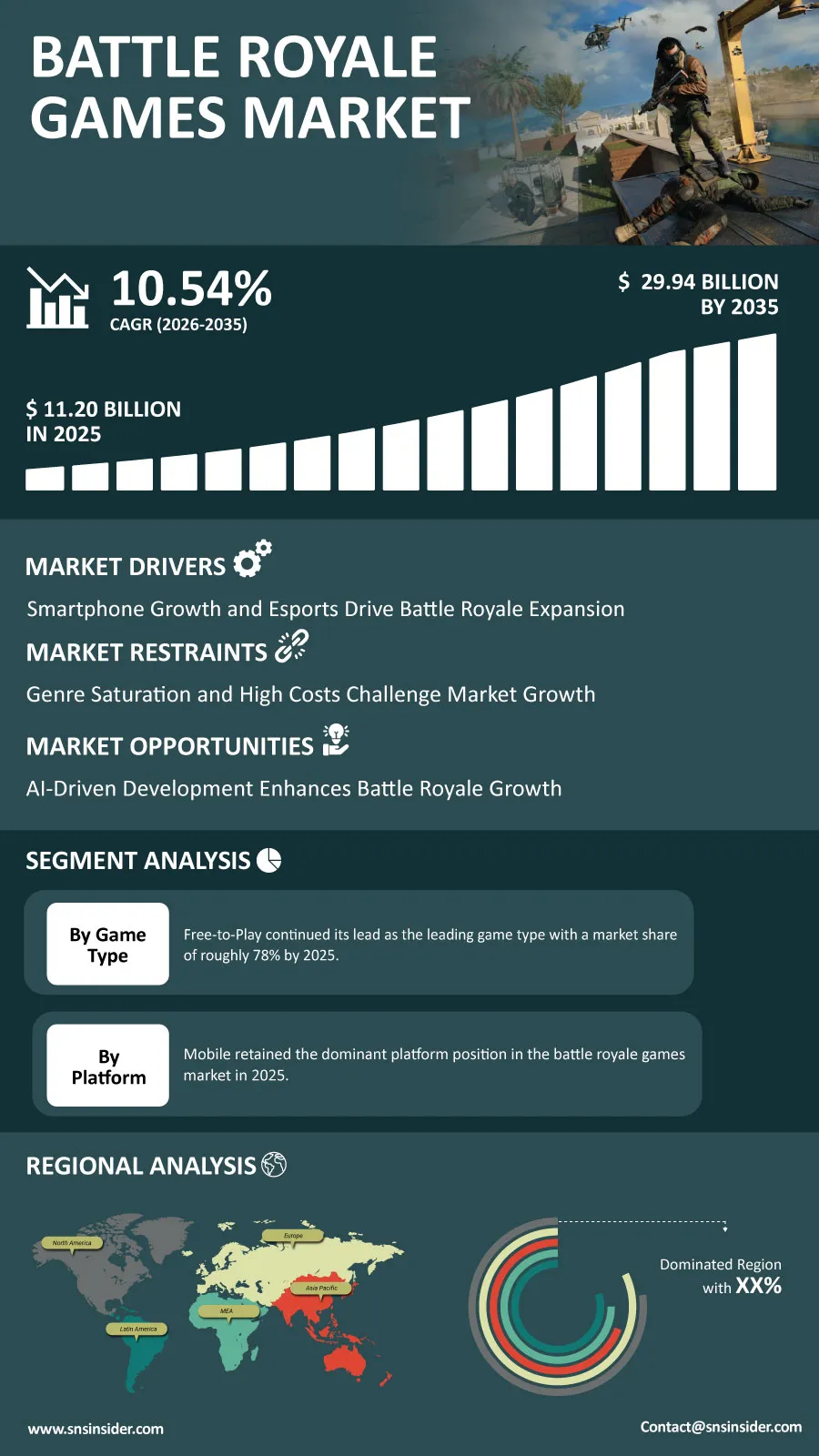
The Battle Royale Games Market around the world is experiencing growth in a new era due to the increased use of immersive multi-player games, live service games, and the use of artificial intelligence. “According to a recent study by SNS Insider, the global Battle Royale Games Market size valued at USD 11.20 billion in 2025, is anticipated to grow to USD 29.94 billion by 2035, registering a CAGR of 10.54% over the 2026–2035 forecast period.”
Competitive online games have led to the development of battle royale games into sustainable gaming platforms and not merely game launches. The emphasis on seasonal updates, events, content creation, and customization by developers to maintain user interest and earn regular profits is becoming more common.
On the other hand, improvements in cloud-based gaming, mobile connections, and graphics technologies are increasing the availability of multiplayer games through different devices such as smartphones, PC’s and consoles. The increased viewership through streaming services and e-sports competitions is adding to this trend.
To Get Detailed Insights on the Battle Royale Games Market – Request a Sample Report
AI Innovation and Live-Service Gaming Open New Revenue Opportunities
Artificial Intelligence technology is becoming an important way for modern game development as the technology enables the introduction of adaptive gaming experience, more intelligent NPCs, and automated content creation. The technology allows developing companies to provide more dynamic games and reduce time to launch seasonal updates.
Cross platform compatibility is also becoming an important trend in competitive gaming as players demand the ability to play without the limitations associated with the platform used. As a result, companies become motivated to create ecosystems that work equally on mobile, console, and PC platforms.
More resources are spent on creating infrastructure for esport competitions, engaging creators and organizing digital events. Gaming audience continues growing around the world and companies look for new revenue streams in premium subscriptions and virtual goods.
Key Market Insights Highlight Changing Player Preferences
Segmented according to game type, the free-to-play segment held around 78% of the market revenues in 2025 since it has the capability to attract a big audience globally via its easily accessible nature and digital monetization strategies. The pay-to-play segment is set to register the highest growth rate until 2035 due to the growing demand for premium games.
By platforms, mobile gaming continued holding the leadership position in the market in 2025 owing to the high prevalence of smartphones as well as advancements in mobile internet technology. The PC segment is set to register the highest growth rate over the forecast period owing to rising investment in gaming hardware in emerging countries.
By end-users, adults formed the largest share of revenues in 2025 owing to their higher digital spending as well as their participation in competitive gaming community. The teenager segment is forecast to register the highest growth rate over the forecast period due to the popularity of mobile games among teenagers.
Technology Advancements Continue to Reshape Competitive Gaming
Innovation in artificial intelligence, cloud computing, and real-time multiplayer technology is making the gaming ecosystem for battle royale games evolve fast. The use of intelligent matchmaking technology, procedural generation of content, and customized gameplay mechanics is intended to increase user engagement and prolong the duration of the game session.
Another strategy that gaming firms are using is collaboration with entertainment firms and influencers, which increases the strength of their player base and improves brand awareness. Digital infrastructure and game engine development will allow faster content release and increased immersion levels.
North America Held the Largest Battle Royale Games Market Share in 2025; Asia Pacific Projected to Register the Fastest CAGR Through 2035
North America continued to lead all other regional markets in 2025, aided by the presence of a mature gaming environment, higher spending power of consumers on digital entertainment, and the presence of prominent game development studios. High levels of esports and streaming activities and premium gaming add-ons continue to strengthen the dominance of regional markets.
The APAC region is likely to show the fastest growth until 2035, owing to increasing penetration of smartphones, low-cost internet connectivity, and growing gaming communities in China, India, Southeast Asia, Japan, and South Korea. Increased investments in mobile esports and digital entertainment have fueled the growth of regional markets.
The established gaming culture and competitive gaming communities in Europe have provided the platform for sustained growth, whereas Latin America and MEA are registering increasing numbers of players owing to mobile-first gaming.
Industry Participants Invest in AI, Cross-Platform Gaming, and Player Engagement
Competition within the global market will be fierce as technology, live service, and immersive multi-player games will help increase user retention. Investments in artificial intelligence, cloud gaming, creators ecosystem, and esports will define the competitive environment for the next ten years in the industry.
Key companies operating in the global Battle Royale Games Market include Epic Games Inc., Krafton Inc., Garena, Activision Blizzard Inc., Electronic Arts Inc., Tencent Games, Respawn Entertainment, NetEase Games, Nintendo Co., Ltd., PUBG Corporation, 2K Games, Bluehole Inc., Supercell, IndiGG, Nodwin Gaming, Riot Games Inc., miHoYo, Ubisoft SE, Bethesda Softworks, and Niantic Inc.
An SNS Insider analyst Sakshi Kale commented, "The next generation of battle royale gaming will be defined by AI-enabled gameplay, seamless cross-platform connectivity, and continuous live-service innovation. Publishers that successfully combine immersive player experiences with scalable digital ecosystems will be best positioned to capture long-term market growth."
About the Author

Get in touch




