
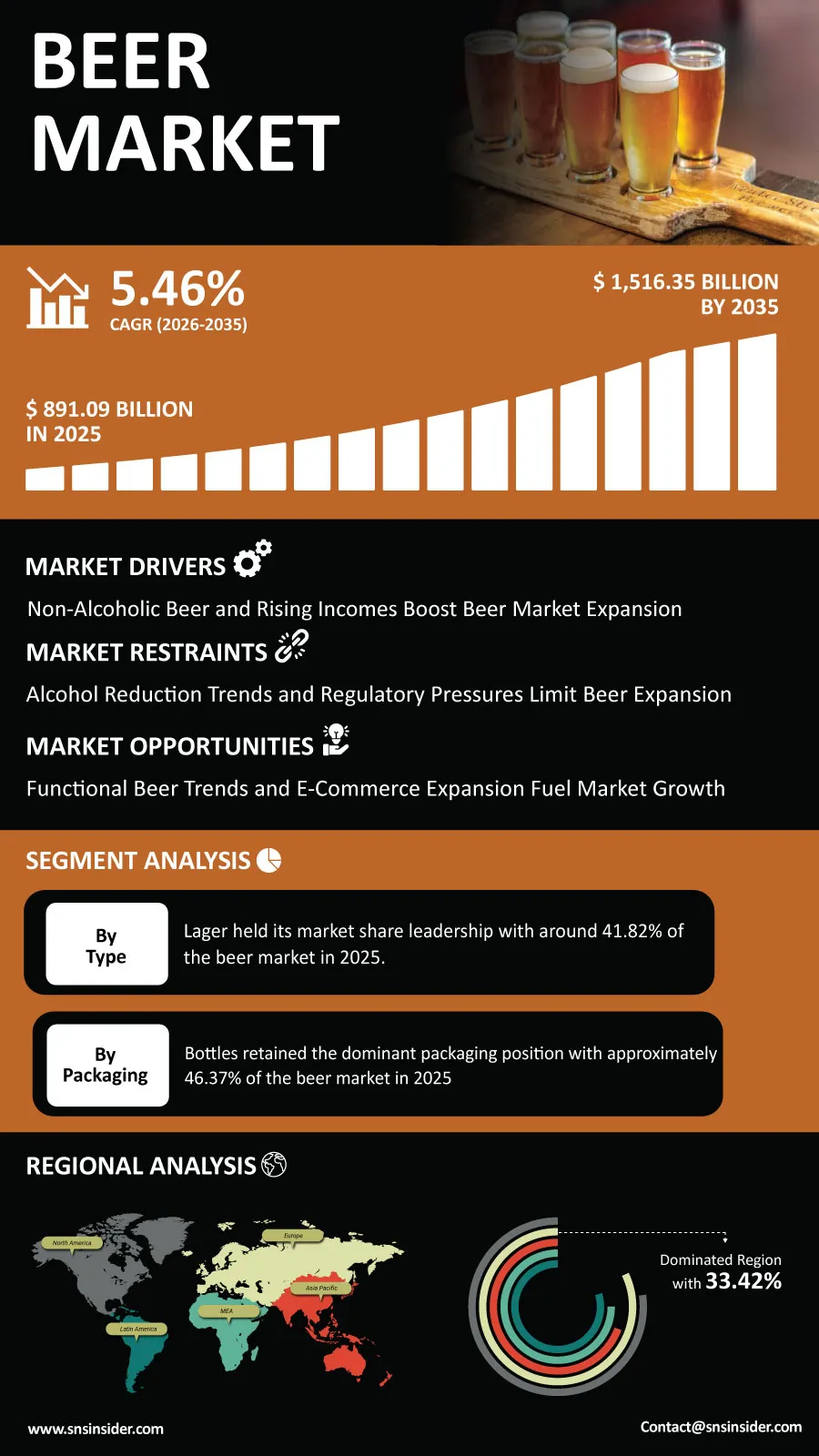
The Beer Market in the Global context is now poised to enter another period of growth as the industry adapts to changing consumer lifestyles and increased demand for premium products. “According to a recent study by SNS Insider, the global Beer Market size valued at USD 891.09 Billion in 2025, is anticipated to grow to USD 1,516.35 Billion by 2035, registering a CAGR of 5.46% over the 2026–2035 forecast period.”
The trends such as changes in consumption patterns, increases in disposable income, and increased retail availability are altering the competitive environment for beer producers around the world. Both large brewers and smaller breweries are focusing on diversifying their product portfolio, adopting sustainable production processes, and utilizing e-commerce platforms in order to enhance customer experience. Premium beers, unique tastes, and functional drinks are attracting new consumers as well as persuading existing customers to try more expensive brands.
The development of cities, active hospitality sector, and tourism-related activities in developing countries are providing the basis for future market expansion. Meanwhile, breweries are introducing modern production technologies as well as brewing sustainably.
To Get Detailed Insights on the Beer Market – Request a Sample Report
Premium Products and Consumer Innovation Create Long-Term Market Opportunities
Breweries are more frequently pivoting their objectives to the quality- and experience-driven beer, focussing on unique ingredients, historical brewing techniques, and a better drinking experience. Consumers are becoming more open to pay for specialty products that feature higher quality, regional authenticity and distinctive flavors.
This growth represents new revenue streams for manufacturers targeting health-conscious consumers, with the rapid expansion of alcohol-free and low-alcohol beer categories. Brewing technology has improved in recent years, allowing producers to create products with the flavourful character of traditional beer while having less alcohol by volume (ABV), attracting an expanded array of consumers into the category.
Digital commerce is also transforming distribution strategies as breweries increasingly to develop direct-to-consumer relationships, drawing upon online retail platforms, subscription services and tailored marketing campaigns. These advances are enabling companies to achieve a wider reach while increasing brand loyalty.
Key Market Insights Reflect Evolving Consumer Preferences
By type, lager generated 41.82% of Revenue share around the globe in 2025 and is favoured most commonly due to its ubiquity, consistent flavour profile and global distribution. Ale is anticipated to post the largest increase through 2035, buoyed by an evolving craft brewing scene and increased interest in high-end beer segments.
Bottles held over 46.37% of market revenue in 2025 by packaging, demonstrating firm consumer preference for premium presentation coupled with traditional retail channels. Can packaging is expected to witness maximum growth during the forecast period owing to growing preference among breweries for portable, easy, and sustainability in packaging solution.
Depending on the quality of production, industrial brewing was acquired 55.46% of total market revenue in a profit due to large and mass-scale manufacturing capabilities as well as global distribution networks (2025). In addition, craft brewing remains strong as consumers seek local products benefiting from unique flavor profiles.
For distribution channel, on-trade establishments such as restaurants, pubs and bars held a major share of the market; however online retail is anticipated to be the fastest growing segment during this period by 2035 as digital purchasing continuing gaining traction.
Sustainable Brewing Technologies Drive Industry Transformation
As manufacturers adopt new production technologies, renewable energy, and resource-efficient manufacturing processes, innovation across brewing operations is emerging as a key competitive differentiator. Environmentally-conscious consumers are more influenced by water conservation initiatives, carbon reduction programs, and recyclable packaging in their purchasing decisions.
While digital technologies are being used to help in various ways production planning, inventory management and supply chain visibility, helping breweries better respond to changing consumer demand. To improve brewing consistency while lowering production costs and operational waste, artificial intelligence (AI), predictive analytics and smart manufacturing systems assist every step of the way.
The focus on sustainability, particularly as it pertains to sourcing ingredients, moving towards circular packaging models and operations that promote environmentally friendly practices is expected to enhance long-term competitiveness throughout the global beer industry.
Europe Accounted for 33.42% Market Share in 2025; Asia Pacific Forecast to Expand at a 7.29% CAGR by 2035
The global market revenue of beer in 2025 was 33.42% held by Europe, thanks to its speaking history of brewing, the premium culture for beer drinking and high consumer demand from traditional and specialty segments. Germany, Belgium, the United Kingdom and the Netherlands also supplying plenty of global brewing innovation along with strong home consumption.
Asia Pacific is expected to grow at the fastest CAGR of 7.29% over the forecast timeframe, owing to the growing middle-class populace, urbanization, and rising disposable incomes in developing countries. Strong consumer trend towards premium drinks paired with the expanding hospitality infrastructure as well as new modern retail channels will continue to provide interesting opportunities across the region.
Craft beer innovation, premium product launches and growing demand for alcohol-free alternatives continue to support North America as a strategically vital market. Otherwise, Latin America and the Middle East & Africa continue to benefit from growing tourism, urban expansion, and increased investments in beverage manufacturing markets.
Industry Participants Focus on Premiumization and Sustainable Growth
The competition in the international beer business continues to be intense as major firms focus on developing high-quality products, innovating their production process, adopting sustainable practices, and connecting with consumers through digitization. Acquisitions, diversification of products, eco-friendly packaging, and foray into new markets are the current trends among competitors.
Key companies operating in the global Beer Market include Anheuser-Busch InBev SA, Heineken N.V., Carlsberg A/S, Molson Coors Beverage Company, Asahi Group Holdings Ltd., Kirin Holdings Company Ltd., Constellation Brands Inc., Grupo Modelo, FEMSA Cerveza, Beijing Yanjing Brewery Co. Ltd., China Resources Beer Holdings Co. Ltd., Tsingtao Brewery Co. Ltd., SABMiller plc, Diageo plc, Boston Beer Company, Sierra Nevada Brewing Co., Athletic Brewing Company, New Belgium Brewing Company, Stone Brewing Co., and Duvel Moortgat NV.
An SNS Insider analyst Santosh Bhul commented, "Consumer preferences are evolving beyond traditional beer offerings toward premium experiences, sustainable production, and innovative low-alcohol alternatives. Brewers that continue investing in product innovation, operational efficiency, and digital engagement strategies are expected to strengthen their competitive position while capturing emerging growth opportunities across global markets."
About the Author

Get in touch




