
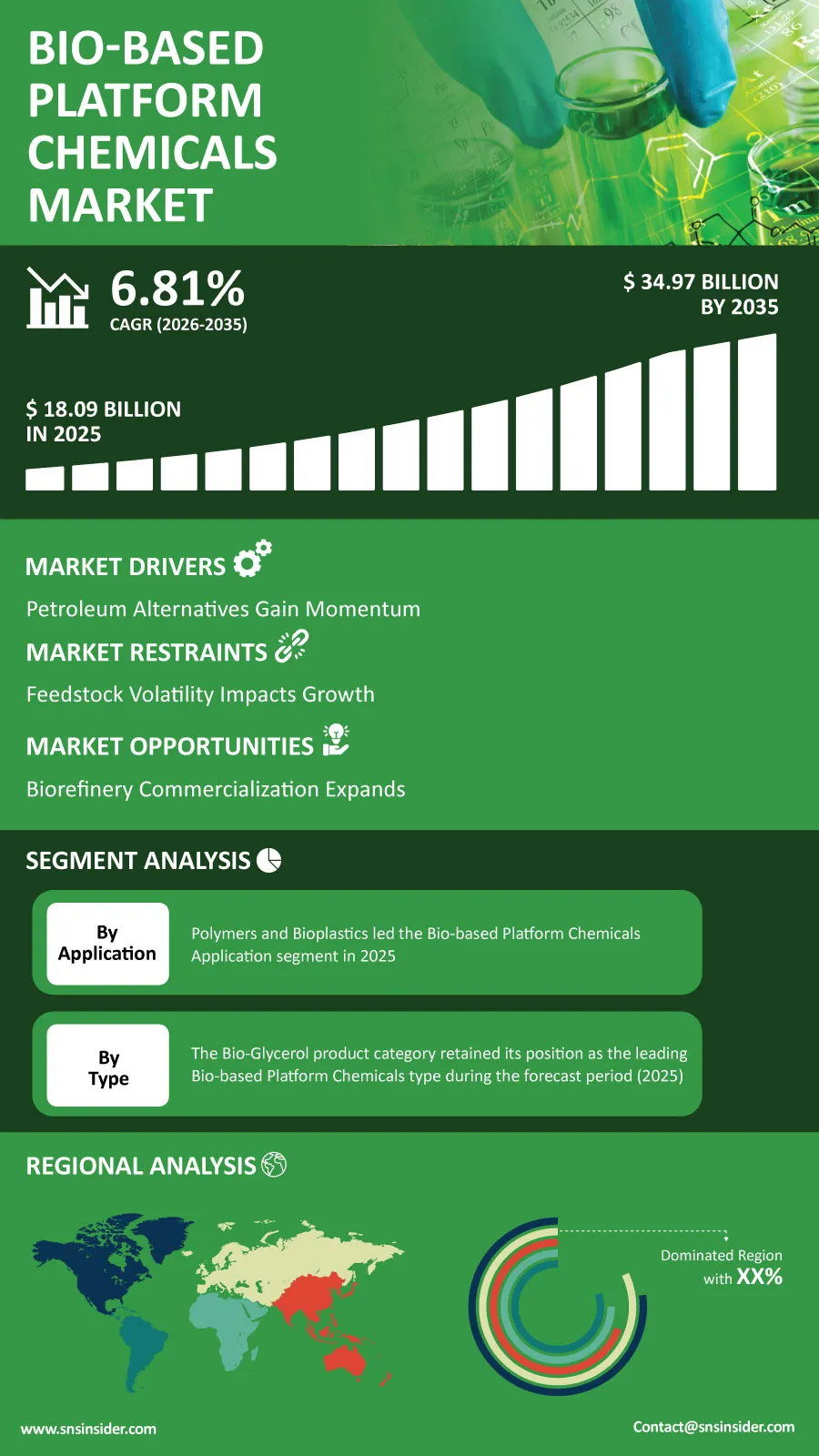
The global Bio-based Platform Chemicals Market is now moving towards a new era of growth as industries speed up the process of shifting towards renewable sources and green chemistry processes. “According to a recent study by SNS Insider, the global Bio-based Platform Chemicals Market size valued at USD 18.09 Billion in 2025, is anticipated to grow to USD 34.97 Billion by 2035, registering a CAGR of 6.81% over the 2026–2035 forecast period.”
The growing emphasis on sustainable manufacturing in terms of regulations along with commitments from businesses regarding decarbonization has encouraged chemical companies to switch to renewable biological sources in place of petrochemical sources. The use of bio-based platform chemicals has become vital raw materials for manufacturing polymers, coatings, medicines, cosmetics, solvents, and specialty chemicals among others.
The growing developments in the domain of industrial biotechnology, precision fermentation, and biorefineries have helped facilitate large scale production of renewable chemicals through enhanced efficiency. Growing investments in next generation fermentation and biomass conversion technology have added momentum to the industry prospects in developed as well as developing nations.
To Get Detailed Insights on the Bio-based Platform Chemicals Market – Request a Sample Report
Renewable Feedstocks and Circular Economy Strategies Create Significant Growth Opportunities
More government and private investments are being made in the bioeconomy projects in an effort to lessen reliance on fossil-based chemicals. The increased commercial adoption of technologies for processing lignocellulosic biomass, use of agriculture residues, and sophisticated fermentation systems is increasing the possibilities for producers to diversify their raw material inputs while minimizing their environmental footprint.
The increased need for compostable packages and consumer goods is also offering long-term prospects for bio-based chemical producers. Innovations in the form of platform chemicals that enable the production of biodegradable plastics, renewable solvents, specialty polymers, and environmentally friendly industrial formulations are being developed.
Key Market Insights Highlight Shifting Demand Patterns
Segment wise, the leading revenue generator in the market in 2025 was Glycerol since it was widely used for various commercial purposes such as pharmaceuticals, food processing, and personal care. Bio-Succinic Acid and Lactic Acid are the fastest-growing products in 2025–2035 due to high demand for bio-polymers and biodegradable plastics globally.
Feedstocks-wise, Sugars and Starch have the largest market share in 2025 thanks to their highly industrialized fermentation processes. It is predicted that Lignocellulosic Biomass will show the highest growth in the forecast period because of second-generation biorefineries and lesser use of edible feedstocks.
When it comes to applications, Polymers and Bioplastics were the revenue generator in 2025. Increasing regulatory pressure to use bioplastics instead of traditional plastics led to that. In turn, Pharmaceuticals & Nutraceuticals and Personal Care & Cosmetics are predicted to grow due to the introduction of renewables in products.
Biotechnology Innovation Accelerates Commercial Development
Bio-based chemicals industry is continuously experiencing gains through technological advancement in the fields of synthetic biology, metabolic engineering, and industrial fermentation. Improved microbial engineering techniques have resulted in increased yields coupled with lower costs of manufacture of valuable platform chemicals.
There is also the investment being made in biorefineries that will produce various chemical streams from renewable biomass feedstocks. The technologies mentioned above are expected to improve competitiveness as well as the range of application in the downstream industries.
Europe Led Bio-based Platform Chemicals Market in 2025, Asia Pacific to Register Fastest Growth Through 2035
The Bio-Based Platform Chemicals Market in Europe was able to retain its dominance throughout 2025 due to strict sustainability laws, environmental policies, and extensive use of renewable chemicals. The continuous execution of the circular economy model and green manufacturing processes is predicted to help in strengthening the regional demand during the forecast period.
It is expected that the fastest growing region will be Asia-Pacific throughout 2035. Increasing production of bioplastics, abundant availability of agricultural biomass feedstocks, government initiatives, and fast industrial growth in China, India, and Southeast Asian countries have created a good environment for the manufacture of bio-based chemicals.
Industry Participants Expand Production and Advance Sustainable Innovation
The competitive environment continues to be very dynamic with the most dominant firms concentrating on commercialization of fermentation technologies, utilization of renewable raw materials, and collaborations to increase their market share. Investments being made towards increasing production capabilities, research and development, and biotechnology advancements have allowed companies to meet the rising demand for sustainable chemicals.
Key companies operating in the global Bio-based Platform Chemicals Market include BASF SE, Corbion N.V., NatureWorks LLC, Evonik Industries AG, Cargill Incorporated, Braskem S.A., Amyris Inc., Genomatica Inc., Gevo Inc., Avantium N.V., DuPont de Nemours Inc., Archer-Daniels-Midland Company (ADM), Novozymes A/S, DSM-Firmenich AG, PTT Global Chemical PCL, LG Chem Ltd., Mitsubishi Chemical Corporation, Toray Industries Inc., TotalEnergies Corbion, and Futerro SA.
An SNS Insider analyst Himanshu Sharma commented, "Growing regulatory emphasis on sustainable manufacturing, combined with rapid advances in industrial biotechnology and renewable feedstock utilization, is accelerating commercialization across the bio-based platform chemicals industry. Companies investing in scalable fermentation technologies, integrated biorefineries, and innovative renewable chemical solutions are expected to capture significant long-term growth opportunities as global industries transition toward a low-carbon economy."
About the Author

Get in touch




