
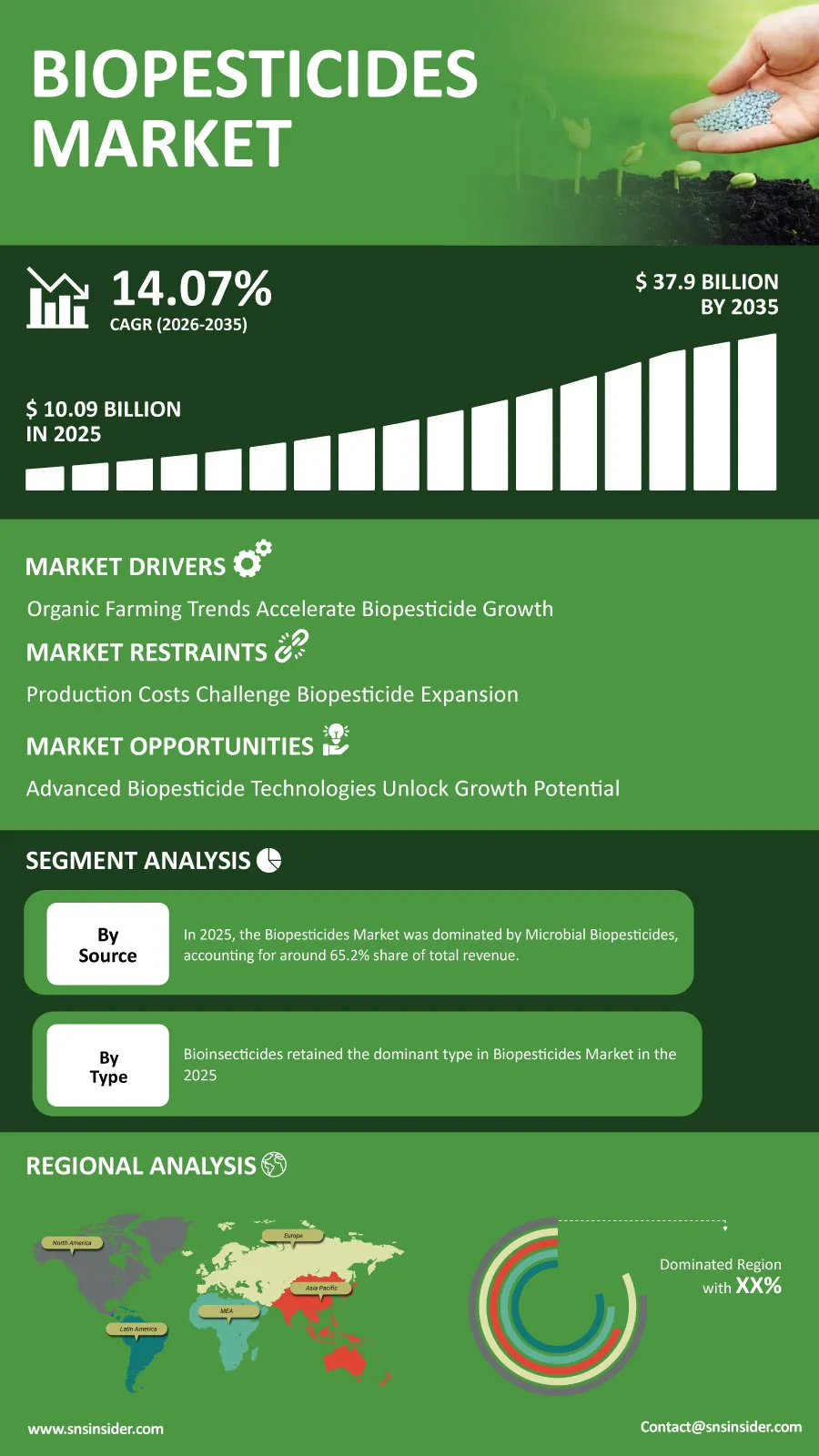
The global Biopesticides Market is headed for rapid growth as more and more agricultural firms move towards sustainable crop protection solutions that provide both production efficiency and environmental safety. “According to a recent study by SNS Insider, the global Biopesticides Market size valued at USD 10.09 Billion in 2025, is anticipated to grow to USD 37.9 Billion by 2035, registering a CAGR of 14.07% over the 2026–2035 forecast period.”
Rising restrictions imposed on the use of chemical pesticides, increasing consumer demand for residue-free produce, and increased use of organic farming methods have led to a change in bioprotection of crops from being a specialty to becoming an advanced agricultural technique. Increasingly, farmers are combining the use of microbes, bioactive molecules, and advanced biological pest control methods to produce high-quality crops.
Innovation in areas of microbial science, biotechnology, and formulation is improving the stability, efficacy, and specificity of products, aiding in the control of resistant pest populations, and sustainable agriculture systems in fruit, vegetable, cereal, and specialty crops.
To Get Detailed Insights on the Biopesticides Market – Request a Sample Report
Regulatory Support and Sustainable Agriculture Create Significant Growth Opportunities
The increasing emphasis by governments around the world on policies to promote environmentally-friendly agricultural inputs is resulting in a conducive environment for biological pest management innovations.
In the light of sustainability becoming a key aim of food production, farmers have started turning to biological substitutes that help reduce chemical footprints without affecting crop production.
The fast growth of organic foods, integrated pest management (IPM) programs, and export-oriented agriculture is leading to new business possibilities for companies. The demand for biological pesticides from the food retail sector and international customers is another major driver pushing the adoption of such technologies.
Technologies like RNA interference (RNAi), microbial genomics, and improved fermentation technology provide the means to develop innovative pest control products. Such next generation biological technologies are anticipated to lead to more uses of biopesticides within the next decade.
Key Market Insights Highlight Expanding Adoption Across Crop Protection
According to the source, Microbial biopesticides constituted around 65.2% of the market revenue in 2025, driven by extensive commercialization of bacterial, fungal, and other beneficial microbial biopesticides. Biochemical biopesticides and Plant-Incorporated Protectants (PIPs) are gaining popularity owing to the expanding applications in biotechnology.
By type, bioinsecticides held the largest share of the market in 2025 due to their wide application in insect pest control across various crop types. Biofungicides are expected to witness the highest CAGR up to 2035 owing to rising need for efficient management of plant diseases in the face of growing resistance to conventional fungicides.
Based on crop type, Fruits & Vegetables were the dominant revenue segment in 2025 due to their high value and stringent quality standards. The segment of Cereals & Grains is expected to grow at the fastest volume CAGR up to 2035 due to extensive use of biological crop protection in commercial farms.
Advanced Biological Technologies Reshape Modern Crop Protection
Biopesticide industry is currently experiencing a fast technological revolution with innovations in microbial discovery, genomic selection, and precision agriculture technology. These firms are making use of advanced biotechnology in order to discover microorganisms that can be used for targeted pest control without causing any ecological damage.
Product innovation will include innovations in micro-encapsulation technology, release technology, drone spray technology, and digital monitoring system of crop for biological products. Combination of biological products and precision agriculture technology will greatly increase efficiency of application process and reduce use of pesticides.
Europe Biopesticides Market Set to Record One of the Fastest Growth Rates Through 2035 Amid Sustainable Agriculture Expansion
North America held the largest share in the revenue of the Global Biopesticides Market in 2025, owing to the well-developed industry of organic farming, effective regulatory pathway, strong research base, and the wide acceptance of integrated pest management programs in specialty and conventional agriculture.
The region of Europe is likely to continue its fast growth due to the implementation of environmental policies, sustainable farming, and low dependency on chemical pesticides leading to increased use of biological products in the industries of horticulture and high value agriculture.
Additionally, the region of Asia Pacific still showcases tremendous growth prospects for future years, thanks to its increasing agricultural output, government-driven sustainable farming projects, organic agriculture, and increased production of biopesticides in China, India, Japan, and Australia.
Industry Participants Accelerate Innovation and Strategic Investments
The competition scene keeps changing as the top players in agricultural biotech continue increasing their investment in microbial research and development, biological products, RNA interference technology, and sustainable crop protection technology. Collaboration, regulatory approval, and innovation of products will continue playing an important role in securing their positions in the international markets.
Key companies operating in the global Biopesticides Market include BASF SE, Bayer AG, Syngenta AG (ChemChina), Corteva Agriscience, Certis Biologicals LLC, Marrone Bio Innovations Inc., Valent BioSciences LLC, Bioworks Inc., Koppert Biological Systems, Novozymes A/S, Isagro S.p.A., Andermatt Biocontrol AG, Intrachem Group, Plant Health Care plc, Seipasa S.A., Lallemand Plant Care, Stockton Bio-Agriculture Ltd., CABI (Centre for Agriculture and Bioscience International), Sumitomo Chemical Agro Europe S.A.S., and Arysta LifeScience (UPL Ltd.).
An SNS Insider analyst Himanshu Sharma commented, "The global shift toward sustainable agriculture, combined with supportive regulatory frameworks and continuous advances in biological science, is fundamentally reshaping crop protection practices. Companies investing in next-generation microbial technologies, RNAi innovation, and precision biological solutions are expected to capture significant long-term growth opportunities as demand for environmentally responsible agriculture continues to accelerate."
About the Author

Get in touch




