
Brachytherapy Market is entering a new phase of clinical adoption as health care providers recognize the importance of delivering precision-based cancer therapies that not only enhance patient recovery but also decrease hospitalization periods. Innovations within the field of radiation oncology, guided imaging, and other advanced forms of therapy planning are prompting hospitals and cancer centers to deliver brachytherapy on a wider scale.
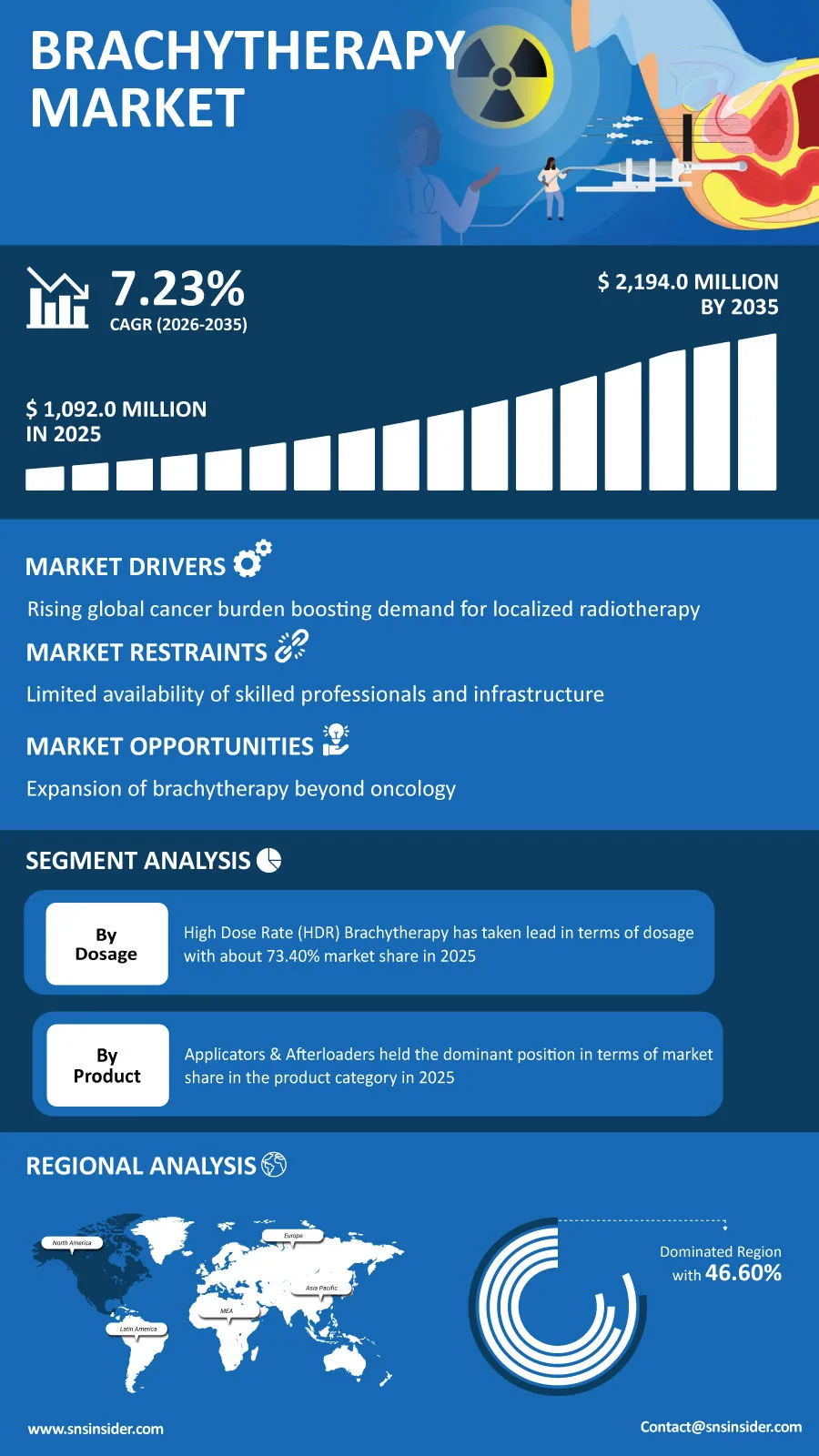
According to a recent study by SNS Insider, the global Brachytherapy Market size valued at USD 1,092.0 million in 2025, is anticipated to grow to USD 2,194.0 million by 2035, registering a CAGR of 7.23% over the 2026–2035 forecast period. The constant growth of the market is fueled by investments in oncology facilities that have been modernized and the rising knowledge on targeted radiation therapy together with continuous improvement of the treatment delivery technology.
Due to the benefits associated with the procedure, the use of brachytherapy is increasingly becoming part of multi-disciplinary care in cancer patients as the process involves delivering radiation to the tumors without exposing the surrounding tissues to any harm. The increasing demand for minimally invasive procedures is motivating the development of more efficient devices.
To Get Detailed Insights on the Brachytherapy Market – Request a Sample Report
Precision Radiation Technologies Expand Clinical Opportunities
The ongoing innovation keeps on shaping up the competitive scenario, as real-time imaging, use of artificial intelligence in treatment planning, and electronic brachytherapy devices find themselves part of regular oncological practice. This helps improve the accuracy of dose delivery, facilitates treatment workflow, and enables outpatient treatments, making it easier for patients.
Additionally, scientists have been working on the application of brachytherapy in other medical fields, which go beyond the standard oncology field. These studies include treatment of arrhythmias of the heart, management of keloid scars, and many more.
Market Segments Highlight Strong Demand Across Oncology Care
Based on dosage, High-Dose Rate (HDR) brachytherapy dominated the global market with approximately 73.40% revenue share in 2025, reflecting its widespread clinical adoption for prostate, cervical, and breast cancer treatment. Low-Dose Rate (LDR) brachytherapy continues to gain momentum, particularly for permanent prostate seed implantation procedures.
Among product categories, Applicators & Afterloaders accounted for approximately 45.20% of market revenue in 2025, supported by their critical role in delivering highly accurate radiation therapy. Electronic brachytherapy systems and radioactive seed technologies are expected to witness continued adoption as healthcare providers pursue more flexible treatment options.
By application, prostate cancer represented approximately 33.15% of total market revenue in 2025. The breast cancer segment is projected to record the fastest expansion throughout the forecast period, advancing at an estimated 7.73% CAGR through 2035 as clinical adoption continues to increase.
Healthcare Investments Strengthen Future Market Outlook
Increased spending on dedicated oncology centers, radiology equipment, and training of specialists is contributing to a robust treatment infrastructure globally. Precision medicine is increasingly prioritized by healthcare institutions, while government bodies keep working to expand their reach of cancer screenings and early detection efforts.
Technology is also disrupting radiation oncology via automation and planning using artificial intelligence in combination with imaging that helps to deliver optimal radiation dose to patients.
Asia Pacific Emerges as the Fastest-Growing Regional Market
North America retained its lead status in 2025, contributing to around 46.60% of the global market share. In North America, the U.S. accounted for about 82.5% of the region's revenue and continues to be benefited by robust oncology infrastructure, good reimbursement scenario, and extensive adoption of HDR and LDR therapy techniques. The U.S. Brachytherapy Market was estimated to be valued at about USD 346.6 million in 2025 and is projected to reach around USD 594.3 million by 2035, growing at a 5.54% CAGR.
The Asia Pacific region is anticipated to grow the fastest, growing at around 7.95% CAGR through 2035. Increasing cancer prevalence, establishment of more oncology centers, and rising investments in health care are driving the demand in key economies in the region. In 2025, China held around 40.6% of the Asia Pacific revenue.
Meanwhile, Germany held around 24.6% of the European regional revenue and Brazil accounted for around 43.8% of the Latin America regional revenue. In the Middle East & Africa, UAE contributed around 22.8% of the regional revenue, aided by continued healthcare reforms in the country.
Industry Leaders Continue Investing in Advanced Cancer Care
Competition within the global brachytherapy industry is accelerating as manufacturers strengthen product portfolios through strategic acquisitions, partnerships, and technology innovation. In October 2023, Elekta agreed to acquire iCAD's Xoft business to expand its electronic brachytherapy capabilities. Varian, a Siemens Healthineers company, partnered with Sun Nuclear during September 2024 to enhance quality assurance solutions for radiotherapy systems. Earlier, Perspective Therapeutics transferred its Cesium-131 brachytherapy business to GT Medical Technologies, reinforcing ongoing consolidation across the sector.
Major companies operating in the global brachytherapy market include Elekta AB, Varian Medical Systems, Inc., Isoray Inc., Becton, Dickinson and Company (BD), Eckert & Ziegler BEBIG, CIVCO Radiotherapy, Boston Scientific Corporation, Theragenics Corporation, iCAD, Inc., GT Medical Technologies, Huiheng Medical, Inc., Panacea Medical Technologies Pvt. Ltd., Sensus Healthcare, Inc., Oncura, Inc., Nucletron B.V. (An Elekta Company), C4 Imaging LLC, Radiation Products Design, Inc., BEBIG Medical GmbH, IsoAid LLC, and K&S Associates, Inc.
An SNS Insider analyst Parry Kardani commented, "The continued evolution of precision radiotherapy technologies is strengthening the role of brachytherapy in modern cancer care. Organizations investing in advanced treatment planning, image-guided delivery, and minimally invasive radiation solutions will be well positioned to address the growing global demand for personalized oncology therapies.
About the Author

Get in touch




