
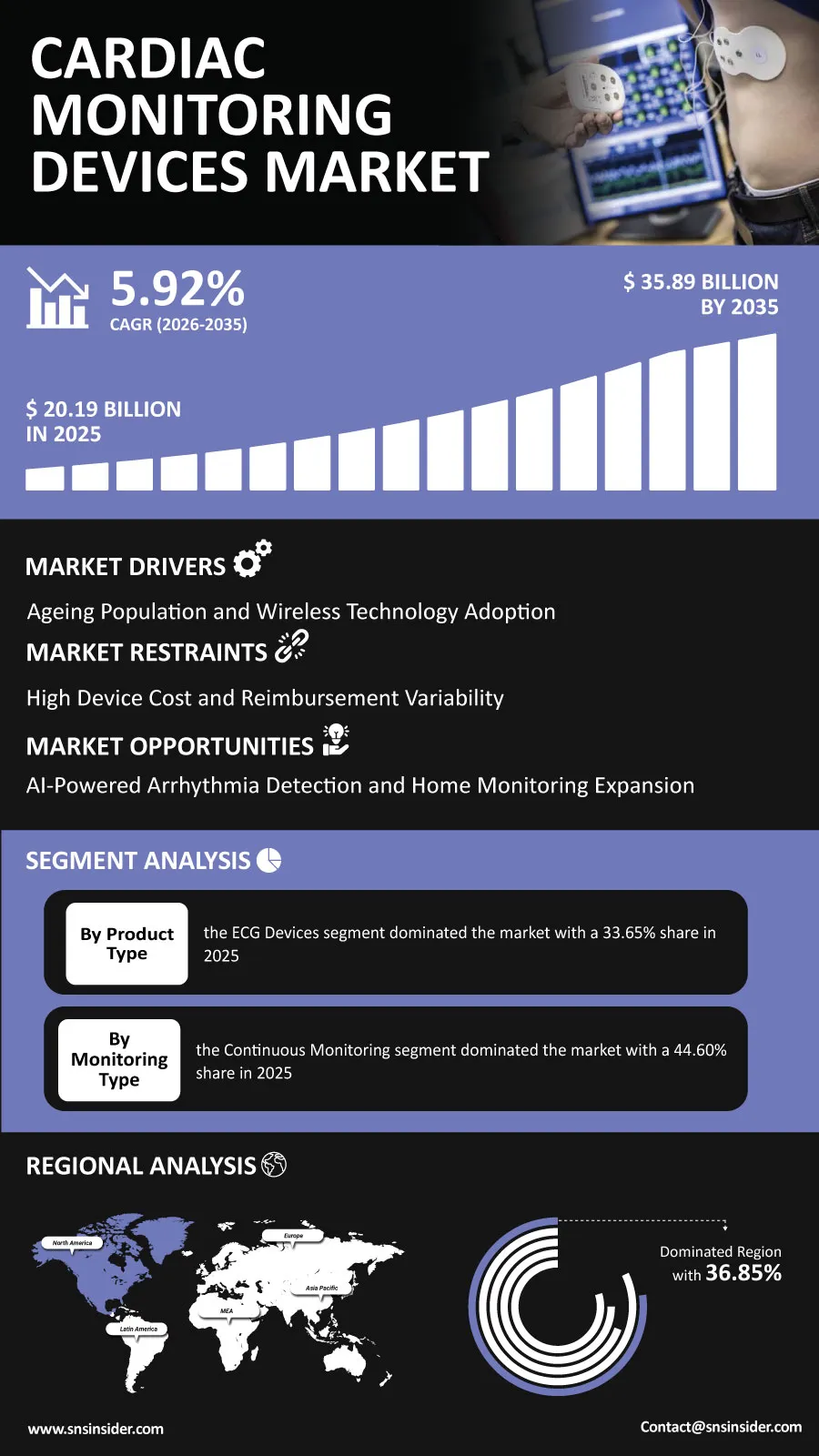
A device the size of a matchstick, inserted beneath the skin, can now track a heartbeat continuously for up to six years without a single wire or external sensor. According to a recent study by SNS Insider, the global Cardiac Monitoring Devices Market, valued at USD 20.19 billion in 2025, is projected to reach USD 35.89 billion by 2035, registering a CAGR of 5.92% across the 2026-2035 forecast period.
Cardiac monitoring devices track the heart's electrical activity and rhythm, spanning everything from a simple resting ECG machine used during a routine office visit through tiny implantable monitors inserted beneath the skin that continuously track heart rhythm for years at a time. These devices give physicians the diagnostic evidence needed to catch arrhythmias that may occur too infrequently for a brief in-office examination ever to capture.
To Get Detailed Insights on the Cardiac Monitoring Devices Market – Request a Sample Report
Ageing Population and Wireless Technology Adoption Fuel Growth
The increasing geriatric population and rising cardiovascular disease prevalence continue to widen demand, as rising cardiac disease incidence expands the diagnosed patient population requiring regular rhythm monitoring. Growing adoption of wireless and wearable monitoring technology reinforces this trend, as continued extension of battery life and monitoring duration keeps expanding how comfortably patients can be monitored.
Manufacturers are responding with AI-powered algorithms that increasingly help clinicians separate genuine arrhythmias from false alerts, and with continued consolidation expanding single-purpose cardiac monitors into comprehensive, multi-vitals monitoring platforms spanning ambulatory, inpatient, and home care settings.
Segment Findings Point to a Market in Transition
ECG devices led the market in 2025, reflecting their status as the most universally used cardiac diagnostic tool, while mobile cardiac telemetry is recording the fastest growth at an 8.75% CAGR as continuous rhythm monitoring demand rises. Continuous monitoring dominates the monitoring-type mix and is also growing fastest at 8.15% as uninterrupted rhythm capture gains favour.
Wireless technology has the biggest market share, but the fastest-growing one is the AI-enabled technology with 9.45% growth because arrhythmia detection via algorithms becomes increasingly popular. The leading segment is Arrhythmia Detection & Monitoring, and Heart Failure Monitoring is the fastest-growing one with 7.25% growth due to an increasing rate of heart failure in elderly patients. Hospitals and clinics have the largest share in the end-user segment, and the fastest-growing one is home care with 8.65% growth.
North America Leads, Asia Pacific Set to Grow Fastest
North America accounted for the largest share of global revenue in 2025, at 36.85%, supported by a substantial ageing population and broad insurance reimbursement coverage. The United States represented the substantial majority of the regional market.
Asia Pacific is projected to expand at the fastest rate of any region through 2035, at a CAGR of approximately 8.35%, as China, India, Japan, and South Korea continue expanding hospital infrastructure and cardiovascular disease diagnosis. Europe remains a significant contributor, anchored by Germany's substantial healthcare sector, while Latin America and the Middle East and Africa continue building adoption at a more gradual pace.
AI Innovation and Platform Consolidation Reshape Competitive Dynamics
Competition within this market increasingly centres on which manufacturers can pair reliable core monitoring capability with genuinely differentiated AI algorithms and battery life, as leading companies continue pursuing acquisitions that broaden their platforms beyond single-purpose cardiac devices toward comprehensive monitoring ecosystems.
Some of the major companies operating in the global cardiac monitoring devices market include Medtronic plc, Abbott Laboratories, Koninklijke Philips N.V., GE HealthCare Technologies Inc., Boston Scientific Corporation, Biotronik SE & Co. KG, iRhythm Technologies, Inc., Baxter International Inc., Nihon Kohden Corporation, and Spacelabs Healthcare.
Looking ahead, the pace of AI algorithm innovation, continued platform consolidation, and sustained ageing population growth are likely to determine which manufacturers gain the most share over the coming decade. Companies that combine proven monitoring reliability with genuine AI and battery innovation are expected to be best placed to benefit from the market's sustained, cardiovascular-disease-driven growth throughout the forecast period.
An SNS Insider Analyst, Parry Kardani commented, "This market continues to benefit from sustained cardiovascular disease prevalence growth and a genuine industry-wide push toward AI-enabled, longer-duration monitoring technology. Manufacturers that pair proven monitoring reliability with genuine AI and battery innovation are best positioned to capture the next phase of demand, particularly across Asia Pacific's fast-growing hospital infrastructure investment."
About the Author

Get in touch




