
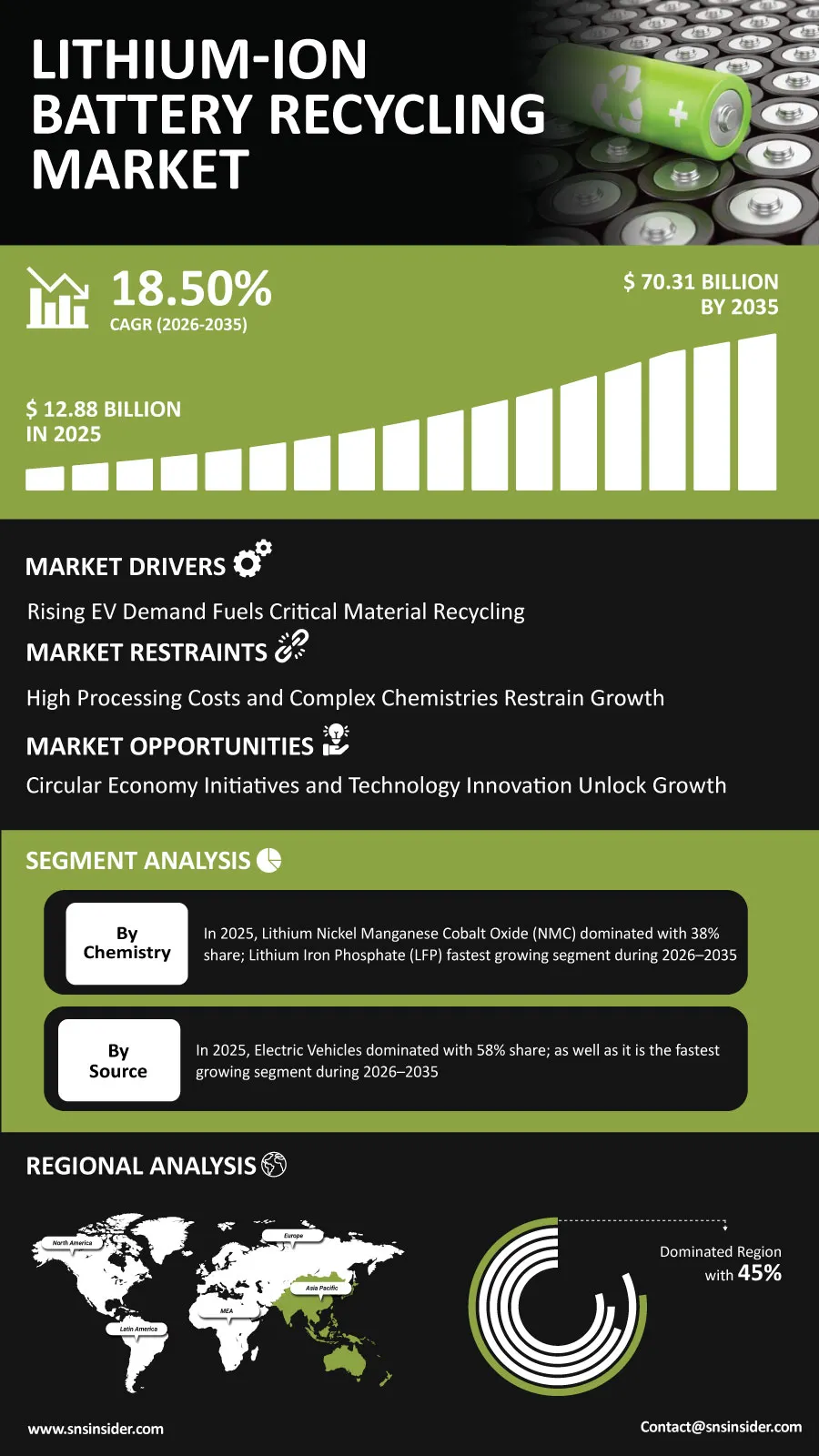
The global Lithium-ion Battery Recycling Market is experiencing substantial growth as electric vehicle manufacturers, battery producers, and energy storage companies increase investments in sustainable battery recovery and critical raw material management. “According to a recent study by SNS Insider, the global Lithium-ion Battery Recycling Market size, valued at USD 12.88 billion in 2025, is anticipated to reach USD 70.31 billion by 2035, registering a CAGR of 18.50% over the forecast period 2026–2035.”
Electric cars' increasing adoption, greater production of batteries, and the increasing demands for lithium, nickel, and cobalt have motivated companies to establish recycling facilities. Lithium-ion battery recycling helps in recovering raw materials from used batteries as well as scrap in the manufacturing process. This means that there will be less reliance on mining for the raw materials required in battery production.
In light of the increased focus of government agencies and manufacturers on the principles of circular economy, lithium-ion battery recycling is becoming a key aspect of the energy transition. The development of hydrometallurgical processing, direct recycling, and material recovery systems is helping the industry in recovering critical materials and reusing them in the manufacturing process.
To Get Detailed Insights on the Lithium-ion Battery Recycling Market – Request a Sample Report
Electric Vehicle Expansion and Critical Mineral Recovery Create New Growth Opportunities
The increased manufacture of electric cars is making lithium-ion battery recycling essential as manufacturers look for sustainable sources of important materials and ways of handling waste from batteries. Increased production of batteries leads to more material being discarded from manufacturing processes, and as the numbers of electric vehicles grow, there will be even more spent batteries available in the future. By recycling these materials, manufacturers can obtain valuable metals and shield themselves from the uncertainties of the raw material market.
Increasing focus on local battery supply chains has led to other recycling opportunities opening up as well. Countries and automakers are developing material recovery systems to increase their supply chain sustainability and become less dependent on minerals supplied from outside the region. Collaboration of battery makers, automakers, and recyclers makes closed loop system possible whereby recovered materials can be used to manufacture new batteries. Development of hydrometallurgy and direct battery recycling technology is increasing these opportunities further.
However, higher processing costs, complicated chemistry of batteries, and the need for operational safety continue to be issues. Battery recycling plants have to make investments in terms of collecting mechanisms, battery disassembly systems, processing technologies, and chemical recovery techniques. The chemistry of batteries is also an issue in some instances due to the introduction of new types of batteries, such as lithium iron phosphate. Industry players are trying to address this issue through technological advancements in processing technologies.
Key Market Insights Highlight Shifting Demand Patterns
By chemistry, Lithium Nickel Manganese Cobalt Oxide (NMC) batteries accounted for approximately 38% of global Lithium-ion Battery Recycling Market revenue in 2025, supported by their widespread use in electric vehicles and the recoverable value of nickel and cobalt. Established recycling processes and demand for recovered battery metals continue to support this segment. Lithium Iron Phosphate (LFP) is projected to register the fastest growth through 2035 as its adoption expands across electric vehicles and stationary energy storage applications. Increasing LFP recycling volumes are encouraging investment in processes capable of economically recovering lithium and other reusable materials.
Based on source, Electric Vehicles dominated the market with approximately 58% of revenue in 2025 and are expected to remain the fastest-growing segment during the forecast period. Growth is supported by expanding electric vehicle production, rising battery manufacturing scrap volumes, and the gradual increase in traction batteries reaching the end of their useful lives. Automotive manufacturers are strengthening relationships with recycling providers to support responsible battery disposal and secure secondary raw materials for future production.
By process, Hydrometallurgical recycling was estimated to have gained approximately 47% share of total revenue generation in 2025 and is also projected to show the fastest growth rate till 2035. The segment's dominance stems from its capability to retrieve metals via chemical reactions and deliver recyclable products. The segment has been gaining traction due to technological developments in selective extraction, reagents and recovery efficiencies. On the basis of end-use application, Automotive dominated the market, accounting for approximately 52% of total revenue generation in 2025, whereas Energy Storage Systems are projected to grow at the fastest rate as renewable energy deployment and stationary battery installations increase the long-term need for responsible battery management.
Closed-Loop Battery Supply Chains Strengthen Demand for Advanced Recycling Technologies
Critical mineral security is now becoming an increasingly important issue, and this is prompting battery makers and auto manufacturers to look at using recycled products as part of their raw material strategy for the future. Recyclers have the potential to recover lithium, nickel, cobalt, and many other minerals from spent batteries that may reduce dependency on mining for raw material while aiding regional battery manufacturing processes.
Technical advancements are now allowing battery recyclers to increase the scope of battery recycling beyond conventional mineral recovery. Direct recycling attempts to maintain cathode structures in order to minimize energy input into making battery minerals. At the same time, innovations such as automated sorting technology, battery diagnosis, and black mass refinement are assisting in improving the efficiency of the recycling process.
Asia Pacific Leads Lithium-ion Battery Recycling Market with 45% Share as North America Registers Fastest Growth Through 2035
Asia Pacific remained in its commanding position in the Lithium-ion Battery Recycling Market, contributing approximately 45% of the market revenues globally in 2025. The dominating presence of the region is attributed to the presence of well-developed recycling operations and high demand for recycled battery materials along with electric vehicle manufacturing activities. China is one of the leading contributors in the region owing to its well-established battery manufacturing sector along with recycling facilities. Japan and South Korea are other significant regions contributing towards regional growth through advanced materials processing solutions and established battery value chains.
The North America region is expected to witness the fastest growth rate during the forecast period from 2026 to 2035 owing to increasing adoption of electric vehicles, increased investment in battery production and increasing focus on local critical mineral production. The U.S. is another prominent contributing region as the Lithium-ion Battery Recycling Market of the U.S. is expected to be worth about USD 2.90 billion in 2025 and will touch USD 14.60 billion by 2035 at a CAGR of 17.50%. Europe is another noteworthy market due to the presence of battery laws, circular economy policies, and investment in recovering materials from electric vehicle batteries and industrial batteries.
Industry Participants Focus on Recycling Capacity Expansion and Critical Material Recovery
Lithium-ion Battery Recycling Competition is becoming more focused on the efficiency of material extraction, cost of processing, battery chemistry, and creation of recycling networks. The companies are utilizing the hydro metallurgical technology, processing of black mass, and forming closed loop partnerships in order to get better access to battery scrap and end-of-life products. In addition to that, the recyclers are expanding partnerships with automotive companies and battery producers.
In 2025, Redwood Materials brought the first phase of its South Carolina recycling operations online, adding more than 20,000 metric tons of annual processing capacity. The company also expanded into energy storage applications through Redwood Energy, highlighting opportunities to repurpose usable battery systems alongside conventional material recovery. In July 2025, Fortum Battery Recycling announced that Business Finland had granted EUR 84.6 million in funding for a proposed expansion of its hydrometallurgical recycling facility in Harjavalta, subject to project progress and a final investment decision. These developments reflect continued investment in recycling infrastructure and the broader use of recovered battery resources.
Key companies operating in the global Lithium-ion Battery Recycling Market include Umicore, Redwood Materials Inc., Contemporary Amperex Technology Co., Limited (CATL), through its Brunp Recycling operations, GEM Co., Ltd., American Battery Technology Company, Ecobat, Fortum Oyj, Glencore plc, Retriev Technologies, SK tes, Veolia Environnement S.A., Neometals Ltd., Akkuser Oy, Duesenfeld GmbH, Ascend Elements, OnTo Technology LLC, Primobius GmbH, and Stena Recycling AB.
An SNS Insider analyst, Sushant Kadam, commented, “The accelerating adoption of electric vehicles, increasing demand for critical battery materials, and growing emphasis on sustainable resource management are creating significant opportunities across the global lithium-ion battery recycling market. As manufacturers seek secure material supplies and more efficient recovery processes, companies that develop scalable recycling technologies, strengthen closed-loop partnerships, and improve the economics of battery material recovery will be well positioned to benefit from the industry's long-term expansion.”
About the Author

Get in touch




