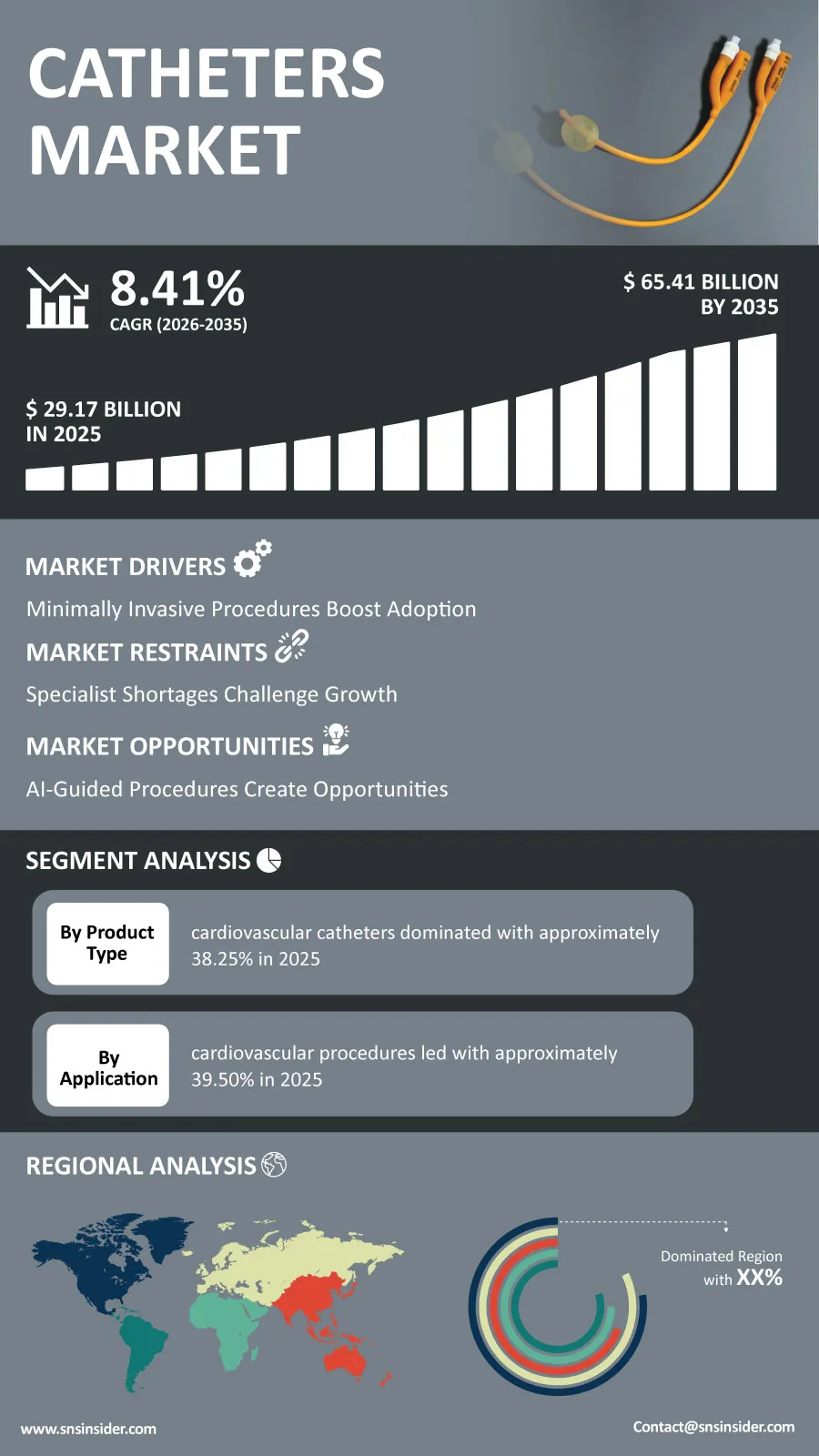
The global Catheters Market is witnessing sustained expansion as healthcare systems increasingly rely on minimally invasive procedures for diagnosis and treatment across multiple specialties. "According to a recent study by SNS Insider, the global Catheters Market size valued at USD 29.17 billion in 2025, is anticipated to grow to USD 65.41 billion by 2035, registering a CAGR of 8.41% over the 2026–2035 forecast period."
Rising requirement for intervention in cardiology, urology, neurology, and critical care processes will increase the use of high-end catheter products. The focus in healthcare organizations is shifting to the devices that ensure higher accuracy and fewer complications along with increased comfort of patients, while allowing shorter stays in the hospital. At the same time, new material-based, antimicrobial, and sensor-equipped catheters will be developed.
To Get Detailed Insights on the Catheters Market – Request a Sample Report
Advanced Medical Technologies Strengthen Market Expansion
Technological advancement in catheters is changing modern-day patient care. There has been increased use of catheters in hospitals that help achieve minimally invasive procedures with accurate results and enhanced patient satisfaction. Advancements in technology have allowed doctors to conduct more complex procedures using catheters in cardiology, neurology, and urology among other areas.
Use of catheters with robotic navigation, smart sensors, antimicrobial coatings, and bio-engineered materials will continue to transform healthcare as we know it. These developments ensure that infection risk is reduced, allow easy navigation during surgery and help make informed decisions. With the continued modernization of the health system's infrastructure, there will be an ongoing need for catheters.
Key Market Findings Highlight Strong Segment Performance
Cardiovascular catheters remained the leading product category, accounting for 38.25% of global revenue in 2025, supported by widespread adoption in diagnostic and therapeutic cardiovascular procedures. Meanwhile, urological catheters are projected to register the fastest growth through 2035 with a CAGR of 8.65%.
Among materials, PVC catheters captured the largest market share at 34.10% in 2025 due to broad clinical usage and cost efficiency. Silicone catheters are anticipated to record the fastest expansion at a CAGR of 8.89%, reflecting increasing preference for long-term patient care applications.
By application, cardiovascular procedures represented 39.50% of market revenue in 2025, while urology procedures are forecast to expand at the highest CAGR of 8.74% over the assessment period.
Hospitals remained the primary end users with 55.30% market share during 2025 owing to the concentration of complex interventional procedures. However, homecare settings are expected to witness the fastest growth, advancing at a CAGR of 9.12% as self-catheterization programs continue expanding globally.
Hospital pharmacies accounted for 48.75% of distribution channel revenue in 2025, whereas online pharmacies are anticipated to achieve the highest growth rate of 9.34% CAGR through 2035, supported by increasing home-based patient management.
Innovation and Home Healthcare Continue Reshaping Industry Trends
There is an increasing emphasis by medical devices companies on innovations which are centered on the patient and enhance their safety, convenience, and overall results. The use of antimicrobial coating, hydrophilic technologies, biodegradability, and real time monitoring is giving rise to different ways of differentiating their products.
It is also observed that there is increasing shift to manage catheters in the long term from hospital settings. The availability of home healthcare services, along with patient monitoring and proper reimbursements in some regions, is allowing patients to have proper treatment while also lowering the healthcare costs.
Regional Markets Demonstrate Strong Growth Potential
North America was the dominant regional market in 2025 due to the development of healthcare infrastructure, high number of procedures, and constant investment in innovation in the field of medicine. In the region, the share of the U.S. market reached 85.7%. The market alone brought revenue of approximately USD 10.79 billion in 2025 and is estimated to grow up to almost USD 24.20 billion by 2035 at a CAGR of 8.41%.
The fastest regional growth rate will be seen in Asia Pacific owing to the expansion of healthcare infrastructure, increased prevalence of chronic diseases, and availability of advanced treatment methods. The contribution of China to the regional revenue was 44.2%.
Germany accounted for 25.3% of Europe's catheter market, while Saudi Arabia represented 29.1% of Middle East & Africa revenue. Brazil contributed 43.6% of Latin America's market, supported by continued investments in specialized healthcare services.
Leading Companies Continue Driving Product Innovation
Competition remains intense as manufacturers invest in advanced product development, strategic collaborations, and next-generation catheter technologies designed to improve procedural performance and patient safety.
Major companies operating in the global catheters market include Medtronic plc, Boston Scientific Corporation, Becton, Dickinson and Company, Abbott Laboratories, Teleflex Inc., B. Braun Melsungen AG, Terumo Corporation, Merit Medical Systems Inc., AngioDynamics Inc., Cook Medical LLC, Penumbra Inc., Edwards Lifesciences Corporation, Fresenius Medical Care AG, Smiths Medical, Cardinal Health Inc., Hollister Inc., Coloplast A/S, Braun Medical Inc., Stryker Corporation, and Argon Medical Devices.
An SNS Insider analyst Parry Kardani commented, "The continued transition toward minimally invasive therapies, combined with advances in catheter materials, digital technologies, and home-based healthcare, is creating significant long-term opportunities for manufacturers delivering safer, smarter, and more efficient catheter solutions."
About the Author

Get in touch