
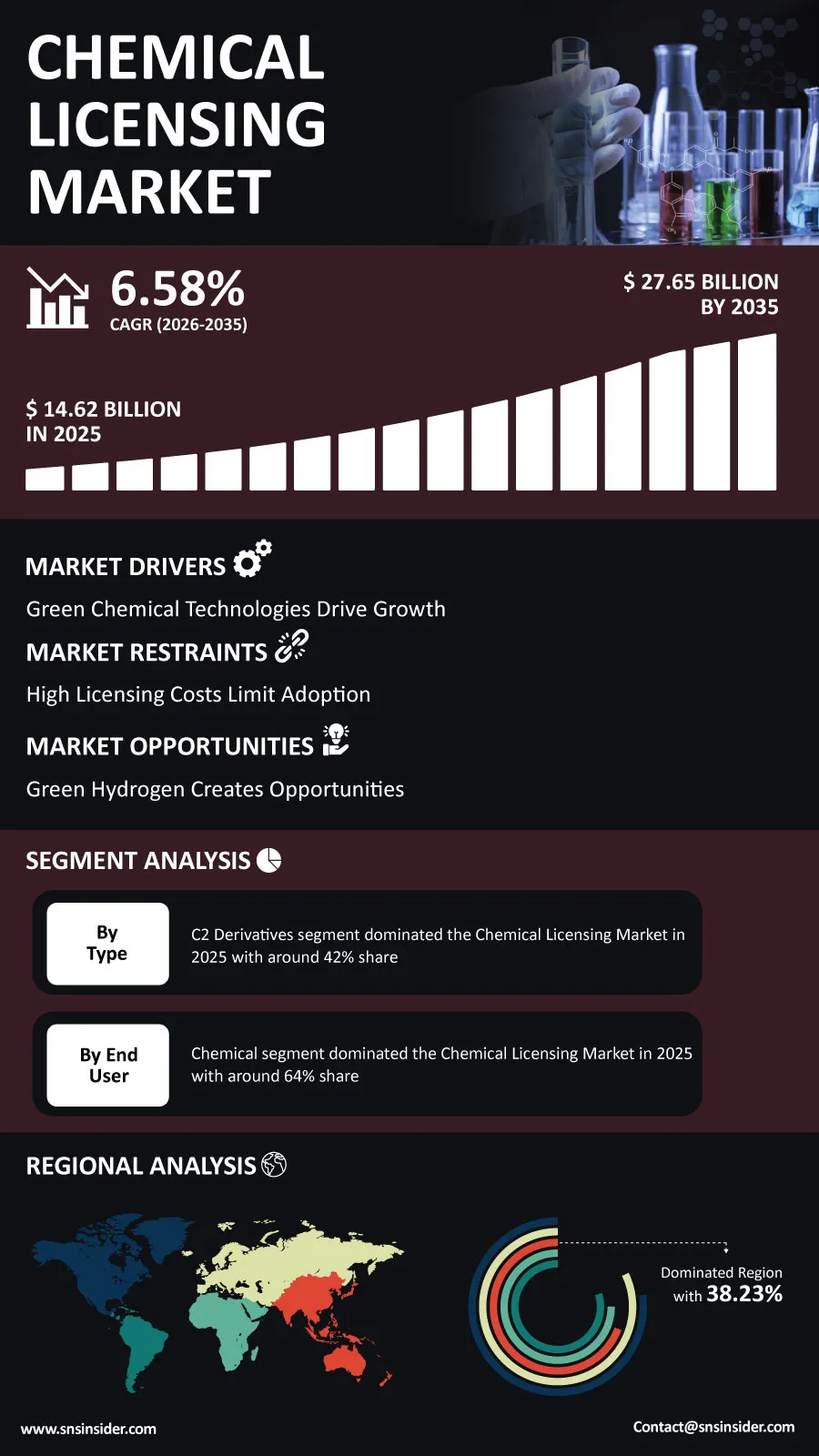
The worldwide Chemical Licensing Market is forecast to undergo consistent growth due to the increasing use of technological advances by chemical producers and energy organizations in order to become more efficient and sustainable. “According to a recent study by SNS Insider, the global Chemical Licensing Market size valued at USD 14.62 Billion in 2025, is anticipated to grow to USD 27.65 Billion by 2035, registering a CAGR of 6.58% over the 2026–2035 forecast period.”
The sector is in the process of a structural shift as producers adopt cleaner production methods, optimize processes via digital means, and leverage technologies that decarbonize while improving production economics. Licensing agreements are rapidly emerging as a key strategy to speed up new product commercialisation without the time-consuming development cycles of proprietary manufacturing processes.
Growing investments in petrochemical complexes, refinery upgrades, hydrogen production and specialty chemical manufacturing are also enhancing demand for licensed technologies across both developed and developing economies.
To Get Detailed Insights on the Chemical Licensing Market – Request a Sample Report
Sustainable Manufacturing and Decarbonization Investments Create Long-Term Opportunities
This has made low-carbon industrial infrastructure an attractive area for continuing significant investment by governments and private sector companies, a space where technology licensors are particularly advantaged. By licensing existing production systems with proven environmental performance, process licensing facilitates compliance with stricter regulatory standards and helps avoid business interruption.
The gradual shift towards green hydrogen and renewable-based feedstocks for the production of low-carbon ammonia is creating new revenue opportunities for technology suppliers. Simultaneously, an increasing demand for licensed ethylene, methanol and polymer production technologies is in line with the forecasted growth of new capacities in Asia Pacific and Middle Eastern regions.
While artificial intelligence, digital twins, predictive maintenance and advanced process control systems will be merged into licensed production platforms by suppliers as the market undergoes digital transformation to accomplish optimal plant throughput while lowering lifecycle expense.
Key Market Insights Highlight Evolving Industry Demand
On type basis, C2 Derivatives generated 42% of global market revenue in 2025 due to continuous demand for ethylene-based products used in packaging, automotive and consumer goods industries. The C1 Derivatives segment is expected to witness the highest CAGR by 2035 as investments in methanol, hydrogen and ammonia production technologies increase.
The Chemical segment dominated the market with about 64% in 2025, as manufacturers used a variety of licensed technologies to improve production efficiency, regulatory compliance, and manufacture high-value specialty chemicals. Refinery upgrade, fuel quality enhancement and broad commercialization of advanced hydroprocessing technologies are expected to make the Oil & Gas segment the fastest growing segment during forecasting period.
Digital Technologies Accelerate Process Innovation
Increasingly, process licensing is being bundled with intelligent digital solutions for plant productivity and operational reliability by technology providers. However, it seamlessly integrates artificial intelligence, real-time analytics, cloud-based monitoring platforms and digital twin technologies to enable chemical producers reduce energy consumption in plants while enhancing process stability and overall reducing maintenance costs.
Innovation is equally extending to carbon capture integration, advanced catalyst development, and cleaner production pathways that enable manufacturers to meet global sustainability targets while maintaining competitive operating performance.
Asia Pacific Captured 38.23% of Chemical Licensing Market Revenue in 2025, While North America Emerges as a High-Growth Region
In 2025, Asia Pacific continued to be the largest regional market, with a global share of 38.23% in terms of revenues. Strong licensing activity due to continued investments in China, India and Southeast Asia refining, Petrochemical manufacturing and specialty chemicals. Increase in industrialization, rising domestic chemical demand and government-backed infrastructure projects continue to strengthen regional dominance.
Chemical companies in North America are likely to continue investing in low-emission production technologies, supply chains for hydrogen (the new industrial fuel), and digital manufacturing capabilities to support healthy growth through the forecast period. Stable growth is being seen in Europe as tighter environmental mandates lead to a wider uptake of renewable feedstock and high levels of sustainable chemical commercialization.
At the same time, new opportunities are opening up in the Middle East and Latin America through refineries expansion projects, multi-billion-dollar investments in petrochemicals and national strategies to build strong domestic chemical production capabilities.
Industry Participants Expand Technology Portfolios Through Strategic Partnerships
The competition in the chemical licensing industry is expected to get even tougher as key technology providers enhance their R&D capabilities, form new strategic alliances, and develop future-generation sustainable production technologies. The companies are focusing on developing efficient catalysts, processing systems, hydrogen technologies, and carbon reduction technologies to meet the changing needs of customers.
Key companies operating in the global Chemical Licensing Market include BASF, Dow, DuPont, Chevron Phillips Chemical, ExxonMobil, Shell, Huntsman, Eastman, Johnson Matthey, LyondellBasell, Linde, Honeywell UOP, KBR, Lummus Technology, SABIC, TechnipFMC, Clariant, Sinopec, PetroChina, and Toyo Engineering.
An SNS Insider analyst, Himanshu Sharma, commented, "The accelerating transition toward sustainable chemical manufacturing, refinery modernization, and digital process optimization is creating sustained demand for advanced licensing solutions worldwide. Companies investing in innovative low-carbon technologies, hydrogen production platforms, and intelligent process management systems will be well positioned to capture long-term growth opportunities as industrial decarbonization continues to reshape the global chemical sector."
About the Author

Get in touch




