
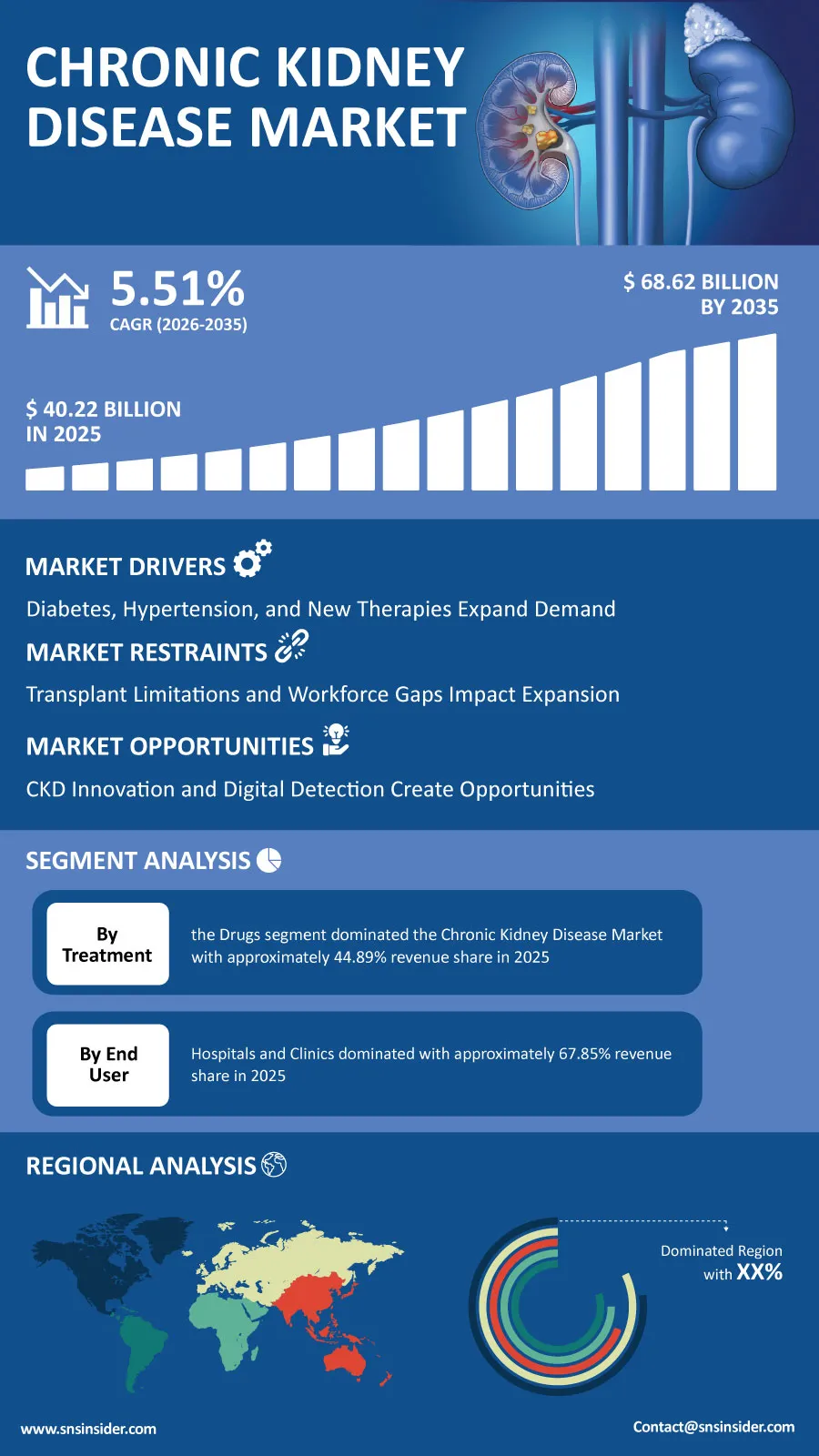
The global Chronic Kidney Disease (CKD) Market is experiencing steady expansion as healthcare systems intensify efforts to improve early diagnosis, disease management, and long-term patient outcomes. "According to a recent study by SNS Insider, the global Chronic Kidney Disease Market size valued at USD 40.22 billion in 2025, is anticipated to grow to USD 68.62 billion by 2035, registering a CAGR of 5.51% over the 2026–2035 forecast period." Growing prevalence of diabetes and hypertension, coupled with advances in kidney-protective therapies and improved access to specialized care, continues to reshape treatment strategies across developed and emerging healthcare markets.
Healthcare providers are looking to slow down disease progression before reaching the point where dialysis or kidney transplant is needed. Screening campaigns, increased awareness among physicians, and ongoing advancements in diagnostics, drugs, and renal replacement therapies are helping in improving patient care and presenting new business prospects.
To Get Detailed Insights on the Chronic Kidney Disease Market – Request a Sample Report
Early Diagnosis and Therapeutic Innovation Transform Patient Care
Management of chronic kidney disease is currently transitioning into a proactive approach as opposed to the reactive one that focuses on treatments at the later stages of the condition. The early detection of any problems with the kidney makes it possible for the doctors to start the treatment earlier, thereby minimizing complications.
Innovation is not only being seen in the areas of treatment, but also in other aspects, such as use of digital health tools, artificial intelligence in risk assessment, home dialysis and advanced medications. These innovations are making the management of chronic kidney disease even easier for healthcare providers.
Key Market Findings Highlight Expanding Treatment Opportunities
By diagnosis, blood tests remained the leading diagnostic method in 2025 owing to their central role in routine kidney function assessment, while imaging tests, including ultrasound, CT, and MRI, continue to gain adoption as structural kidney evaluation becomes increasingly important.
By treatment, the drugs segment accounted for approximately 44.89% of market revenue in 2025, supported by expanding use of kidney-protective pharmacotherapies. Meanwhile, the kidney transplant segment is projected to register the fastest growth, advancing at a CAGR of approximately 6.22% through 2035.
Among end users, hospitals and clinics dominated the market with approximately 67.85% revenue share in 2025, reflecting their leadership in dialysis, transplantation, and specialized renal care. Diagnostic centers are anticipated to become the fastest-growing end-user category, expanding at a CAGR of approximately 5.77% as preventive screening programs continue to expand.
Digital Health and Precision Medicine Strengthen CKD Management
Technological advances that facilitate real-time monitoring and personalized care have been embraced by healthcare providers. Tele-nephrology services are helping increase access to specialists for those living in underserved areas, while connected health applications help ensure adherence to medications and monitoring of kidney health.
Simultaneously, advancements in drug discovery are opening up new options for the treatment of kidney disease. New approaches in drug discovery that focus on inflammation, fibrosis, and metabolic disorders are supplementing the existing drug categories, thus adding more ways to prevent further disease progression.
Regional Markets Continue to Expand
The North American region remained the leading regional market due to the presence of well-developed renal care infrastructure, reimbursement policies, and adoption of innovative treatments. In the North American region, the U.S. chronic kidney disease market stood at approximately USD 13.23 billion in 2025 and is expected to grow and reach USD 20.16 billion by 2035 with a CAGR of 5.43% during the period.
The Asia Pacific region is estimated to be the fastest-growing regional market in the coming years due to increased health care spending, increased cases of early diagnosis, and increased availability of nephrological services. In 2025, China contributed approximately 61.7% to the revenue of the Asia Pacific region.
Germany comprised approximately 22.3% share of the revenue in the European region due to developed health care infrastructure and reimbursement policies. In the Latin American region, Brazil contributed approximately 44.2% to the regional revenue while in the Middle East & Africa region, Saudi Arabia contributed approximately 38.4% to the regional revenue.
Leading Companies Advance Innovation Across Kidney Care
Competition within the chronic kidney disease market continues to intensify as pharmaceutical companies, dialysis providers, diagnostic manufacturers, and medical technology firms accelerate investments in innovative therapies and integrated patient care solutions.
Major companies operating in the global Chronic Kidney Disease Market include Fresenius Medical Care AG & Co. KGaA, DaVita Inc., AstraZeneca plc, Amgen Inc., Abbott Laboratories, F. Hoffmann-La Roche Ltd., Baxter International Inc. (Vantive), B. Braun Melsungen AG, Medtronic plc, Novo Nordisk A/S, Boehringer Ingelheim GmbH, Eli Lilly and Company, Bayer AG, Otsuka Holdings Co., Ltd., CSL Vifor, Siemens Healthineers AG, Beckman Coulter Inc., ACON Laboratories, Inc., Nova Biomedical, and GlaxoSmithKline plc.
An SNS Insider analyst Parry Kardani commented, "The future of chronic kidney disease management lies in earlier diagnosis, multidisciplinary care, and therapies capable of slowing disease progression before renal failure develops. Companies combining pharmaceutical innovation, digital health technologies, and integrated renal care solutions will be well positioned to address the growing global burden of chronic kidney disease.
About the Author

Get in touch




