
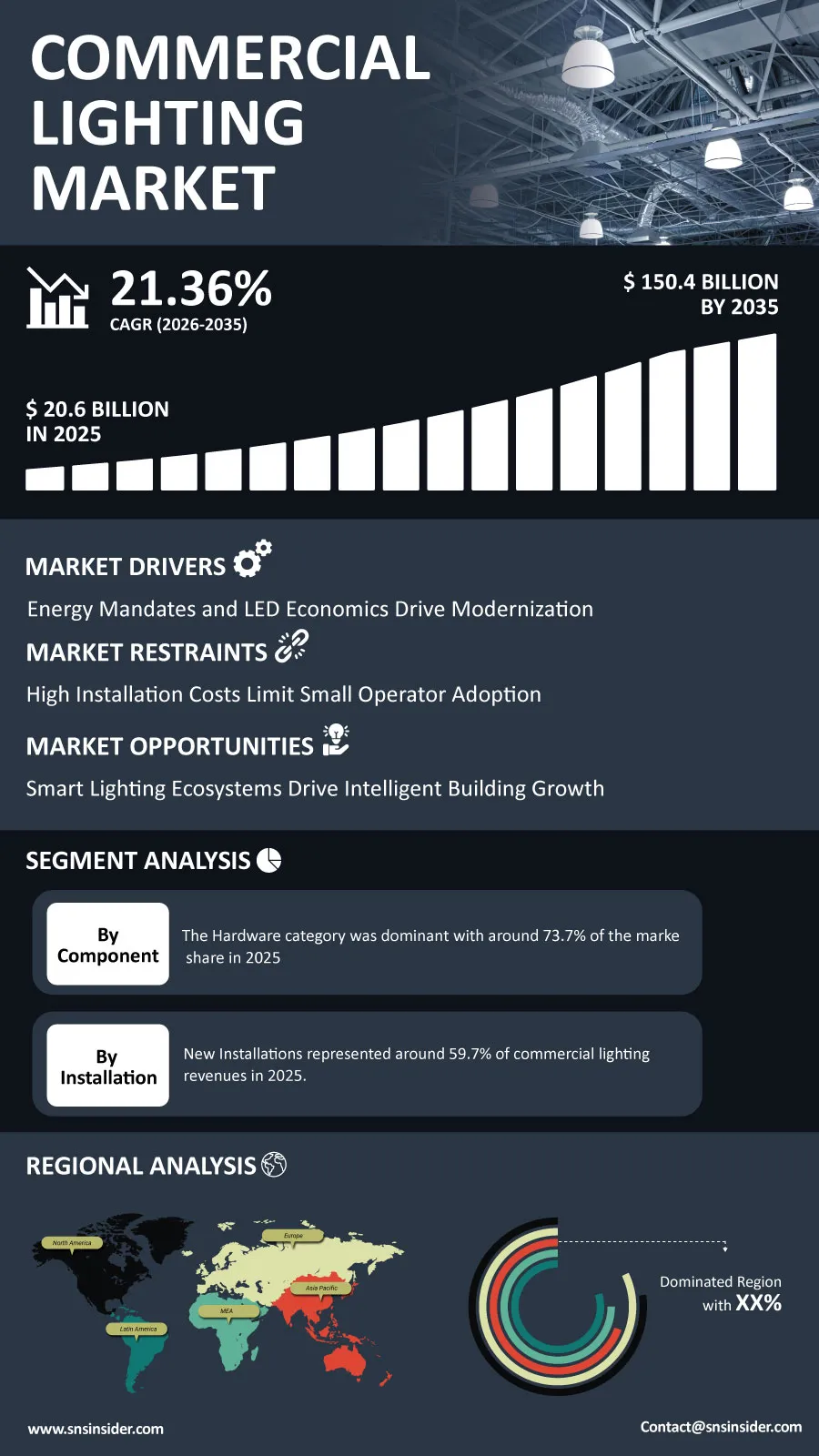
The global Commercial Lighting Market is entering a high-growth phase as businesses accelerate the modernization of building infrastructure and shift toward energy-efficient, connected illumination systems. According to a recent study by SNS Insider, the global Commercial Lighting Market size valued at USD 20.6 billion in 2025, is anticipated to grow to USD 150.4 billion by 2035, registering a CAGR of 21.36% over the 2026–2035 forecast period.
Property developers are now increasingly focusing on lighting as an integral part of their energy management and sustainability initiatives, instead of merely considering lighting from the perspective of an isolated building expenditure. Upgrading to LED lighting systems that have integrated controls and occupancy sensors is helping companies’ lower electricity usage, while providing better insights on building performance.
Moreover, the upgrading process is becoming more widespread with the nearing of time for replacing traditional fluorescent and high-intensity discharge lighting fixtures. This is mainly because of reduced LED prices, strict efficiency regulations, and the emergence of financing schemes.
To Get Detailed Insights on the Commercial Lighting Market – Request a Sample Report
Smart Building Adoption Continues to Create New Growth Opportunities
Integration of LEDs with IoT technologies is revolutionizing the way lighting facilities for commercial buildings are constructed. Systems are able to switch light automatically based on occupancy, presence of sunlight, schedule, and operation needs in order to ensure optimized energy consumption without sacrificing comfort of occupants.
Lighting-as-a-Service offers more possibilities due to reduced financial burden of upgrades. Using managed services companies will be able to upgrade their lighting systems using contracts that include installation, monitoring, maintenance, and optimization.
Another opportunity is represented by human-centric lighting, especially in office buildings, hospitals, and schools. Tunable lighting, which allows for changing the temperature of light and its pattern, is becoming popular among businesses concerned about well-being of their employees or patients.
Key Market Insights Highlight Shifting Demand Patterns
By component, hardware is expected to account for approximately 73.7% of global market revenue in 2025, supported by demand for LED luminaires, drivers, sensors, and control equipment. Meanwhile, software is projected to be the fastest-growing component as cloud-based management platforms, AI-driven energy optimization, and predictive maintenance tools become increasingly important to connected building operations.
Based on technology, LED lighting is anticipated to maintain its leading position in 2025, while smart and connected LED systems are expected to record the fastest growth through 2035. The integration of wireless controls, sensors, analytics, and automated building management is expanding the value proposition beyond basic illumination.
By installation, new installations are forecast to represent approximately 59.7% of market revenue in 2025, supported by continued commercial construction and the incorporation of efficient lighting systems during the building design stage. Retrofit installations are expected to grow at the fastest pace as property owners replace aging infrastructure without undertaking complete lighting system reconstruction.
In terms of application, offices are projected to remain the leading segment in 2025, reflecting the extensive global commercial office building base and strong demand for energy-saving solutions. Healthcare and education are expected to be among the fastest-growing applications as institutions invest in specialized illumination, wellness-focused environments, and energy-efficient infrastructure.
Connected Lighting Strengthens Energy and Operational Efficiency
Lighting systems in commercial establishments are increasingly integrating into building management systems. These advanced systems allow the monitoring of energy usage, detecting areas that are not being utilized, scheduling lights, and even anticipating problems within the lighting system that might result in failure.
AI and analytics will play a significant role in optimizing system performance through predicting problems and optimizing energy usage. New uses of lighting systems like the Li-Fi have opened up new possibilities for using the lighting system as an infrastructure for wireless communications.
Asia Pacific Leads the Commercial Lighting Market as Global LED Adoption Accelerates
Asia Pacific is set to remain a key commercial lighting market due to the high rate of commercial construction, increased urbanization, presence of efficient LED manufacturers and energy efficiency programs initiated by governments. In China there is a major market, while in India and Southeast Asia commercial constructions are contributing to growth in demand for advanced lighting infrastructure.
In North America there continue to be many opportunities due to the large-scale commercial buildings’ renovation and energy efficiency programs, utilities’ encouragement and existing LED supply chains. The US is the leading market in the region, as more commercial property owners are undertaking retrofit projects in order to save money.
In Europe there is also ongoing demand for commercial lighting products due to energy performance requirements and sustainability goals. Finally, the Middle East, Africa and Latin America have seen the emergence of new opportunities for commercial lighting due to commercial construction, smart city initiatives, high energy prices and retail/hospitality sector expansion.
Industry Participants Focus on Connected Solutions and Innovation
The competitive landscape is evolving as lighting manufacturers expand beyond hardware to provide integrated software, controls, analytics, and building automation capabilities. Companies are focusing on AI-enabled energy management, connected lighting platforms, human-centric illumination, and service-based business models to strengthen recurring revenue opportunities and improve customer value.
Key companies operating in the global Commercial Lighting Market include Signify N.V. (Philips Lighting), Acuity Brands, Inc., OSRAM GmbH, Eaton Corporation, Legrand S.A., Hubbell Incorporated, Zumtobel Group AG, General Electric Lighting (Savant Systems), Panasonic Corporation, Cree Lighting (IDEAL Industries), LSI Industries Inc., Lutron Electronics Co., Digital Lumens (OSRAM), Itron Inc., and Cooper Lighting Solutions (Signify).
An SNS Insider analyst Sushant Kadam commented, “The commercial lighting industry is moving rapidly toward intelligent, connected, and service-driven infrastructure. The combination of energy efficiency requirements, building modernization, and demand for smarter workplaces is creating substantial opportunities for companies that can combine advanced LED hardware with automation, analytics, and human-centric lighting capabilities.”
About the Author

Get in touch




