
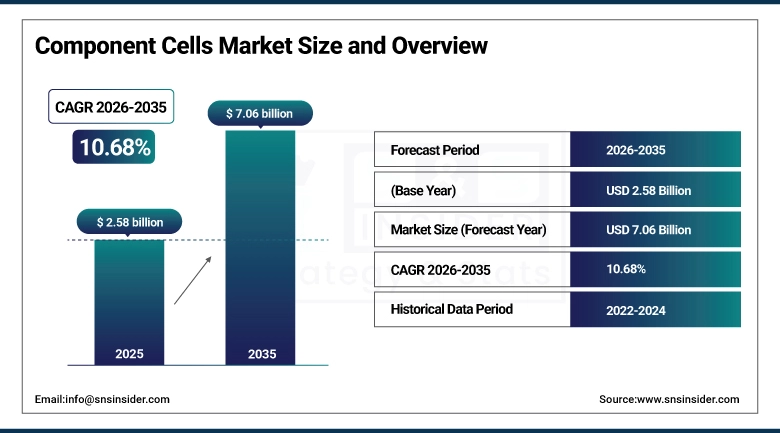
As per the SNS Insider Report titled, Component Cells Market Size, Share & Segmentation, By Type, By Application, By Product Format, By End User, By Region, And Global Forecast 2026–2035, “The global Component Cells Market size valued at USD 2.58 billion in 2025, is anticipated to grow to USD 7.06 billion by 2035, registering a CAGR of 10.68% over the 2026–2035 forecast period.”
Key Takeaways:
- The Component Cells Market was valued at USD 2.58 billion in 2025 and is projected to reach USD 7.06 billion by 2035.
- By Type, Chemically Competent Cells dominated the market with a 53.65% share in 2025.
- Electrocompetent Cells are expected to witness the fastest growth, expanding at a CAGR of 10.93% during 2026–2035.
- By Application, Cloning & Sub-Cloning accounted for the largest market share of 42.71% in 2025.
- Protein Expression is projected to be the fastest-growing application segment, registering a CAGR of 12.91% over the forecast period.
- By Product Format, Single-Use Aliquots held the leading market share of 46.45% in 2025.
- Kits (Competent Cells + Reagents) are anticipated to grow at the fastest CAGR of 11.42% through 2035.
- By End User, Pharmaceutical & Biotechnology Companies captured 53.11% of the market in 2025, while Contract Research Organizations (CROs) are forecast to expand at the fastest CAGR of 12.84%.
Why Component Cells Market is Growing?
The Component Cells Market is witnessing strong growth owing to the rising demand for sophisticated tools used in molecular biology. Competent cells play an important role in cloning, transformation, gene editing, and plasmid propagation. These cells help in the uptake of DNA and their expression efficiently.
The increasing growth in biotech research, investment in life science innovation, and increasing usage of recombinant DNA technology have created an increase in market demand. Competent cells are being widely used by pharmaceutical companies in developing biologics, vaccines, and protein therapeutics. Moreover, the increased usage of genome editing using CRISPR technology and other synthetic biology tools has generated a need for highly efficient transformation techniques.
The development in cell engineering techniques, higher efficiencies of transformation and the use of pre-made competent cells have been playing significant roles in increasing laboratory efficiency and widespread adoption.
Component Cells Market Statistics:
- Over 70% of processes for producing recombinant proteins are done using bacteria-based expression platforms around the world.
- The number of synthetic biology companies that have been created throughout the last decade has increased dramatically and they receive billions of dollars in investments from venture capitals each year.
- Biologics are estimated to constitute a growing proportion of the pharmaceutical pipeline and hence there is demand for molecular cloning and expression techniques.
- Every year millions of genetic transformation experiments are conducted in research facilities around the world for various purposes including genomics, proteomics and cell engineering.
- The amount of money invested in biotechnology research and development continues to increase each year thanks to public funding as well as investments by private sector organizations.
- The growing use of gene editing technologies such as CRISPR has increased the demand for efficient cloning and transformation technologies.
- The manufacture of biologics is being increased in pharmaceutical and biotech companies due to the increasing demand for monoclonal antibodies, recombinant proteins and therapeutic agents.
Emerging Trends:
Component Cells Market is observing some revolutionary changes that are bringing a change in research and bioprocessing strategies. The efficiency of electrocompetent cells is rising because of their high transformation efficiencies in complicated cloning scenarios. There has been an increased usage of special strains for cloning difficult sequences, expressing toxic proteins, and handling larger plasmids.
Another significant trend in the field includes the increasing need for kits with competent cells and optimal reagents. This allows for a more efficient preparation process and ensures that any experiments carried out will be consistent.
Developments in synthetic biology and genome engineering have continuously influenced improvements in competent cells technology. Next generation competent cells are now being developed to facilitate advanced gene synthesis, pathway engineering, and production processes using cells. In addition, there has been growing cooperation between biotech companies and universities in advancing their products and technologies.
Top 10 Companies:
- Thermo Fisher Scientific
- Merck KGaA
- Agilent Technologies
- Promega Corporation
- Takara Bio Inc.
- Bio-Rad Laboratories
- New England Biolabs
- GenScript Biotech Corporation
- Lucigen Corporation
- OriGene Technologies
About the Author

Get in touch




