
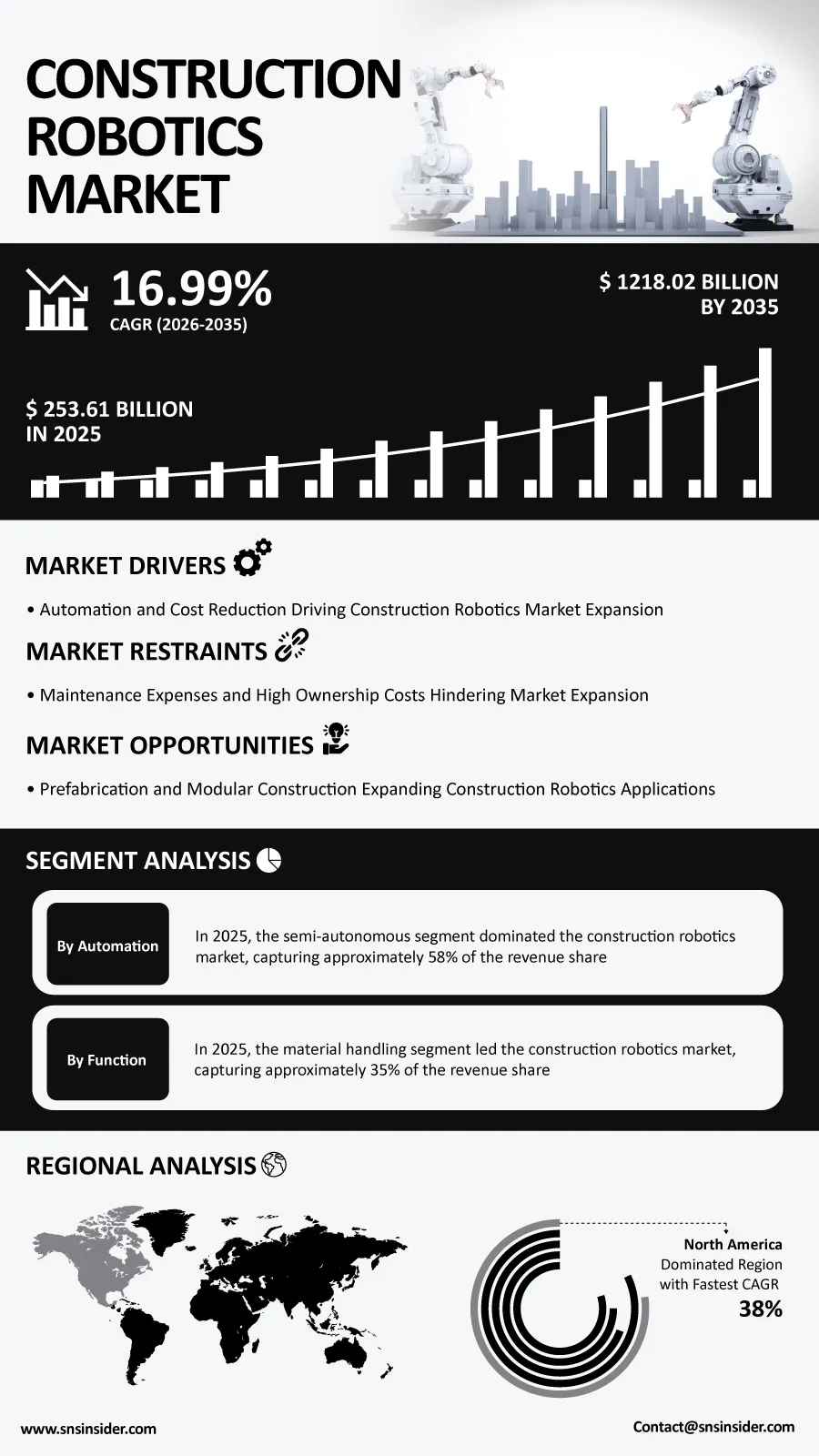
The global Construction Robotics Market is entering a period of accelerated transformation as construction companies increasingly turn to automation to address workforce shortages, improve productivity, and meet rising demand for faster project execution. According to a recent study by SNS Insider, the global Construction Robotics Market size valued at USD 253.61 billion in 2025, is anticipated to grow to USD 1218.02 billion by 2035, registering a CAGR of 16.99% over the 2026–2035 forecast period.
Construction companies have been making use of robots for tasks related to handling materials, demolition, brick laying, 3D printing, and various other labor-intensive tasks. Through the fusion of artificial intelligence, computer vision, sensor technology, and autonomous motion, machines are able to carry out more complicated operations.
Urban growth through infrastructural projects and real estate development is offering even more possibilities to the manufacturers of robots. Consistency, less wastage, and safety at work have become key considerations for the owners of projects and hence, automation has become a crucial part of construction today.
To Get Detailed Insights on the Construction Robotics Market – Request a Sample Report
Labor Shortages and Infrastructure Investment Create New Growth Opportunities
The world of construction industry still experiences difficulties related to the accessibility of skilled labor and high costs of the workforce. Robotic devices provide assistance to contractors in overcoming such problems through the automation of recurring actions and the possibility for human workers to be engaged in control processes and other more profitable activities on projects.
There is a positive influence from the increase in infrastructure, smart cities, and urbanization projects, which contributes to the growth of the market. Continuous working of robotic devices and their ability to ensure accuracy are particularly interesting solutions for such projects where any delays can have a significant impact on costs.
On the other hand, Robots-as-a-Service systems will go a long way towards lowering the costs of adoption in that construction companies will be able to take advantage of automated systems without having to make any significant financial investment up front.
Key Market Insights Highlight Shifting Demand Patterns
By automation, semi-autonomous systems segment held approximately 58% of market revenue in 2025 owing to their ability to combine automated functionality with human oversight makes them suitable for complex construction environments and easier to integrate into existing workflows. Fully autonomous systems are projected to register the fastest growth, with a CAGR of approximately 18.24% through 2035, supported by advances in AI, machine learning, and autonomous navigation.
Based on function, material handling segment held approximately 35% of market revenue in 2025, driven by demand for automated lifting, transportation, and placement of construction materials. Demolition robotics is forecast to be the fastest-growing segment, expanding at a CAGR of 26.53% as contractors increasingly deploy machines for hazardous, confined-space, and high-risk demolition operations.
By end use, industrial construction segment dominated approximately 43% of market revenue in 2025. Large factories, warehouses, and industrial facilities provide favorable environments for robotic automation due to repetitive workflows and high productivity requirements. Residential construction is projected to grow at the fastest CAGR of 18.64% through 2035 as housing demand, urbanization, and labor constraints encourage greater use of automated building technologies.
AI and Autonomous Systems Reshape Construction Workflows
AI, machine vision, IoT connectivity, and sensors are opening doors for construction robotics. Machines can now move around a construction site on their own, gather information about projects, and do tasks precisely without requiring much intervention.
Robotics systems designed to work in collaboration with humans are also enhancing the relationship between people and machines. This can help ensure the safety of workers through the performance of physically taxing and hazardous tasks.
North America Holds 38% Construction Robotics Market Share in 2025 as Asia Pacific Grows at a 21.3% CAGR Through 2035
It is forecasted that North America will contribute around 38% of the market revenue of the global market in 2025 owing to high costs of construction labor, labor shortages, large amounts spent on infrastructure development, and use of automated technologies. The US will continue to be the key contributor in the region owing to investment in the construction of smart infrastructure and the development of robots.
Asia Pacific is expected to be the region where the highest growth will take place and where the CAGR will reach 21.3% from 2025 to 2035. Owing to rapid urbanization, infrastructure megaprojects, and development of smart cities initiated by the governments of different countries in the region, the usage of robots in the construction industry grows rapidly.
Industry Participants Focus on Automation and Intelligent Robotics
The competitive landscape is evolving as robotic systems have been launched by technology providers to help enhance efficiency, safety, and construction accuracy. The investments being made include autonomous mobility, artificial intelligence-based control systems, remote operation, 3D printing, and specialized robotics for difficult construction operations.
Key companies operating in the global Construction Robotics Market include ABB, Advanced Construction Robots, BROKK GLOBAL, Ekso Bionics, Autonomous Solutions Inc., MX3D, Husqvarna AB, FBR Ltd, Conjet, Komatsu Ltd., Fujita Corporation, Contour Crafting Corporation, CyBe Construction, KEWAZO, RobotWorx, Built Robotics, ICON Technology, Inc., Dusty Robotics, MUDBOTS 3D CONCRETE PRINTING, LLC, and Advanced Construction Robotics, Inc.
An SNS Insider analyst Sushant Kadam commented, “The convergence of labor shortages, infrastructure expansion, and rapid advances in artificial intelligence is creating a strong foundation for construction robotics adoption. As robotic systems become more flexible, autonomous, and economically accessible, construction companies that embrace automation will be better positioned to improve productivity, strengthen safety, and meet the growing demands of modern project delivery.”
About the Author

Get in touch




