
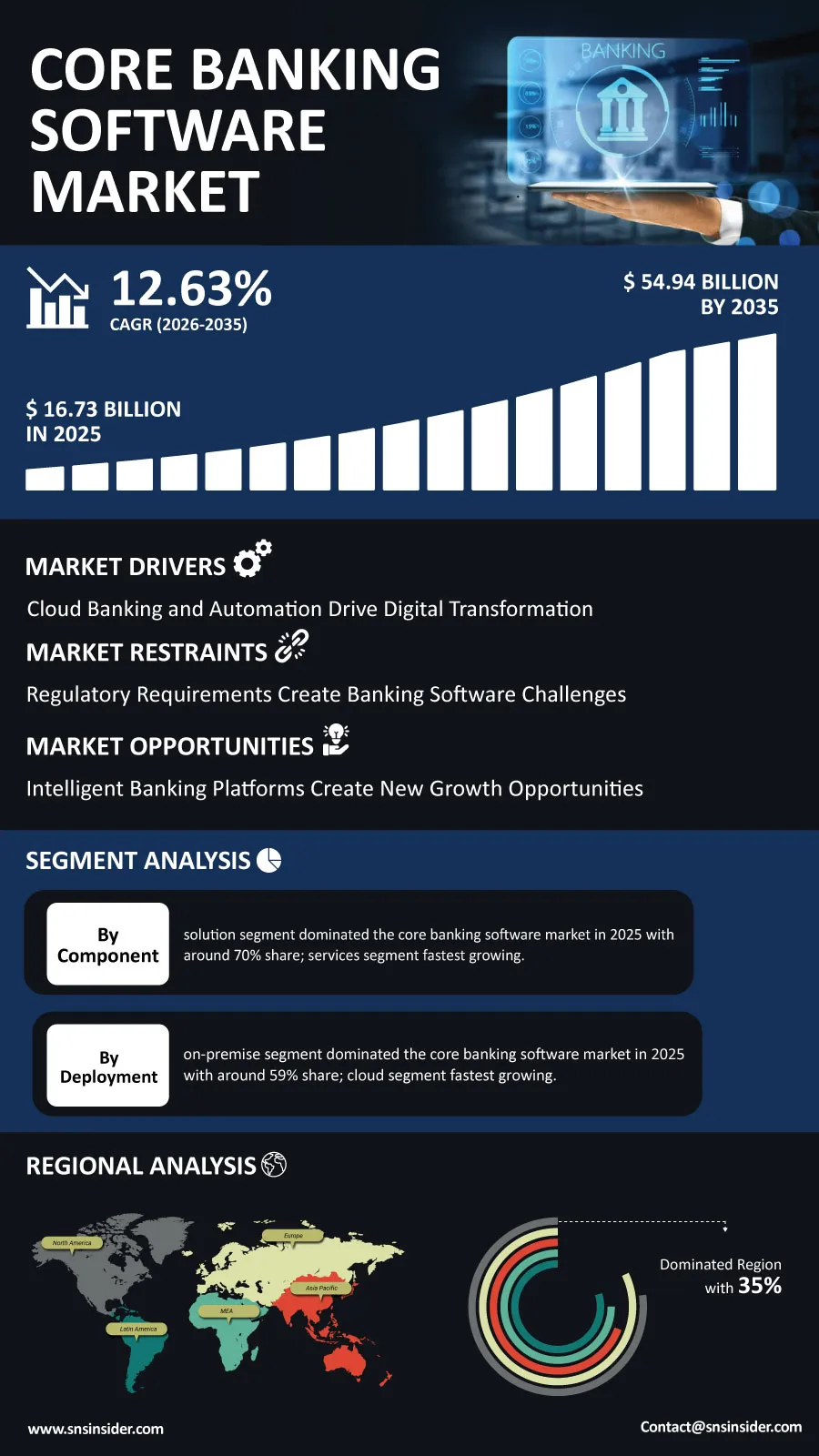
The global market for Core Banking Software is entering a new stage of growth with banks focusing on digital infrastructure, intelligent automation, and customer-oriented banking software solutions. “According to a recent study by SNS Insider, the global Core Banking Software Market size valued at USD 16.73 billion in 2025, is anticipated to grow to USD 54.94 billion by 2035, registering a CAGR of 12.63% over the 2026–2035 forecast period.”
Financial organizations from developed and developing countries are upgrading their existing IT infrastructures in order to increase operational flexibility and to satisfy changing customer needs. Increasing demand for flexible account management, instant payments, account opening processes, and other financial services prompts companies to adopt next-generation core banking systems, which allow them to continuously innovate.
Increasing investments into artificial intelligence, automation, cloud-native technologies, and open banking systems are also driving changes in priorities of banks' IT departments. Financial institutions look for scalable software solutions that would provide them with increased operational resiliency and facilitate regulatory compliance, cybersecurity, and personalized banking services through various digital touchpoints.
To Get Detailed Insights on This Market – Request a Sample Report
Digital Banking Modernization Creates New Growth Opportunities
Financial organizations keep increasing investments into modernization projects as competition grows in the realms of retail, commercial, and digital banking. With cloud-powered platforms, it becomes possible to offer more flexibility in developing innovative financial products, processing transactions and scaling operations.
There is an increasing need in software products that can support embedded finance, open banking solutions, and digital payments platforms. In view of closer cooperation between banks and fintech organizations, there is an increased need in flexible banking platforms that would be able to integrate third-party applications and ensure faster innovation.
Artificial intelligence is increasingly becoming an important part of modern banking software due to its ability to support fraud detection, predictive analysis, customer engagement and workflow automation.
Key Market Insights Highlight Changing Banking Technology Demand
As per product segment, solutions segment accounted for almost 70% of market revenue in 2025 owing to rising adoption of integrated banking platforms for transaction processing, customer management, and operational efficiency. Services segment is likely to grow at the fastest rate till 2035 owing to growing demand for consulting, migration, integration, and managed services from financial institutions.
In terms of deployment, on-premise solutions accounted for almost 59% of market revenue in 2025 owing to high demands in data governance, security, and regulatory compliance. Cloud deployment is expected to witness the highest growth in order to gain flexibility, scalability, and cost optimization.
On the basis of end use, banks accounted for almost 63% of market share in 2025, whereas financial institutions are likely to witness fastest growth till 2035 owing to digital transformation efforts in credit unions, cooperative banks, and non-bank financial institutions.
Intelligent Banking Technologies Accelerate Industry Innovation
The providers of technology are developing new analytics tools, artificial intelligence, machine learning, and automation features that streamline complicated processes in the banking sector and help improve customer interaction through modern solutions. These tools will allow financial organizations to cope with increasing transaction amounts and perform operations more precisely.
Moreover, the providers of software are increasingly investing in cybersecurity solutions, API management, and real-time data that increase the efficiency of digital banking ecosystems. The fusion of intelligent automation and secure cloud computing makes the banks capable of coping with the changing requirements of customers and regulatory changes.
North America Held 35% of the Core Banking Software Market Share in 2025; Asia Pacific Projected to Register the Fastest CAGR Through 2035
The North American region has a share of about 35% in terms of market revenue in 2025 because of the broad adoption of digital banking, technology investment, well-developed financial infrastructure, and the early use of artificial intelligence technologies in banking. Regular modernization programs among leading financial institutions help the region sustain its position.
The APAC region will be the fastest-growing during 2035 due to the fast financial digitalization of governments, banks, and fintech organizations in this region. The growth opportunities of this region are also fueled by the increasing availability of the Internet, the growing number of smartphones, the growing volume of digital payments, and investments in new banking infrastructures.
The Europe region keeps expanding steadily due to banking modernization efforts. Also, the regions of Latin America and MEA are investing in digital financial solutions.
Industry Participants Focus on Cloud Platforms and AI-Driven Banking Solutions
In Core Banking Software Market Competition is Increasing due to investments being made by tech companies in cloud native architecture, intelligence automation, cyber security, and banking ecosystem platforms. Strategic partnerships and innovations in core product offerings will continue to be critical in helping banks enhance operational performance and fulfill future digital banking needs.
Key companies operating in the global Core Banking Software Market include Capgemini, Finastra, FIS, Fiserv, Inc., HCL Technologies Limited, Tata Consultancy Services (TCS), Mambu, Avaloq, EdgeVerve Systems (Finacle), Backbase, nCino, Forbis, Securepaymentz, Novatti, Capital Banking Solutions, Infosys Limited, Jack Henry & Associates, Inc., Oracle Corporation, Temenos Group, and Unisys.
An SNS Insider analyst Sakshi Kale commented, "Financial institutions are entering a new era where cloud-native platforms, intelligent automation, and AI-enabled banking capabilities are becoming essential components of long-term competitiveness. Organizations investing in scalable core banking modernization will be better positioned to deliver secure, personalized, and efficient financial services while adapting to rapidly evolving customer expectations and regulatory requirements."
About the Author

Get in touch




