
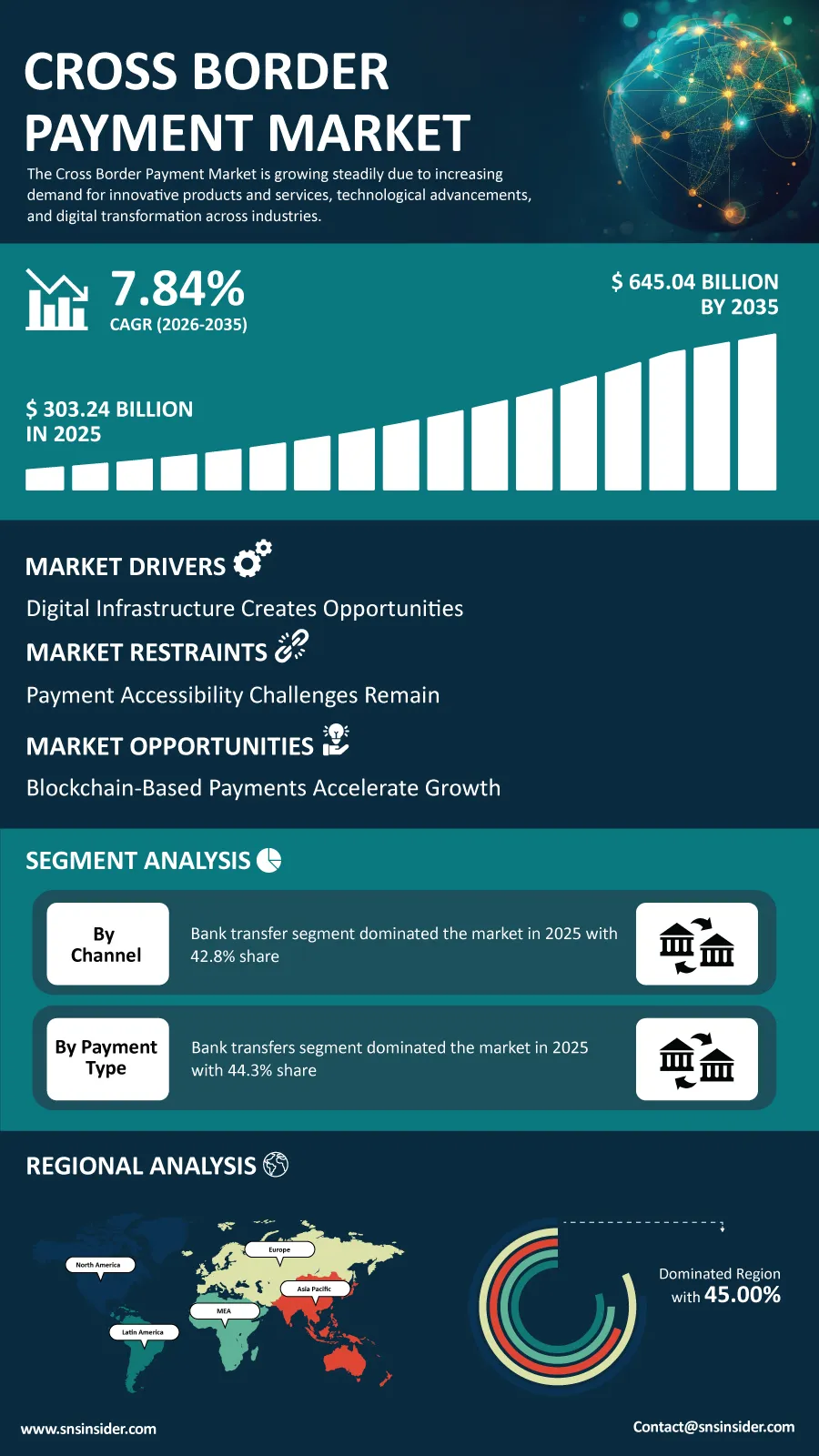
The global cross-border payment market is going through substantial expansion as international commerce, digital financial services and cross-border e-commerce. “According to a recent study by SNS Insider, the global Cross-Border Payment Market size valued at USD 303.24 billion in 2025, is anticipated to grow to USD 645.04 billion by 2035, registering a CAGR of 7.84% over the 2026–2035 forecast period.”
The rapid flow of goods, services, capital and people across international borders is driving the demand for payment solutions that enable quicker settlements, increased transparency and lower transaction costs. We level up financial institutions, payment providers and fintech companies, modernizing estate legacy payments infrastructure to enable complex international transactions in seamless customer experiences through our one-stop-shop across consumer & enterprise verticals.
The industry is additionally being led by constant advancements in blockchain technology, API-driven banking, artificial intelligence, and cloud-based payment platforms. The latest trend among organizations is to migrate to several intelligent payment systems that help enhance fraud detection, automate compliance processes and facilitate real-time international transactions along with evolving regulatory requirements.
To Get Detailed Insights on the Cross-Border Payment Market – Request a Sample Report
Digital Financial Infrastructure Creates Long-Term Growth Opportunities
In anticipation of the next-gen payment networks intended to enhance transaction velocity, lower operational complexity and supplement financial connectivity across the globe, financial institutions and payment service providers are making heavy investments. Recent leaps towards real time payment systems and digital banking services open new avenues for businesses and consumers to transfer funds across borders with far less friction than traditional methods.
Cross-border e-commerce, international remittance and multinational business operations continue to grow, creating new needs for new digital payment solutions offered by payment providers So, businesses looking to utilise pay platforms are demanding transparent foreign exchange pricing, minimum reconciliation and integration into enterprise financial systems.
Then again, Distributed Ledger Technology (DLT), Embedded financing and intelligence powered Compliance platforms are enabling payment ecosystems to be more secure & scalable. These innovations are enabling financial institutions to drive operational efficiencies while bolstering transaction monitoring and regulatory compliance across global payment corridors.
Key Market Insights Highlight Shifting Demand Patterns
According to the method of transaction, the B2B segment is projected to make up 47.5% of global market revenue in 2025 due to the rise in international business activities, supplier payments, and business transactions across national boundaries by multinational companies. The C2C segment is projected to witness the fastest growth up to 2035, with international remittances, mobile payment apps, and digital consumer transactions growing all over the world.
By the channel of payment, the bank transfer segment will generate 42.8% of global market revenue in 2025 owing to the existing infrastructure, safety of transactions, and widespread use in international transactions. The card payment segment will be growing the fastest over the forecast period due to the growth of international online shopping, international tourism, and merchant acceptance.
In regards to payment method, bank transfer was responsible for about 44.3% of market revenue in 2025 because of its reliability in facilitating high-value cross-border payments. The fastest growth is predicted to be experienced by digital wallet payment method until 2035 as smartphones continue to revolutionize cross-border payments. In regard to end-users, large enterprises were contributing 48.1% of total market revenue in 2025 while SMEs were anticipated to be the fastest growing group due to digital commerce in the global economy.
Advanced Payment Technologies Accelerate Industry Transformation
The cross-border payment industry is rapidly contemporizing as the world economy pulls financial institutions towards more effective technologies with streamlined settlement of funds that render improved speed, transparency and security. These include AI, blockchain-based settlement platforms, real-time payment networks, and API-enabled financial services which are now allowing their providers to offer highly efficient payment experience across several international corridors.
They are also using intelligent fraud detection, automated compliance verification, and data-driven transaction monitoring to give boost to their payment ecosystems. Such innovations lower operational costs, raise customer confidence and cater to the growing volumes of cross-border transaction services for businesses and consumers.
North America Held Over 45.00% of the Cross-Border Payments Market Share in 2025; Asia Pacific Projected to Register the Fastest Growth Through 2035
In 2025, North America is expected to represent an estimated share of over 45.00% of the total global revenue due to its well-developed financial infrastructure, high level of international trade activity and leading position in the digital payment innovation. The US continues to be the hub of global payment processing operations via its vast correspondent banking network and massive volumes of cross-border transactions.
The region is expected to be the fastest-growing regional market until 2035. The extraordinary growth seen around your region can be attributed to rising cross-border e-commerce, greater digital payment adoption rate, a rapid increase of remittance inflows and exciting fintech innovation across China, India and Southeast Asia. Reinforced market opportunities due to investments in real-time payment connectivity and financial inclusion.
The region still plays a key role as a driver of worldwide market extension by means of coordinated installment enactment, an all-inclusive monetary framework and the proceeded with reception of moment installment frameworks. At the same time, cross-border trade and remittance activity is always growing in the Middle East, Africa, and Latin America as those countries gradually build their investments in digital financial products and international payment capabilities.
Industry Participants Focus on Innovation and Next-Generation Payment Solutions
The competitive environment will remain very volatile, considering that global financial institutions, payment networks, and fintech companies are continuing to invest in the development of real-time payment solutions, blockchain-based payment settlements, AI-based regulatory compliance systems, and digitization of the financial industry. Such strategic alliances, payment network growth, and technological innovations allow companies to make international payments more efficient and address cross-border payments demand.
Key companies operating in the global Cross-Border Payment Market include Visa Inc., Mastercard Incorporated, PayPal Holdings Inc., Western Union Company, MoneyGram International Inc., Wise Plc, Stripe Inc., Adyen N.V., Payoneer Global Inc., Worldpay Inc., FIS Global, Fiserv Inc., JPMorgan Chase & Co., Citigroup Inc., HSBC Holdings Plc, SWIFT, Ripple Labs Inc., Ant Group, Tencent Holdings Ltd., and Remitly Global Inc.
An SNS Insider analyst Sakshi Kale commented, “The accelerating digitalization of international commerce, combined with advances in real-time payment infrastructure and intelligent financial technologies, is fundamentally reshaping the cross-border payment landscape. Organizations investing in secure, transparent, and technology-driven payment ecosystems will be best positioned to capture long-term growth opportunities as global financial connectivity continues to expand.”
About the Author

Get in touch




