
Cross-Border Payment Market Report Scope & Overview:
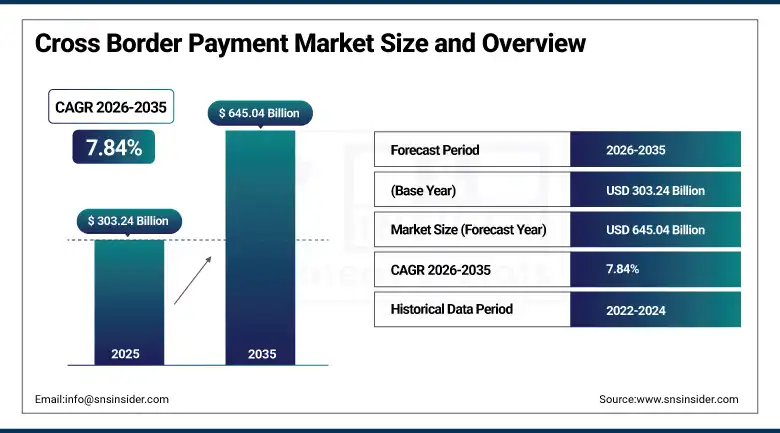
The Cross-Border Payment Market was valued at USD 303.24 Billion in 2025 and is expected to reach USD 645.04 Billion by 2035, growing at a CAGR of 7.84% from 2026 to 2035.
The Cross Border Payment Market is growing steadily due to increasing demand for innovative products and services, technological advancements, and digital transformation across industries. Rising consumer awareness, expanding e-commerce, and the adoption of automation and AI-driven solutions are driving efficiency and improving customer experiences. Additionally, growing investments in research and development, regulatory support, and emerging business models are fostering Cross Border Payment Market expansion, while enterprises focus on scalability, cost optimization, and sustainable practices to maintain competitiveness and meet evolving Cross Border Payment Market needs.
Cross-border payment activity surged as digital platforms enabled instant, low-cost transfers 75% of users embraced mobile and real-time solutions for e-commerce, remittances, and global business, driven by AI-powered compliance and greater transparency. Bank for International Settlements (BIS) reported that global foreign exchange markets process around USD 7.5 trillion in daily transactions, reflecting the substantial scale of international trade, investment activities, and cross-border financial settlements that continue to drive demand for efficient payment infrastructure.
Market Size and Forecast
-
Market Size in 2026E: USD 327.01 Billion
-
Market Size by 2035: USD 645.04 Billion
-
CAGR: 7.84% from 2026 to 2035
-
Fastest Growing Region: Asia Pacific
-
Largest Region: North America
To Get more information On Cross Border Payment Market - Request Free Sample Report
Cross-Border Payment Market Trends
-
Rising globalization of trade, e-commerce, and international business transactions is driving the cross-border payment market.
-
Growing adoption of digital payment platforms and real-time money transfer solutions is boosting market growth.
-
Expansion of international remittances and global workforce mobility is fueling cross-border transaction volumes.
-
Increasing focus on faster settlement, lower transaction costs, and enhanced payment transparency is shaping adoption trends.
-
Advancements in blockchain technology, API-based payment infrastructure, and AI-driven fraud detection are improving efficiency and security.
The U.S. Cross-Border Payment Market Outlook
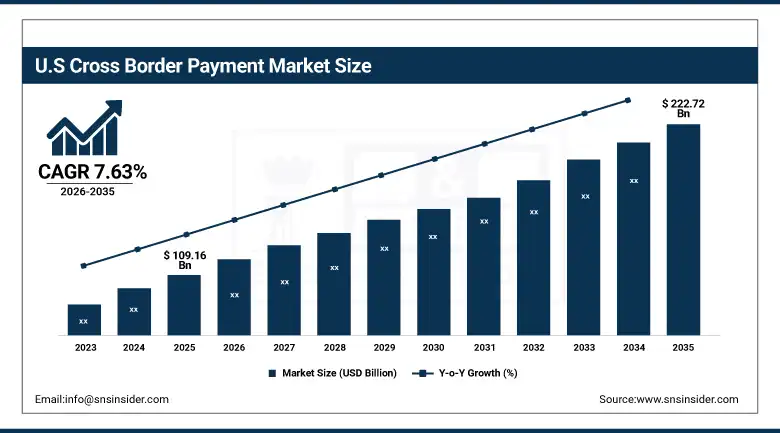
U.S. Cross Border Payment Market is valued at USD 109.16 billion in 2025 and is expected to reach USD 222.72 billion by 2035, growing at a CAGR of 7.63% from 2026-2035.
Cross Border Payment Market Growth in the U.S. is influenced by growing adoption of new technologies, digitalization, and need for innovation in the market. Consumer awareness, automation and artificial intelligence technology investments, and efficiency along with scalability have become some of the key elements which will contribute to the growth of the Cross Border Payment Market.
Additionally, the World Bank identifies the United States as one of the world's largest remittance-sending countries, with outward remittance flows exceeding USD 70 billion annually, highlighting the region's significant role in global cross-border money movement.
Cross-Border Payment Market Segment Analysis
-
By Transaction Type, business to business (B2B) segment dominated the cross border payment market in 2025 with 47.5% share; customer to customer (c2c) segment is the fastest growing segment with a CAGR of 11.2%.
-
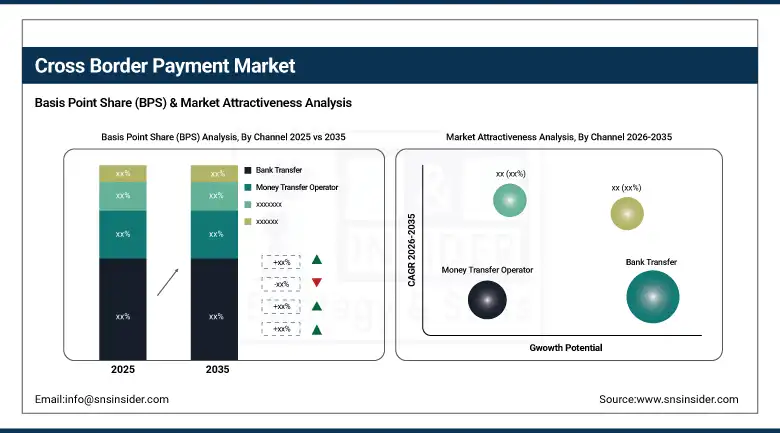
By Channel, bank transfer segment dominated the market in 2025 with 42.8% share; card payment segment is the fastest growing segment with a CAGR of 12.0%.
-
By Payment Type, bank transfers segment dominated the market in 2025 with 44.3% share; digital wallets segment is the fastest growing segment with a CAGR of 13.5%.
-
By End User, large enterprises segment dominated the market in 2025 with 48.1% share; SMEs segment is the fastest growing segment with a CAGR of 12.7%.
By Transaction Type, business to business (B2B) segment dominated the cross border payment market, customer to customer (C2C) segment is expected to grow fastest
Business to Business (B2B) dominated the cross border payment market due to the high amount of volume and value of international payments that were carried out by companies. Businesses require reliable, compliant, and efficient methods of payments to facilitate their international transactions. With continued globalization of business and increase in international businesses and transactions, the significance of the B2B segment in the cross border payments industry will continue to grow.
Customer to Customer (C2C) is the fastest-growing segment, owing to the increased activity in international migrations and rise in remittances and popularity of online payment methods among consumers. Consumers are increasingly relying on mobile apps to make international transfers. This is supported by the availability of smartphones and internet connectivity. In addition, the increasing demand for instant and cost-effective international fund transfers is driving growth in the C2C segment.
By Channel, bank transfer segment dominated the cross border payment market, card payment segment is expected to grow fastest
Bank Transfer led the cross border payment market due to its reliability, safety, and wide acceptance by enterprises and financial organizations. Reliable banking channels help to transfer funds through international trade settlement and secure high-value international transactions. Due to their reliable systems, regulatory compliance, security, and widespread availability around the world, bank transfers have become the favored payment channel. Ongoing developments in the digital banking space have been further strengthening this market position.
Card Payment is the fastest-growing channel because of the rising popularity of international online retailing. Credit and debit cards provide the most convenient means of making cross-border payments and travel payments due to their ease and speed. Technological advances have been made, which have boosted consumer confidence in cards such as virtual payment cards and contactless cards. Growth prospects are strong owing to increasing merchant acceptance and online shopping practices.
By Payment Type, bank transfers segment dominated the cross border payment market, digital wallets segment is expected to grow fastest
Bank Transfers dominated the market because they provide a safe and efficient way of making international money transfers. Bank transfers are commonly used by financial institutions and organizations when making payments and settling other organizational matters. They enjoy a great reputation owing to their regulatory frameworks, established structure, and capacity to facilitate large-value transfers. The demand for more transparent, secure, and reliable means of making international payments has been contributing greatly to the dominance of bank transfers in the market.
Digital Wallets are the fastest-growing payment type, driven by increasing digitalization and shifting preferences among consumers towards payment methods are the main driving forces of this phenomenon. Digital wallet apps offer fast and convenient payment options for international transfers. Other factors such as high penetration rates of smartphones, development of various fintech environments, and incorporation of multiple payment modes into digital wallets are supporting the trend.
By End User, large enterprises segment dominated the cross border payment market, SMEs segment is expected to grow fastest
Large Enterprises dominated the cross border payment market because of their presence and operations on the international scale and significant transactions that were performed. Large Enterprises conducted many payments through various countries in connection with purchasing processes, trading, investing, and managing employees. They had sufficient resources to implement sophisticated payments technologies. The ongoing development of multinational corporations and their international business environment promotes domination of the segment.
SMEs are the fastest-growing end-user segment, due to the development of globalization and international business relationships between firms, as well as involvement in online commerce. The development of various fintech technologies allows even small businesses to perform international payments easily. Availability of global e-commerce channels and customers from around the world creates new perspectives and opportunities for businesses. Payment transparency, low transaction fees, and foreign exchange are making the segment grow rapidly.
Regional Analysis
|
Region |
Major Country |
Share within Region, 2025 (%) |
|---|---|---|
|
North America |
United States |
84.73% |
|
Europe |
United Kingdom |
32.84% |
|
Asia Pacific |
China |
38.47% |
|
Middle East & Africa |
UAE |
24.73% |
|
Latin America |
Brazil |
43.84% |
North America Cross-Border Payment Market Insights
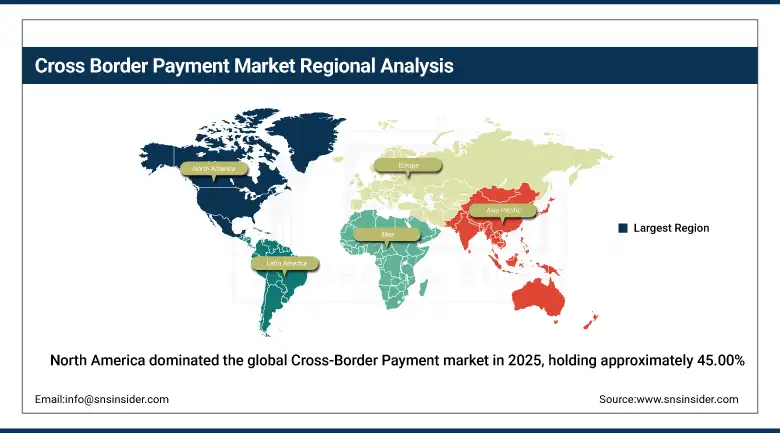
North America dominated the global Cross-Border Payment market in 2025, holding approximately 45.00% of global revenues. The United States accounts for approximately 84.73% of regional revenue through its dual role as the world's most commercially active originator and intermediary of international payment flows, supported by the USD's global reserve currency status that routes a disproportionate share of global cross-border payment value through U.S. correspondent banking infrastructure. Canada contributes supplementary demand through its substantial trade-driven payment flows with both the United States and global trading partners, and its domestic fintech sector's growing cross-border payment service innovation.
According to the U.S. Bureau of Economic Analysis (BEA), total U.S. international trade in goods and services exceeds USD 7 trillion annually, generating substantial demand for cross-border payment solutions. The Federal Reserve reports that Fedwire processes transactions worth trillions of dollars daily, supporting large-scale domestic and international financial activity.
Get Customized Report as per Your Business Requirement - Enquiry Now
Europe Cross-Border Payment Market Insights
Europe held a significant share of global Cross-Border Payment revenues in 2025. The Single Euro Payments Area has created an integrated European domestic payment market whose technical standards, regulatory framework, and real-time settlement infrastructure now encompass 36 European countries. The SEPA Instant Credit Transfer scheme's progressive adoption across EU member states is reducing intra-European cross-border payment friction to the level of domestic transactions, while the EU's focus on cross-border payment transparency and cost disclosure under the Cross-Border Payments Regulation is improving consumer visibility into FX margins and fees.
According to the European Central Bank (ECB), the TARGET payment system settles transactions worth more than €2 trillion daily, highlighting the substantial scale of financial transactions processed across the region. Additionally, the Single Euro Payments Area (SEPA) covers 36 European countries, enabling harmonized euro-denominated transactions and simplifying cross-border payments for businesses and consumers. These factors continue to support Europe's position as a key region in the global Cross-Border Payment Market.
Asia Pacific Cross-Border Payment Market Insights
Asia Pacific is the fastest-growing regional Cross-Border Payment market, projected to expand at approximately 10.04% CAGR through 2035, driven by the rapid growth of Asian e-commerce cross-border exports, the extraordinary scale of Asian diaspora remittance flows, and the progressive bilateral real-time payment system interconnection across the region. India accounts for the world's largest inbound remittance recipient status, receiving over USD 120 billion in annual inflows whose management efficiency improvement is a national financial inclusion and economic priority.
According to the Asian Development Bank (ADB), Asia accounts for approximately 35–40% of global trade flows, underscoring the region's critical role in international commerce and financial transactions.
China remains one of the world's largest trading nations, with total goods trade exceeding USD 6 trillion annually, generating substantial cross-border payment volumes.
Additionally, the World Bank reported that India received approximately USD 129 billion in remittances in 2024, the highest globally, highlighting the significant scale of international money transfers within the region. These factors continue to strengthen Asia Pacific's position as the fastest-growing market for cross-border payment solutions.
MEA & Latin America Cross-Border Payment Market Insights
Middle East and Latin America are high-growth Cross-Border Payment markets whose large diaspora remittance inflows, expanding international trade activity, and growing digital payment adoption are creating rapidly expanding commercial demand. The UAE leads MEA revenues at approximately 24.73% of the regional total through its role as a global financial hub whose banking sector intermediates substantial cross-border payment flows across the Middle East, Africa, and South Asia, and whose large expatriate workforce generates significant outbound remittance volumes.
Brazil leads Latin American revenues at approximately 43.84% of the regional total through the Brazilian Real's growing convertibility, Brazil's expanding international trade, and the PIX instant payment system's exploration of cross-border payment interoperability that is progressively improving Brazil's international payment infrastructure.
Market Dynamics
Growth Drivers: Global trade expansion and digital payment innovations are accelerating demand for efficient cross-border payment infrastructure worldwide.
The cross-border payment market's growth is driven by the simultaneous expansion of the underlying economic activity generating cross-border payment demand and the commercial maturation of technology platforms that serve this demand more efficiently than legacy infrastructure. Global goods and services trade volumes, international digital commerce, cross-border investment, and diaspora remittance flows are each expanding at rates above global GDP growth, creating a secular demand expansion that is independent of payment infrastructure efficiency improvements.
Simultaneously, the competitive pressure of fintech challengers including Wise, Revolut, Airwallex, and Payoneer on traditional correspondent banking economics is driving continuous cost reduction and speed improvement that expands the commercial addressable market by making cross-border payments economically viable for smaller transaction values and more frequent use cases than legacy pricing structures supported.
Restraints: Regulatory compliance complexity and correspondent banking de-risking practices are increasing costs and limiting payment accessibility.
Anti-money laundering and know-your-customer compliance requirements that differ in implementation standards, documentation requirements, and enforcement intensity across every national jurisdiction create compliance overhead whose management requires specialist expertise and technology investment that constrains both the geographic breadth and the cost efficiency of cross-border payment service provision.
Financial institution de-risking, the practice of terminating correspondent banking relationships with counterparties in higher-risk jurisdictions to reduce AML compliance burden, has progressively reduced the geographic coverage of cross-border payment infrastructure in developing markets, creating payment corridors where limited competition and infrastructure gaps generate above-market pricing that extracts value from remittance senders and their recipients rather than incentivising market entry through commercial opportunity.
Opportunities: Blockchain, distributed ledger technologies, and cryptocurrencies enable faster settlements, lower transaction costs, and greater transparency in cross-border payments.
Blockchain technology and distributed ledger technologies help accelerate the process of cross-border transactions. By using smart contracts and digital currencies, fewer intermediaries are involved in the process, thus minimizing costs associated with transaction fees and avoiding any possible issues associated with frauds. Corporations are benefiting from immediate settlements, improved cash flow management, and better tracking of transactions. The use of cryptocurrencies for international transactions is gaining popularity and becoming more common, particularly among small enterprises and fintech services. There are ample growth prospects for payment service providers adopting innovative payment solutions.
In 2025, 60% of cross-border payment providers adopted blockchain or distributed ledger technology, cutting average settlement times by 70% and reducing transaction costs by up to 40% while enhancing end-to-end transparency.
Recent Developments:
-
2025: Mastercard launched Mastercard Move, a wallet-to-wallet cross-border payment service enabling consumers and small businesses to send money globally in seconds via mobile applications across 150+ countries with transparent upfront FX rates, competing directly with specialist remittance operators in the consumer cross-border transfer market.
-
2024: Visa expanded Visa Direct real-time push payments to support instant cross-border disbursements in 100+ currencies with transparent FX rates, enabling merchants, platforms, and financial institutions to disburse international payments through Visa network quality and fraud protection.
-
2024: Ripple expanded its XRP Ledger-based cross-border payment service to additional corridors in Southeast Asia and Latin America, providing financial institutions with blockchain-based cross-border settlement whose near-instant finality and transparent pricing demonstrated measurable cost reduction versus correspondent banking alternatives.
Cross-Border Payment Market Key Players are:
-
Visa Inc.
-
Mastercard Incorporated
-
PayPal Holdings Inc.
-
Western Union Company
-
MoneyGram International Inc.
-
Wise Plc
-
Stripe Inc.
-
Adyen N.V.
-
Payoneer Global Inc.
-
Worldpay Inc.
-
FIS Global
-
Fiserv Inc.
-
JPMorgan Chase & Co.
-
Citigroup Inc.
-
HSBC Holdings Plc
-
SWIFT
-
Ripple Labs Inc.
-
Ant Group
-
Tencent Holdings Ltd.
-
Remitly Global Inc.
Cross-Border Payment Market Report Scope:
| Report Attributes | Details |
|---|---|
| Market Size in 2025 | USD 303.24 Billion |
| Market Size by 2035 | USD 645.04 Billion |
| CAGR | CAGR of 7.84% From 2026 to 2035 |
| Base Year | 2025 |
| Forecast Period | 2026-2035 |
| Historical Data | 2022-2024 |
| Report Scope & Coverage | Market Size, Segments Analysis, Competitive Landscape, Regional Analysis, DROC & SWOT Analysis, Forecast Outlook |
| Key Segments | • By Transaction Type (Business to Business (B2B), Customer to Business (C2B), Business to Customer (B2C), Customer to Customer (C2C)) • By Channel (Bank Transfer, Money Transfer Operator, Card Payment, Others) • By Payment Type (Bank Transfers, Card-Based Payments, Digital Wallets, Cryptocurrency Payments, Mobile Money) • By End User (Individuals / Migrant Workers, SMEs, Large Enterprises, E-commerce Platforms, Financial Institutions) |
| Regional Analysis/Coverage | North America (US, Canada), Europe (Germany, UK, France, Italy, Spain, Russia, Poland, Rest of Europe), Asia Pacific (China, India, Japan, South Korea, Australia, ASEAN Countries, Rest of Asia Pacific), Middle East & Africa (UAE, Saudi Arabia, Qatar, South Africa, Rest of Middle East & Africa), Latin America (Brazil, Argentina, Mexico, Colombia, Rest of Latin America). |
| Company Profiles | Visa Inc., Mastercard Incorporated, PayPal Holdings Inc., Western Union Company, MoneyGram International Inc., Wise Plc, Stripe Inc., Adyen N.V., Payoneer Global Inc., Worldpay Inc., FIS Global, Fiserv Inc., JPMorgan Chase & Co., Citigroup Inc., HSBC Holdings Plc, SWIFT, Ripple Labs Inc., Ant Group, Tencent Holdings Ltd., Remitly Global Inc. |
Frequently Asked Questions
The Cross-Border Payment Market is expected to grow at a CAGR of 7.84% from 2026 to 2035.
The Cross-Border Payment Market was valued at USD 303.24 Billion in 2025.
Expanding global trade, e-commerce growth, real-time payment connectivity, fintech innovation, and increasing SME globalization are driving cross-border payment demand.
The bank transfer segment dominated the Cross-Border Payment Market with 42.8% share in 2025.
North America dominated the Cross-Border Payment Market in 2025, holding approximately 45.00% of global revenues.
