Cryo Electron Microscopy Market is heading into a new era of growth and development from a scientific and business perspective due to increasing efforts made by pharma companies, biotech companies, and research facilities in the field of high-end molecular imaging technologies. The increasing need for protein, virus, and other complex biomolecule imaging has increased the importance of cryo electron microscopy (cryo-EM) in fields such as drug discovery, vaccine production, and precision medicines.
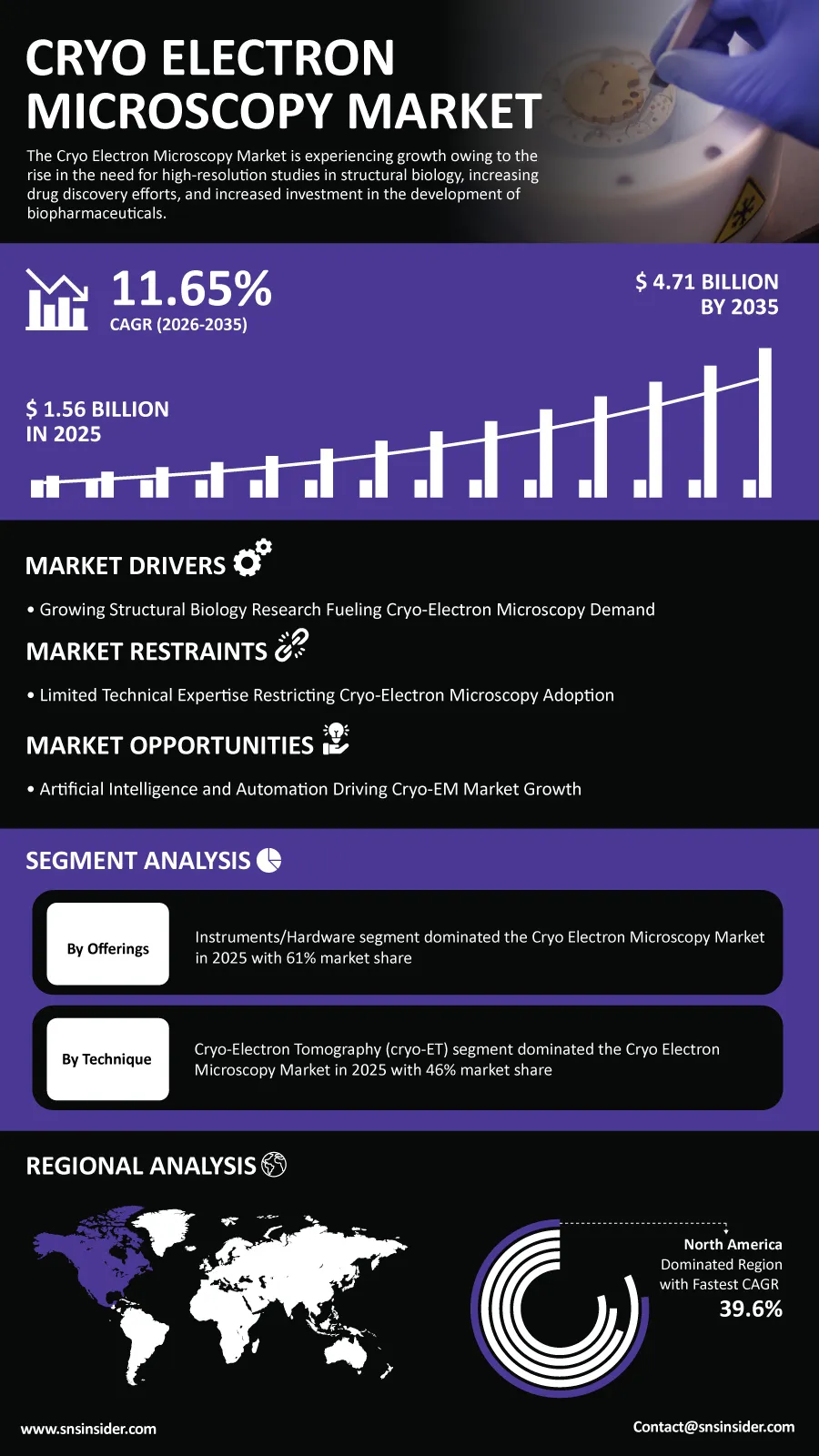
According to a recent study by SNS Insider, the global Cryo Electron Microscopy Market size valued at USD 1.56 billion in 2025, is anticipated to grow to USD 4.71 billion by 2035, registering a CAGR of 11.65% over the 2026–2035 forecast period. Increasing government support for life science research, expanding biologics pipelines, and the need for detailed structural analysis are expected to sustain long-term market growth across academic and commercial research environments.
Since modern medicine and healthcare rely more on molecular interactions to innovate in therapies, Cryo-EM is now an indispensable analysis tool for the development of future medicines. With better detectors, better software for imaging, and sample preparation automation, scientists are able to achieve more detailed information about structures much faster than before.
To Get Detailed Insights on the Cryo Electron Microscopy Market – Request a Sample Report
Pharmaceutical Research Expands Demand for Advanced Imaging Systems
The increasing complexity of biotherapeutics and precise drugs is leading the pharmaceuticals industry to focus on advanced imaging technologies that can help accelerate research timescales. The increasing popularity of cryo-electron microscopy is because it allows scientists to study biological molecules with near-atomic precision without having to go through the process of crystallisation.
AI is revolutionizing imaging processes through better image reconstruction, saving manual processing time, and increasing analysis precision. With the help of these technological advancements, laboratories within research organizations have become more productive, allowing for efficient drug discovery.
Market Segments Reflect Strong Research and Commercial Adoption
By offering, Instruments and Hardware accounted for 61% of global market revenue in 2025, supported by continuous investments in high-performance microscopes, detectors, and imaging infrastructure. Services are expected to record the fastest expansion throughout the forecast period as laboratories increasingly outsource imaging, maintenance, training, and analytical support.
Among imaging techniques, Cryo-Electron Tomography (cryo-ET) captured 46% of the market in 2025 due to its ability to generate highly detailed three-dimensional cellular images. Micro Electron Diffraction (MicroED) is projected to register the fastest growth as researchers seek advanced solutions for analysing extremely small crystalline structures.
By application, Structural Biology represented 42% of total market revenue during 2025, reflecting widespread use in protein, virus, and biomolecular research. Drug Discovery is anticipated to emerge as the fastest-growing application as pharmaceutical companies increasingly integrate cryo-EM into biologics development and precision medicine programmes.
Academic and Research Institutes remained the largest end-user segment with 54% market share in 2025, while pharmaceutical and biotechnology companies are forecast to deliver the strongest future growth as commercial adoption accelerates.
Innovation and Collaboration Strengthen Industry Momentum
The technology vendors are still rolling out cutting-edge imaging systems to boost research facilities in the structural biology field and pharmaceutical discovery. In 2026, Direct Electron extended its range of direct detectors to boost the efficiency of high-speed cryo-electron microscopy imaging processes. Prior collaboration among Rigaku, JEOL, and Kyoto University had supported research collaboration for the advancement of structural biology innovation.
In terms of product launches, recent years have been very productive in terms of imaging advancements. In 2024, Thermo Fisher Scientific has launched the Glacios 2 Cryo-TEM, while its Titan Krios G4 was deployed for use in the development of molecular imaging programs in Europe.
North America Leads While Asia Pacific Records Fastest Growth
North America was responsible for 39.6% of the total Global Cryo Electron Microscopy Market in 2025, due to robust pharmaceutical research, government investments and advanced healthcare facilities. In the region, the share of revenue of the U.S. was 93.2%. The market value of the U.S. Cryo Electron Microscopy Market in 2025 stood at USD 0.53 billion and is forecast to hit USD 1.53 billion by 2035 at a CAGR of 11.10%.
The Asia Pacific region is expected to be the fastest growing in terms of revenue generation in the period up to 2035 as the government continues to make substantial investments in the biotechnology and pharmaceutical research industry. Australia was responsible for 8.3% of revenue generation in the region, while growing investments in other parts of the region create good opportunities for imaging techniques.
In Europe, the contribution to regional revenue generation made by the UK was 21.4%. Brazil was responsible for 47.8% of revenue generation in Latin America, while the UAE's contribution was 10.9% in the Middle East & Africa region.
Industry Leaders Expand Advanced Imaging Portfolios
Competition continues to intensify as manufacturers focus on detector innovation, automation, artificial intelligence, and integrated imaging solutions to meet rising demand from life sciences and pharmaceutical research organisations. Major companies operating in the global Cryo Electron Microscopy Market include Thermo Fisher Scientific Inc., JEOL Ltd., Hitachi High-Tech Corporation, Carl Zeiss AG, Leica Microsystems, Olympus Corporation, Nikon Corporation, Gatan Inc., Delmic B.V., Protochips Inc., DENSsolutions, Direct Electron LP, TESCAN ORSAY HOLDING, Oxford Instruments plc, Cordouan Technologies, Evident Corporation, Hamamatsu Photonics K.K., Bruker Corporation, Rigaku Corporation, and Park Systems Corporation.
An SNS Insider analyst Parry Kardani commented, "Cryo-electron microscopy is becoming one of the most valuable technologies supporting modern biomedical research. Continuous advances in imaging performance, artificial intelligence, and laboratory automation are enabling researchers to accelerate structural biology discoveries and improve the development of next-generation therapeutics, creating significant long-term opportunities across the global life sciences industry.
About the Author

Get in touch