
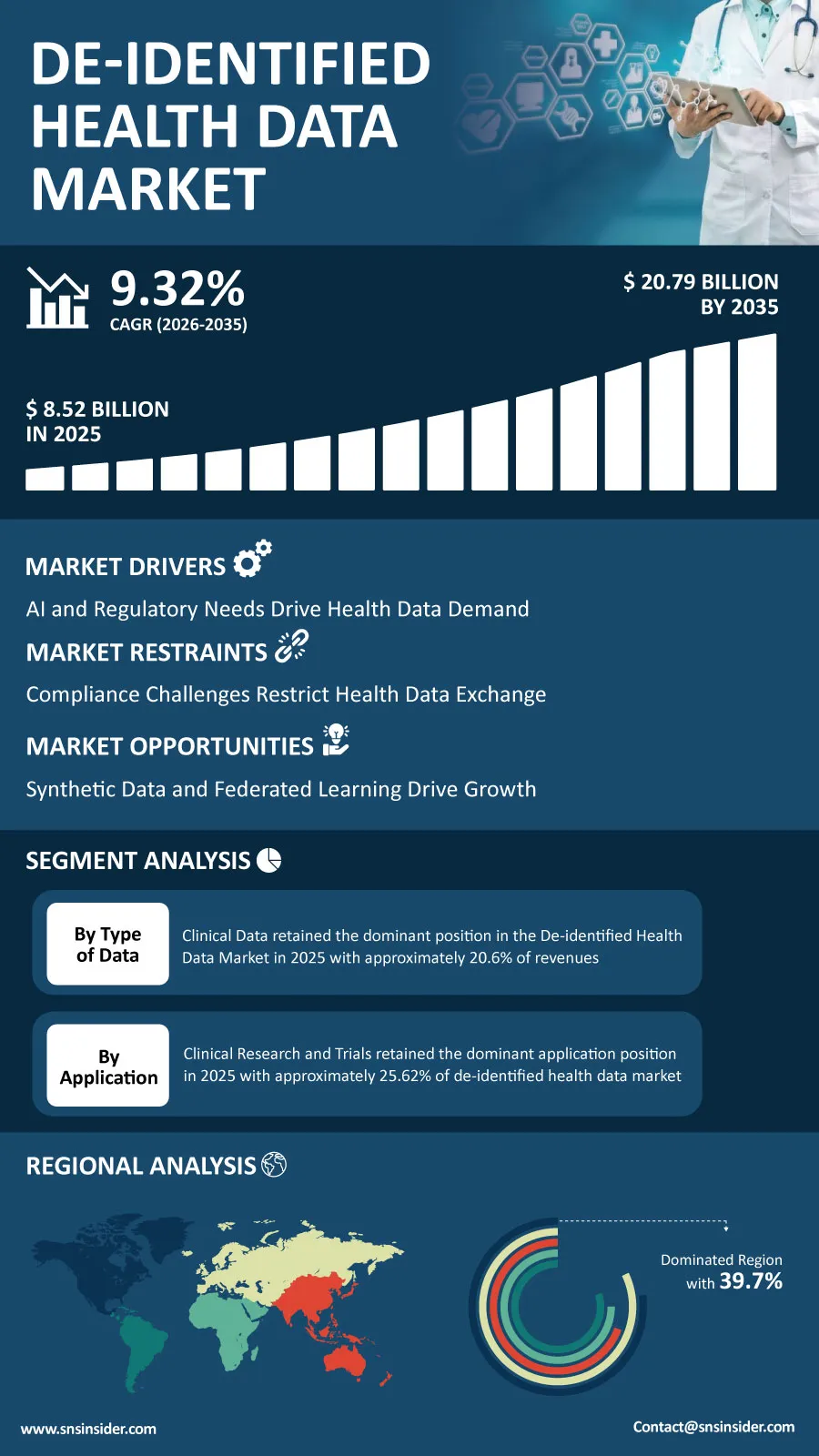
The global De-identified Health Data Market is expected to witness significant expansion as healthcare organizations, life sciences companies, and technology providers increasingly rely on privacy-compliant healthcare data to accelerate innovation while safeguarding patient confidentiality. “According to a recent study by SNS Insider, the global De-identified Health Data Market size valued at USD 8.52 billion in 2025, is anticipated to grow to USD 20.79 billion by 2035, registering a CAGR of 9.32% over the 2026–2035 forecast period.”
However, with the increasing volume of clinical data from healthcare institutions across the globe using digital healthcare platforms, EMR, laboratory databases, and connected healthcare technology, there is an increase in the need for innovation within healthcare that is leading institutions to embrace de-identified data which facilitates medical research, artificial intelligence innovation, healthcare planning, and pharmaceutical innovation.
As healthcare continues its digital transformation, secure data-sharing practices are becoming increasingly important for supporting scientific discovery, improving healthcare delivery, and advancing evidence-based medicine.
To Get Detailed Insights on the De-identified Health Data Market – Request a Sample Report
AI and Real-World Data Continue to Transform Healthcare Research
Artificial intelligence, predictive analytics, and machine learning are being increasingly adopted in healthcare to enhance diagnostics, streamline treatment algorithms, and aid clinical decision making. For this purpose, access to varied and high-quality data sets that preserve patient confidentiality is essential.
De-identified health data is emerging as an important asset for pharmaceutical firms, biotech companies, academia, and innovators in digital health to advance their research and development efforts. Developments in cloud computing and other privacy-preserving technologies have made de-identified health data more accessible for research purposes.
Growing collaboration among healthcare providers, technology companies, and research organizations is expected to create new opportunities for responsible data utilization while strengthening compliance with evolving privacy regulations.
Key Market Findings Highlight Strong Growth Potential
By data category, clinical data accounted for approximately 20.6% of global market revenue in 2025, reflecting its central role in medical research, healthcare analytics, and evidence generation. Meanwhile, behavioral and patient-reported data is projected to record the fastest growth through 2035, driven by increasing adoption of digital health platforms, wearable technologies, and patient engagement solutions.
Across applications, clinical research and trials represented approximately 25.62% of total market revenue in 2025, supported by growing reliance on real-world health information to improve study design and accelerate research activities. However, drug discovery and development is expected to emerge as the fastest-growing application segment, fueled by expanding use of AI-driven drug development and precision medicine initiatives.
Among end users, healthcare providers generated the largest market revenue in 2025, reflecting their role as major producers and users of clinical information. At the same time, pharmaceutical companies are anticipated to register the fastest growth during the forecast period, supported by increasing investments in real-world evidence, biomarker research, and advanced therapeutic development.
Privacy Technologies and Digital Health Infrastructure Drive Market Evolution
Healthcare organizations are focusing on deploying technology solutions that ensure proper handling of data while complying with changing regulations. The use of advanced privacy solutions and secure data exchange solutions, together with advanced analytics, is assisting organizations in extracting the maximum possible benefit from healthcare data while ensuring patient privacy.
The expansion of precision medicine, value-based healthcare, and population health initiatives is also creating new opportunities for organizations capable of delivering reliable, privacy-compliant healthcare datasets that support large-scale research and clinical innovation.
Regional Markets Continue to Expand
The North American market had 39.7% of the world market revenue in 2025 due to its sophisticated digitization of healthcare, high usage of electronic health records, regulatory frameworks, and investments made in healthcare analytics and life sciences research. North America continues to be a world leader in building healthcare data ecosystem that complies with privacy standards.
On the other hand, the Asia-Pacific region will become the world's most rapidly growing market until 2035 due to its rapid healthcare digitization, development of electronic health systems, biotech investments, and government initiatives to modernize healthcare data.
Leading Companies Focus on Data Innovation and Strategic Partnerships
Competition within the de-identified health data market continues to intensify as organizations invest in advanced analytics, secure data platforms, interoperability solutions, and AI-enabled healthcare intelligence. Strategic collaborations between healthcare providers, technology companies, and pharmaceutical organizations are further strengthening innovation across the industry.
Key companies operating in the global de-identified health data market include IQVIA, Oracle Health, Merative, Optum, Veradigm, HealthVerity, Truveta, Komodo Health, Tempus, and Datavant.
An SNS Insider analyst Parry Kardani commented, "The rapid expansion of AI-enabled healthcare, precision medicine, and real-world evidence is fundamentally changing how healthcare organizations use clinical information. Secure, privacy-preserving data ecosystems will become increasingly important as healthcare innovation continues to accelerate worldwide.
About the Author

Get in touch




