
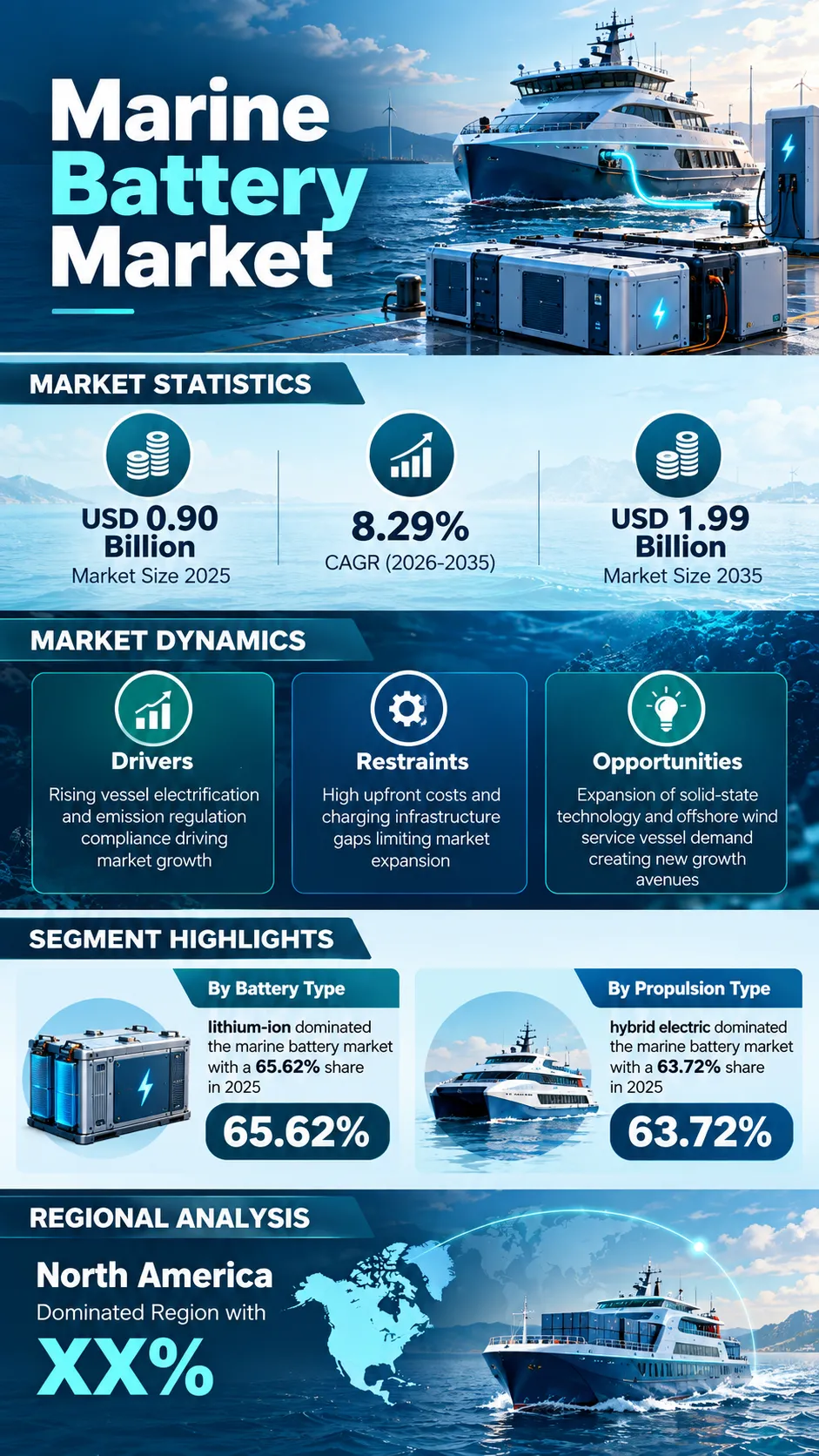
The global Marine Battery Market is set for significant expansion as vessel electrification and emission regulation compliance continue to reshape maritime energy storage worldwide. “According to a recent study by SNS Insider, the global Marine Battery Market size valued at USD 0.90 billion in 2025, is anticipated to grow to USD 1.993 billion by 2035, registering a CAGR of 8.29% over the 2026–2035 forecast period.”
There have been notable changes within marine energy storage technology over time, due to which many manufacturers who aim at improving safety and energy density of their products can take advantage of this trend. This includes the need for more advanced lithium-ion and solid-state battery techniques that will provide ship operators with the ability to achieve reliable, efficient vessel electrification. This applies in situations where marine batteries support propulsion, auxiliary power, and emergency backup applications. Manufacturers are constantly working hard to ensure that their battery systems perform better than before in order to meet various safety and energy density requirements.
To Get Detailed Insights on the Marine Battery Market – Request a Sample Report
Solid-State Technology and Vessel Electrification Create New Demand
The marine battery market has come a long way from traditional lead-acid starter batteries to more advanced lithium-ion batteries and solid-state batteries. With the increased investments in technology such as solid-state batteries, containerized skids packaging, and energy management system software by companies of all sizes in this industry, there is a need for improved marine battery products.
New battery technology and energy management systems will make the vessel safer, increase energy density, and make it possible to move into new commercial, recreational, and even offshore vessel uses. This will give shipowners the opportunity to shift away from the traditional diesel propulsion system to a new marine battery one.
Marine battery manufacturers, shipbuilders, and electric vessel operators are increasingly cooperating thanks to the growing interest in developing future solutions for reliable, high-capacity marine energy storage.
Key Market Findings Highlight High-Growth Segments
The lithium-ion segment dominated all categories in the marine battery market share with 65.62% revenue share in 2025 due to high energy density and long lifespan. The fastest growing category is expected to be solid-state batteries which will grow at a CAGR of 9.14% through 2035, owing to their revolutionary safety, efficiency, and energy density benefits.
By propulsion type, hybrid-electric systems held 63.72% of market share in 2025 due to their ability to bridge existing diesel infrastructure with battery-supported efficiency gains. Fully electric propulsion will see the fastest growth in revenue generation at a CAGR of 10.20%, driven by fully electric designs increasingly leading newbuild construction on fixed ferry routes.
Based on capacity, systems between 1 MWh and 5 MWh captured 54.10% of market share in 2025 thanks to their fit for most ferry crossings and offshore service duty cycles. On the other hand, systems above 5 MWh will be the segment recording the fastest revenue growth at a 10.60% CAGR, supported by growing offshore wind service vessel demand.
Distributive sales channel trends are changing as well. OEM procurement accounted for 62.40% of market revenue owing to sustained new vessel construction integrating battery systems directly. But aftermarket sales will turn out to be the fastest-growing channel through 2035, on the back of growing retrofit demand converting conventional diesel-based power systems.
Safety, Energy Density, and Retrofit Flexibility Gain Importance
In this regard, ship operators have been looking at marine battery products that would deliver more consistent safety performance while requiring greater energy density and retrofit flexibility.
Innovation in solid-state battery technology, containerized skid packaging, and energy-management software has been making it possible for companies to come up with products that appeal to increasingly emission-conscious commercial and recreational vessel operators. In addition to that, increasing emphasis on high-capacity system development is also making it possible for manufacturers to find solutions that serve offshore wind service vessels and specialized large-vessel applications. Such trends are likely to become even more prominent in the future.
Europe Emerges as the Largest Market Amid Rapid Vessel Electrification
The Europe region represented the largest share of regional market revenue in 2025, owing to the rapid electrification of marine vessels including recreational boats, ferries, and offshore support vessels across the region. On the other hand, Asia Pacific is expected to witness the fastest-growing regional market during the forecast period through 2035, propelled by rapid expansion of commercial shipbuilding capacity and growing government initiatives promoting electric and hybrid vessel adoption.
Leading Companies Drive Innovation and Competition
The environment continues to stay very dynamic since players continue innovating on solid-state technology and energy-management software as well as forming partnerships in order to enhance their position in the industry. Some of the major companies that operate in the global marine battery market are Siemens Energy, Leclanché, Corvus Energy, Toshiba, EnerSys, Echandia Marine, EST-Floattech, Lifeline Batteries, PowerTech Systems, and Saft.
An SNS Insider analyst Sushant Kadam commented, "The growing global push to decarbonize shipping operations is creating unprecedented demand for reliable, high-capacity marine battery technology. Manufacturers that successfully combine solid-state innovation, energy-management software integration, and retrofit-friendly design will be best positioned to capitalize on emerging opportunities across commercial, recreational, and offshore vessel segments."
About the Author

Get in touch




