
The global digital X-ray systems market is now experiencing steady commercial growth. Healthcare providers are stressed to take on more patients without adding staff or floor space. “Imaging departments are expected to provide faster results, lower operating costs and uniform image quality across all sites. These pressures are moving digital radiography from an equipment upgrade to a core operational investment.
According to a recent study by SNS Insider, the global Digital X-Ray Systems Market size was valued at USD 4.85 Billion in 2025 and is anticipated to reach USD 7.39 Billion by 2035, registering a CAGR of 4.30% over the forecast period 2026–2035. The market is estimated at USD 5.06 Billion in 2026.
Patient Throughput Is Becoming the Main Business Case for Digital Imaging
Hospital administrators now measure imaging assets by the number of patients they can serve each day. Long wait times affect patient satisfaction, referral volumes, and departmental revenue. Equipment that shortens each exam therefore carries clear financial value.
Digital systems remove film processing steps and allow images to be reviewed within seconds. This helps technologists complete more exams per shift and reduces the need for repeat scans.
Suppliers that can show measurable gains in daily exam capacity are well placed in budget discussions. Purchase decisions are moving away from unit price and toward cost per exam over the system's working life.
To Get Detailed Insights on the Digital X-Ray Systems Market – Request a Sample Report
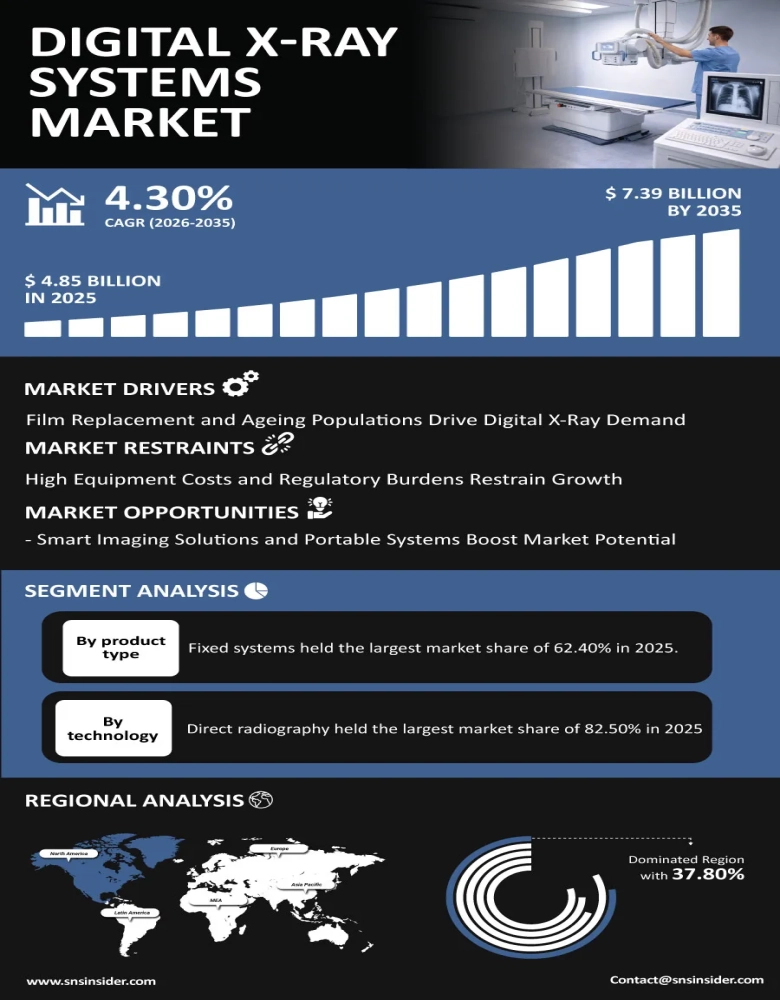
Image Data Is Opening Revenue Streams Beyond Hardware Sales
Every digital exam produces an image file that can be stored, shared, and reviewed again. For large hospital networks, this data supports remote reading, second opinions, and long-term patient records.
As providers link x-ray systems with archiving and reporting platforms, demand is growing for software that manages images across many sites. This gives suppliers a route to stay involved with customers after installation.
Software licenses, image processing upgrades, remote service tools and workflow analytics can all provide a recurring revenue stream. They also build customer loyalty into the next replacement cycle.
Digital X-Ray Systems Market Segmentation Highlights
By Product Type
Fixed systems held the largest market share of 62.40% in 2025, reflecting their central role in high-volume hospital radiology rooms. Portable and mobile systems are expected to register the fastest CAGR of 6.50%. This creates opportunities in bedside imaging, emergency care, and care delivery outside the main radiology department.
By Technology
Direct radiography accounted for a market share of 82.50% in 2025 and is expected to grow at a CAGR of 5.20%. It is faster and the workflow is less complex, making it the preferred solution for providers upgrading from older cassette-based equipment, which is a large upgrade market for suppliers.
By Application
General radiography accounted for the largest market share of 42.80% in 2025. The dental segment is expected to register a CAGR of 6.90%. Growth is supported by commercial opportunities in private dental practices, compact intraoral and panoramic units, and chairside imaging.
By End User
Hospitals accounted for 55.40% of total market revenue in 2025. Ambulatory surgical centers are projected to experience the highest CAGR of 6.80%. Opportunities exist in compact systems, rapid installation, and service plans tailored for smaller facilities.
North America Leads with 37.80% Market Share as Asia Pacific Advances at 6.40% CAGR
North America held the biggest share of the Digital X-Ray Systems Market with 37.80% of revenue in 2025. The U.S. market was valued at USD 1.59 Billion in 2025 and is expected to grow at a CAGR of 4.00%. The region provides steady opportunities for suppliers to hospital networks, imaging center chains and outpatient groups. The basis for purchasing decisions here is the responsiveness of the service, the availability of the systems and the ability to integrate with existing IT systems.
Asia Pacific contributed 25.80% of revenue in 2025 and is projected to record the fastest CAGR of 6.40% over 2026–2035. Expanding hospital capacity and public primary care programs are creating demand for affordable systems, local service networks, and flexible financing.
Europe held 27.40% of the global market in 2025, followed by Latin America at 4.90% and the Middle East & Africa at 4.10%. Opportunities in these regions will depend on public health budgets, equipment replacement schedules, and the pace of the shift away from film.
Leasing and Managed Equipment Services Could Widen Market Access
Many small clinics and regional hospitals can’t afford the upfront cost of new digital systems,” These buyers can upgrade their imaging through leasing plans, pay-per-use agreements and managed equipment services.
Manufacturers can tap this group through partnerships with financing companies, group buying organizations and service providers. This widens the customer base without requiring large capital budgets.
Additionally, these models can drive recurring revenue through maintenance contracts, detector upgrades, staff training, and software subscriptions.
Competitive Outlook: Workflow Efficiency to Become a Key Differentiator
In the future, competition in the digital x-ray systems industry will probably be based on more than image resolution. Customers are demanding more and more systems that reduce the time of exams, the radiation dose and are easily integrated into their existing workflow.
Suppliers that can offer reliable hardware combined with easy software, fast service support and flexible purchasing options, are better positioned in the market. Commercial growth may also be aided by alliances with healthcare IT vendors, distributors, and service firms.
Digital X-Ray Systems Market Outlook to 2035
Digital x-ray systems will be increasingly used in the next decade to plan hospital capacity, expand outpatient services and control costs. Suppliers able to demonstrate clear gains in patient throughput, dose reduction and operating efficiency will be well placed to capture new demand across hospitals, clinics and dental practices.
About the Author

Get in touch




