
The global hospital EMR systems industry is moving into a new stage of commercial growth. Hospital leaders no longer see electronic records only as a compliance requirement. They see them as a core operating platform that affects staff productivity, billing accuracy, and patient throughput. As hospitals face rising labor costs and tighter reimbursement, investment in a well-run record system has a clearer financial payoff.
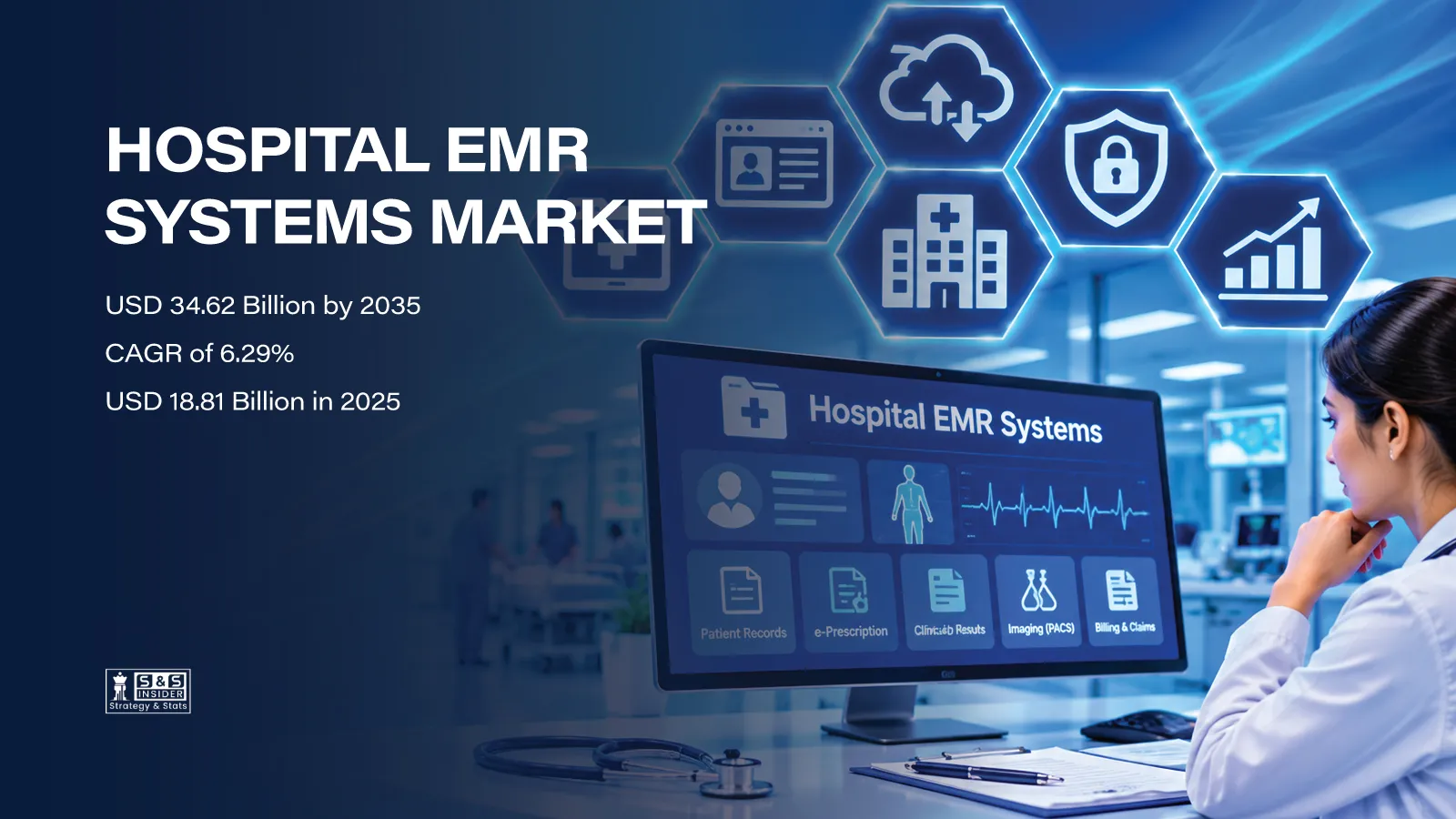
According to a recent study by SNS Insider, the global Hospital EMR Systems Market size was valued at USD 18.81 Billion in 2025 and is anticipated to reach USD 34.62 Billion by 2035, registering a CAGR of 6.29% over the forecast period 2026–2035. The market is estimated at USD 19.99 Billion in 2026.
Clinician Time Is Becoming the Main Measure of System Value
Staff shortages have made clinician time one of the scarcest resources in a hospital. Every extra minute spent on charting reduces the time available for patient care. It also adds to burnout and staff turnover.
Hospital buyers now judge record systems by how much documentation work they remove. Tools that shorten note writing, reduce repeated data entry, and present the right information at the right moment have direct operational value.
Vendors that can show measurable time savings per shift have a stronger case in budget reviews. The sales discussion shifts from license cost to staff capacity and retention.
To Get Detailed Insights on the Hospital EMR Systems Market – Request a Sample Report
Connected Hospital Data Opens Revenue Beyond the Core Record
A hospital record system holds years of clinical, operational, and financial data. When this data links with billing, supply, scheduling, and outside care partners, it becomes a planning asset for the whole organization.
Hospital groups with several sites can use shared data to compare performance, manage capacity, and plan service expansion. This creates demand for analytics, reporting, and data exchange tools built on top of the main record.
Add-on modules, data exchange services, analytics licenses, and managed hosting can produce recurring revenue. They also deepen vendor relationships long after the first installation.
Hospital EMR Systems Market Segmentation Highlights
By Component
Software held the largest market share of 58.54% in 2025, since the record platform is the base layer of every deployment. The services segment is expected to register the fastest CAGR of 7.99%. This points to growing room for implementation support, training, optimization, and managed services.
By Deployment
Cloud deployment accounted for 53.01% of the market in 2025 as hospitals shifted away from maintaining their own data centers. The hybrid deployment is expected to grow at a CAGR of 6.64%. It provides opportunities for hospitals that want the flexibility of the cloud but still want to keep some systems on site.
By Hospital Size
Medium-sized hospitals accounted for the largest share of 43.84% in 2025. Large hospitals are expected to register a CAGR of 7.72%. Growth there comes from enterprise-wide upgrades, system consolidation after mergers, and wider use of advanced clinical tools.
By Application
Cardiology accounted for 27.94% of total market revenue in 2025. Oncology is expected to grow at the fastest CAGR of 8.40%. This creates opportunities for specialty workflows, treatment planning tools, and long-term patient tracking features.
North America Leads with 41.71% Market Share as Asia Pacific Advances at 7.40% CAGR
North America dominated the Hospital EMR Systems Market revenue share with 41.71% in 2025. The US market was valued at USD 7.14 Billion in 2025 and is projected to grow at a CAGR of 6.47%. Most hospitals in the region have some form of record system, so the main opportunities are in replacing older systems, moving them to the cloud and adding AI functions. Integration depth, data security, and vendor support quality all influence buying decisions.
Asia Pacific region is expected to witness the highest CAGR of 7.40% from 2026 to 2035. “Demand is driven by new hospital construction and expansion of public health digitization programs that require scalable, cost-effective systems that provide local language and regulatory support. Revenues in the region are dominated by China.
Europe held a 26.43% share of the global market in 2025, followed by Latin America at 4.93% and the Middle East & Africa at 4.75%. Opportunities in these regions will depend on national e-health policy, public hospital budgets, and the pace at which interoperability rules are put in place.
Subscription and Managed Service Models Could Reach Smaller Hospitals
For smaller hospitals, it's difficult to buy a whole system. High initial costs and lack of in-house IT staff slow their adoption decisions. Subscription pricing, hosted platforms and fully managed services lower that barrier.
Regional IT partners, hospital networks and shared service organizations can help vendors extend their customer reach. These channels allow us to reach facilities that cannot handle large projects on their own.
Models provide steady revenue from support contracts, upgrade fees, training programs and optional modules.
Competitive Outlook: Usability and Interoperability to Become Key Differentiators
The competition for the future in the hospital EMR systems industry is likely to be more than lists of features. Hospitals increasingly want systems that are easy for clinicians to use, that share data seamlessly with outside partners and that remain available during outages and cyber assaults.
Vendors that offer a solid core platform along with practical AI tools, strong security and flexible pricing may be in a better competitive position. Commercial growth can also be aided by partnerships with cloud providers, health information exchanges and specialty software companies.
Hospital EMR Systems Market Outlook Through 2035
Hospital EMR systems will play a bigger role in workforce planning, care coordination and hospital financial management in the next decade. Vendors that are able to demonstrate clear improvements in clinician productivity, data sharing and operating efficiency will be well positioned to capture new demand across hospitals of all sizes.
About the Author

Get in touch




