
The global 3D display industry is moving into a phase of fast commercial growth. Device makers, content producers, and enterprise buyers now see depth-based visuals as a way to stand out in crowded product categories. As screen hardware becomes more alike across brands, the ability to show realistic depth is turning into a real point of value for both consumers and professional users.
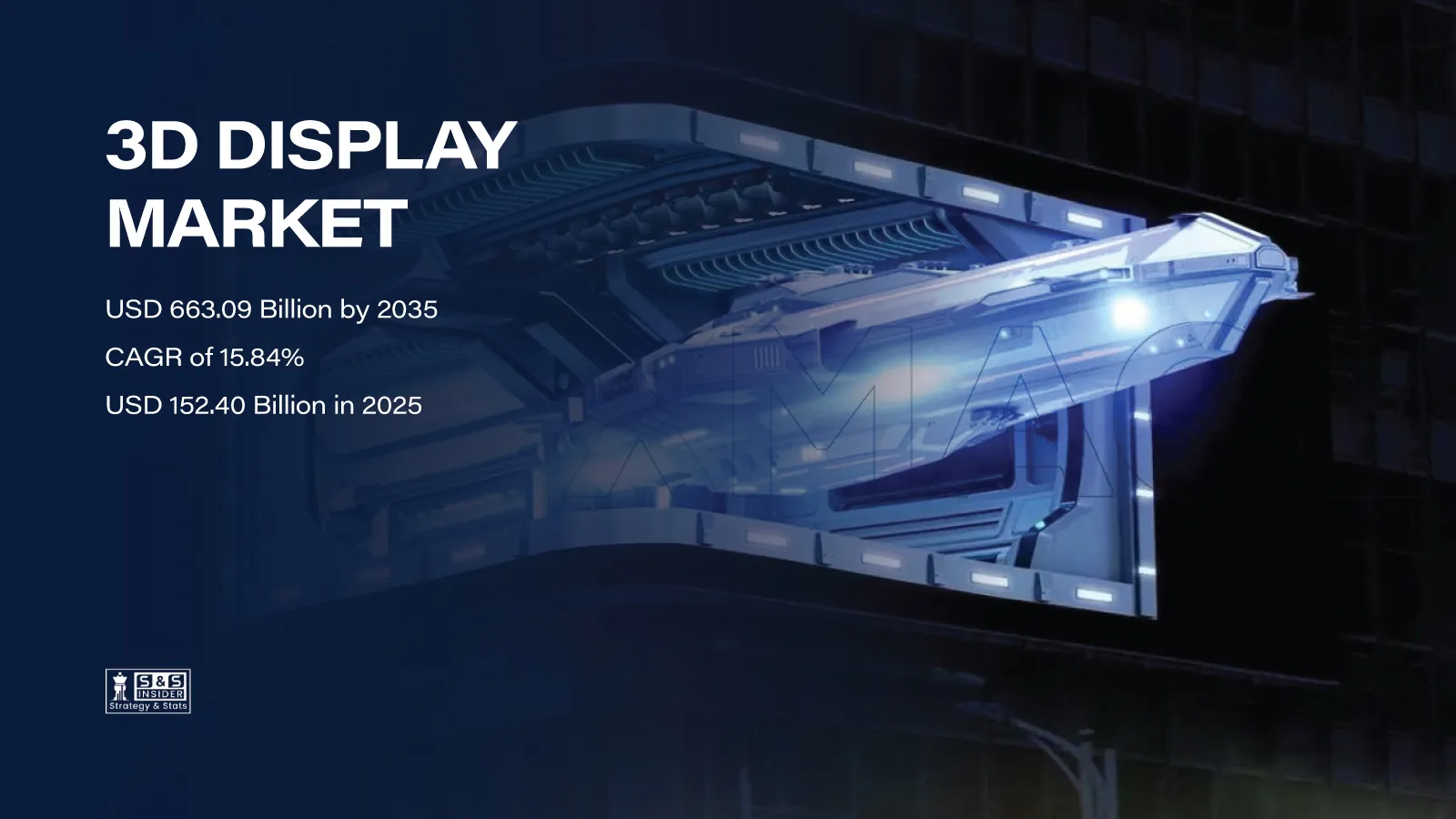
According to a recent study by SNS Insider, the global 3D Display Market size was valued at USD 152.40 Billion in 2025 and is anticipated to reach USD 663.09 Billion by 2035, registering a CAGR of 15.84% over the forecast period 2026–2035. The market is estimated at USD 176.54 Billion in 2026.
Product Differentiation Is Making Depth a Commercial Selling Point
Display brands face strong price competition as standard panels become common products. Adding depth gives manufacturers a way to support premium pricing and protect margins. A clear visual benefit is easier to show a buyer than a small gain in resolution.
3D capabilities can help in revitalizing product lines and upgrading products. This is especially important in areas where upgrade cycles have been slowing down.
Suppliers who can demonstrate the advantages of depth features like enhanced design evaluation and more satisfying gaming will have a stronger story to sell to channel partners and consumers alike.
To Get Detailed Insights on the 3D Display Market – Request a Sample Report
Professional Visualization Opens Revenue Beyond Consumer Screens
Over the long term, the business potential of 3D displays reaches well beyond home entertainment. Surgeons, engineers, product designers, and trainers all work with complex shapes that are hard to read on flat screens.
Hospitals, design studios, and training centers may pay more for systems that cut review time and reduce errors. This creates room for suppliers to sell full visualization setups rather than single screens.
Software tools, content conversion services, workflow integration, and support contracts can add steady income and keep customers engaged after the hardware sale.
3D Display Market Segmentation Highlights
By Technology
In 2025, stereoscopic technology had the largest market share of 59.80% due to its well-established use and lower production cost. The holographic and light field technology is expected to grow at a CAGR of 20.48%, providing opportunities for suppliers that can provide glasses-free viewing for retail, medical and design applications.
By Display Type
Televisions accounted for 52.40% of the market in 2025, supported by their wide reach in households. Head-mounted displays are anticipated to grow at the highest CAGR of 21.36%, opening opportunities in gaming, workforce training, and remote collaboration.
By Panel Technology
In 2025, LED panels held the largest market share of 52.60%. The OLED panels are expected to register a CAGR of 22.40% and are driven by the demand for thinner designs, higher contrast and better image quality in premium and wearable devices.
Asia Pacific accounted for the largest share of 3D Display Market in 2025, holding 43.80% of the global revenue share. Asia Pacific is expected to register the fastest CAGR of 17.12% during the forecast period, 2026–2035. Strong demand for consumer electronics and a base of panel production in the region provide opportunities for component suppliers, contract manufacturers and brands that sell at competitive prices.
North America held 25.60% revenue share in 2025. The U.S. market was USD 28.87 Billion in 2025 and is expected to reach USD 85.37 Billion by 2030, at a CAGR of 15.02%. “The region has a lot of potential in medical imaging, defense, gaming and enterprise design where buyers look for image accuracy, reliability and technical support.
Europe held a 19.20% share of the global market in 2025, followed by Latin America at 5.80% and the Middle East & Africa at 5.60%. Opportunities in these regions will depend on consumer spending, industrial design activity, and investment in healthcare technology.
Display-as-a-Service Could Unlock New Commercial Opportunities
Advanced holographic and light field systems carry a high upfront cost. Many retailers, event organizers, and training providers need them only for set periods or specific projects. Leasing, rental, and pay-per-use models give these buyers a lower-risk way in.
Manufacturers can widen their customer base by working with event firms, digital signage operators, and visualization service providers.
These models can also bring recurring income through content updates, maintenance plans, software access, and operator training.
Competitive Outlook: Content Readiness to Become a Key Differentiator
The future of competition in the 3D display industry is about more than just panel quality. Buyers want systems that come with ready content, easy setup and comfortable viewing over long sessions.
Suppliers that combine strong hardware with content tools, developer support, and flexible pricing may gain a stronger position. Alliances with game studios, medical software firms, and automotive suppliers can also support growth.
3D Display Market Outlook Through 2035
3D displays will become more important in entertainment, medical visualization, product design and in-vehicle systems over the next decade. Suppliers able to offer comfortable viewing, consistent content supply and clear value to professional users will be best positioned to capture the growing demand.
About the Author

Get in touch




