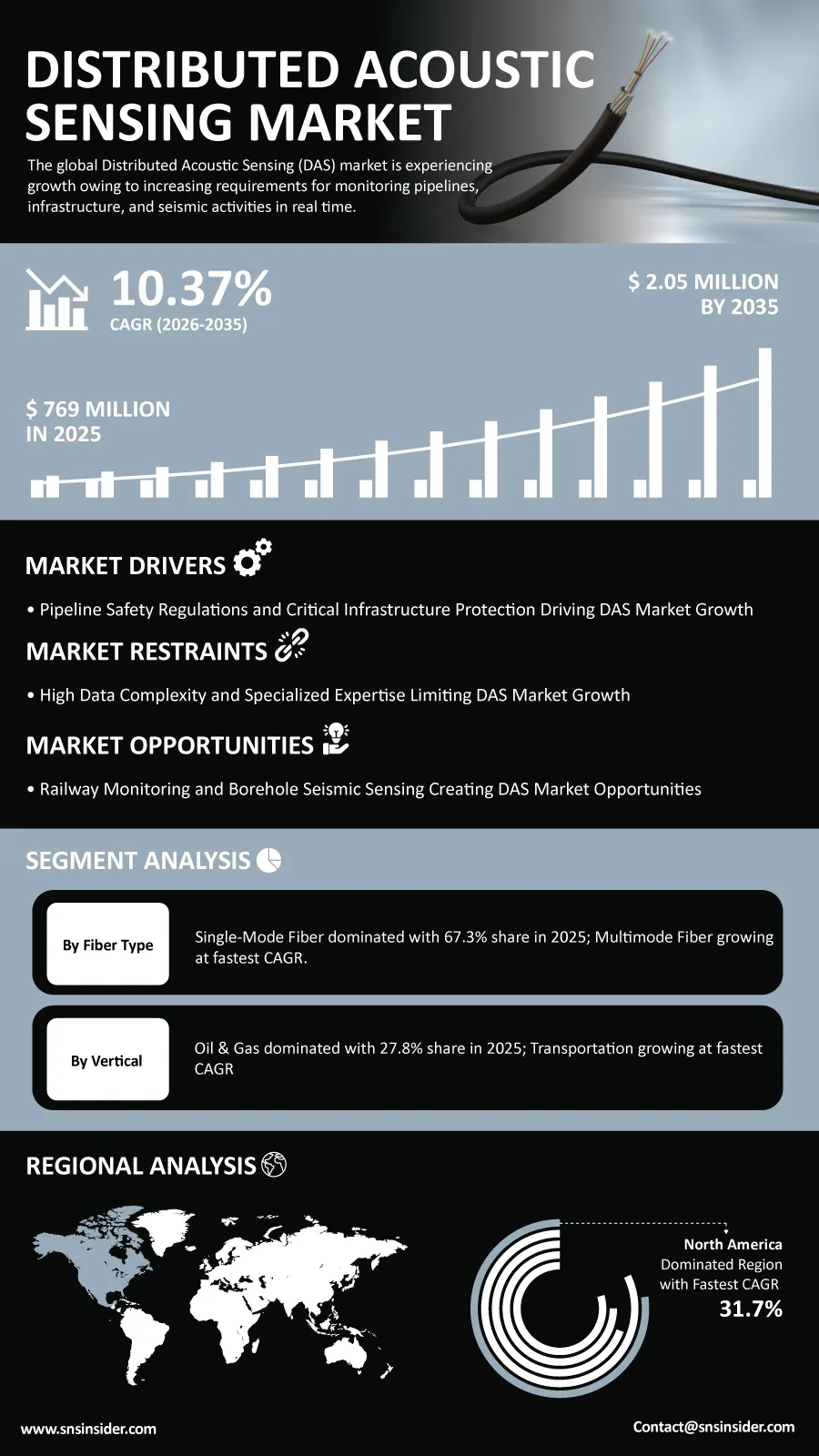
The global Distributed Acoustic Sensing (DAS) Market is entering a period of sustained growth as industries seek continuous, high-resolution monitoring for pipelines, railways, energy infrastructure, and other critical assets. According to a recent study by SNS Insider, the global Distributed Acoustic Sensing (DAS) Market size valued at USD 769 million in 2025, is anticipated to grow to USD 2.05 billion by 2035, registering a CAGR of 10.37% over the 2026–2035 forecast period.
The growing requirement to identify any threats to the infrastructure before they become serious has prompted the use of fiber optic sensing systems that have the capability to monitor large regions through a single sensing cable. The energy sector, transporters, and owners of infrastructures are increasingly relying on DAS for round-the-clock surveillance and operation intelligence.
Improvements in optical sensors, artificial intelligence, and cloud computing are enhancing the capability of DAS systems to separate significant events from general activities. As a result, applications of DAS are being expanded from conventional pipeline surveillance to transportation security, seismic activity monitoring, industrial security, and sub-surface exploration.
To Get Detailed Insights on the Distributed Acoustic Sensing (DAS) Market – Request a Sample Report
Critical Infrastructure Monitoring Creates New Growth Opportunities
An increased focus from regulators on pipeline integrity and infrastructural safety is leading to an increasing need for monitoring systems capable of operating consistently despite their geographic distribution. DAS systems are able to detect acoustic signatures linked with excavations, infrastructural disturbances, security breaches, and other potentially harmful incidents that require rapid action.
Furthermore, DAS is making progress in the field of transport infrastructure. Rail companies are assessing the potential of fiber optic acoustic monitoring to detect abnormalities in the tracks, intrusion attempts, and mechanical incidents. An opportunity has arisen to monitor extensive infrastructure using existing fiber optic networks.
At the same time, DAS in boreholes is emerging in the fields of oil and gas exploration and geophysics, as well as being used for downhole seismic and reservoir characterization, among others.
Key Market Insights Highlight Shifting Demand Patterns
By fiber type, single-mode fiber is expected to account for approximately 67.3% of global market revenue in 2025. Its long-distance transmission capabilities and strong sensitivity make it well suited for extensive pipeline and infrastructure monitoring projects. Meanwhile, multimode fiber is projected to register the fastest growth as adoption expands across shorter-distance industrial, campus, and facility-level applications where installation simplicity and cost efficiency are important considerations.
Based on vertical, oil and gas is anticipated to contribute 27.8% of market revenue in 2025, supported by extensive pipeline networks and increasing requirements for continuous asset surveillance. Transportation is projected to experience the fastest growth through 2035 as railway operators and infrastructure authorities increase investments in automated track monitoring and safety systems.
AI-Enabled Analytics Strengthen DAS Operational Intelligence
The increase in acoustic data created by distributed sensor networks has resulted in a rising demand for sophisticated analytics platforms that can handle and interpret such data in real-time. Machine learning technologies are now becoming more popular for use in acoustic event classification and elimination of false alerts in order to focus on the critical events.
DAS technology combined with distributed temperature sensing enables operators to monitor their infrastructure in a much more efficient way, as the information about acoustic and thermal events will be available and will provide them with an understanding of the pipeline condition and the flow behavior.
Infrastructure monitoring using cloud-based platforms makes it possible for operators to monitor all geographically dispersed assets at once and from one dashboard.
North America Accounts for 31.7% Market Share in 2025 Amid Rising Distributed Acoustic Sensing Adoption
The North American region is anticipated to be the dominant regional market, holding 31.7% share of the total worldwide market in 2025. This region is well equipped with energy infrastructure and pipeline infrastructure, and also has technology vendors as well as investment in infrastructure security. The U.S. will continue its presence in the market as energy firms and the government continue monitoring.
Asia Pacific region is anticipated to be the fastest growing regional market on account of growth in pipeline infrastructure, rail infrastructure, intelligent transportation systems, and industrialization. There are good investments being made in China, India, Japan, and other countries of the region for the infrastructure monitoring systems.
The growing deployment of high-speed rail networks and expanding energy infrastructure are expected to create additional opportunities for DAS providers across the region.
Industry Participants Focus on Sensing and Analytics Innovation
The competitive landscape remains active as technology providers focus on improving sensing range, spatial resolution, event classification, and integration with enterprise monitoring platforms. Companies are developing more capable interrogators and analytics solutions while pursuing partnerships with energy operators, transportation authorities, and infrastructure owners to expand commercial deployments.
Key companies operating in the global Distributed Acoustic Sensing (DAS) Market include Halliburton Company (Sensor Solutions), Schlumberger Limited (SLB), Baker Hughes Company, Silixa Ltd., OptaSense Ltd. (QinetiQ Group), Fotech Solutions Ltd. (BP Ventures), Future Fibre Technologies Ltd., Omnisens SA, AP Sensing GmbH, Bandweaver Technologies Ltd., Ziebel AS, NKT Photonics A/S, Luna Innovations Inc., OFS Fitel LLC (Furukawa Electric), Sensuron LLC, Weatherford International plc, Hifi Engineering Inc., Brugg Cables AG, Viper Innovations Ltd., and Arrowtec Technologies Ltd.
An SNS Insider analyst Sushant Kadam commented, “The growing requirement for continuous infrastructure visibility is creating strong opportunities for Distributed Acoustic Sensing technology across energy, transportation, and security applications. As AI-powered analytics, fiber-optic innovation, and cloud-based monitoring mature, DAS providers that can deliver scalable and accurate event detection will be well positioned to benefit from the global shift toward predictive infrastructure management.”
About the Author

Get in touch