
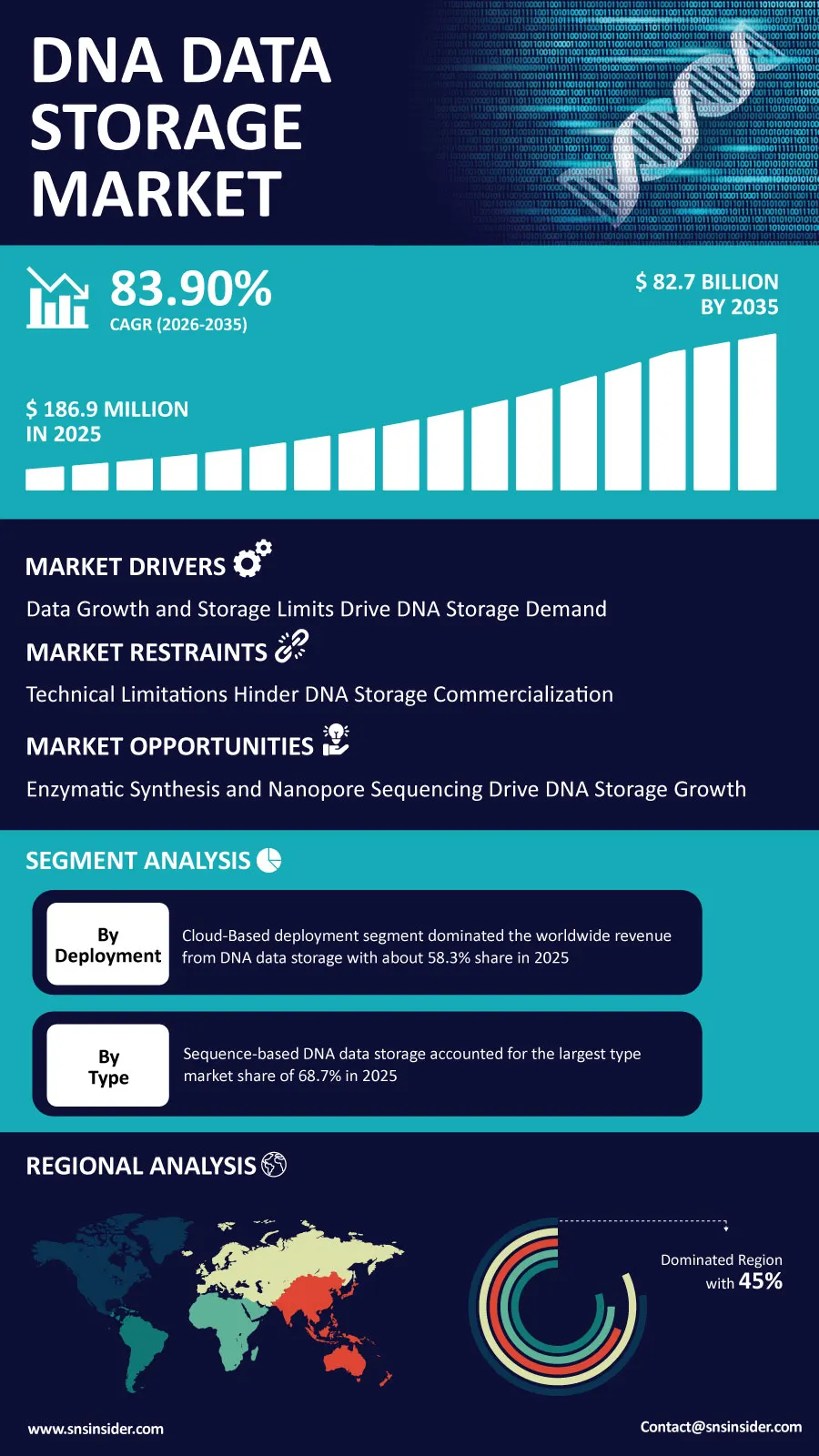
The global DNA Data Storage Market is entering a transformative phase as organizations confront the escalating volume of digital information and the long-term limitations of conventional storage infrastructure. According to a recent study by SNS Insider, the global DNA Data Storage Market size valued at USD 186.9 million in 2025, is anticipated to grow to USD 82.7 billion by 2035, registering a CAGR of 83.90% over the 2026–2035 forecast period.
There has been an increase in the growth rate of artificial intelligence, genomic research, cloud computing, IoT networks, and high-resolution digital material that has created a huge need for archival storage. DNA is the latest option available that can store information for an extraordinarily long period of time and also uses very little energy.
Major investments in synthetic biology, DNA synthesis, sequencing, and molecular computing have led to the fast development of DNA data storage technology from being experimental research to its potential commercialization. Companies and organizations including IT companies, biotech companies, universities, and governments are increasingly cooperating to enhance writing speed, reading efficiency, data accuracy, and economics.
To Get Detailed Insights on the DNA Data Storage Market – Request a Sample Report
Advances in Molecular Computing Create New Growth Opportunities
Continuous development and innovation in the DNA synthesis and sequencing process is contributing to the growth of the DNA Data Storage Market. With the cost of DNA synthesis on the decrease, efforts are being made to create new ways of encoding information within molecules and retrieving it as and when needed.
Development of enzymatic DNA synthesis is one such innovative development that is likely to increase throughput while decreasing costs involved in traditional chemical synthesis of DNA. In addition to this, the use of nanopore sequencing and targeted molecular information retrieval can provide an opportunity to retrieve selective information without analyzing the whole DNA sequence.
The integration of artificial intelligence into encoding, decoding, and error-correction processes is also expected to improve data integrity and accelerate retrieval. These advances could expand the commercial use of DNA storage beyond specialized research environments and toward large-scale archival applications.
Key Market Insights Highlight Shifting Demand Patterns
By type, sequence-based DNA data storage is expected to account for approximately 68.7% of global market revenue in 2025, supported by extensive research validation and successful demonstrations involving large-scale information encoding and retrieval. Structure-based DNA data storage is projected to record the fastest growth through 2035 as researchers explore molecular architecture and three-dimensional configurations to increase density and improve retrieval performance.
Based on deployment, cloud-based DNA data storage is anticipated to contribute 58.3% of market revenue in 2025. Cloud delivery allows organizations to access emerging molecular storage capabilities without establishing specialized laboratory infrastructure. On-premises deployment is expected to experience the fastest growth as government agencies, defense organizations, and other security-sensitive institutions seek greater control over data sovereignty and confidential archival information.
By end user, biotechnology and healthcare are projected to lead the market with a 38.6% revenue share in 2025. The continued generation of genomic, clinical, and biomedical datasets is creating significant demand for long-duration data preservation. Government and defense are expected to be the fastest-growing end-user segment as agencies evaluate molecular storage for sensitive records, intelligence archives, and information requiring preservation over extended time horizons.
Archival Storage Requirements Strengthen Industry Demand
The increasing global data imprint is now turning out to be a significant driving factor behind DNA storage research. The conventional data storage devices undergo regular replacement, expend energy in data center infrastructure, and are subject to degradation. DNA storage could prove to be an ideal solution due to extremely high information capacity and stability at the molecular level.
Nonetheless, it is important to emphasize that this type of technology is currently limited only to archival purposes but not active data processing. Expensive synthesis, slow process of writing, and reading are still some of the limitations preventing the widespread application of this technology.
North America Holds 45% Market Share in 2025 as Asia Pacific Emerges as the Fastest-Growing Region
The North American region is set to dominate the regional markets and will generate roughly 45% of the total global revenue in 2025. The region will be benefitted by having strong biotechnology capabilities, research and development programs of tech companies, prestigious universities, and government funding for advanced research in molecular storage.
The Asia-Pacific region will be among the fast-growing regions during the forecast period due to growing biotech industries, genomics projects by government authorities, and investments in advanced data infrastructure. The economies, such as China, Japan, India, and other countries in the region are improving capabilities in synthetic biology and molecular technology that provides an environment for future commercialization.
Similarly, the Europe region is becoming a major center of innovations due to research funding, data sovereignty, and genomics infrastructure. Lastly, the Middle East, Africa, and Latin America regions are becoming emerging regions because of investments in sovereign data infrastructure and biotech research.
Industry Participants Focus on Commercialization and Technology Innovation
The competitive landscape remains highly research-driven, with companies and institutions concentrating on reducing synthesis costs, improving molecular encoding, and increasing retrieval speeds. Strategic collaboration between technology providers and biotechnology companies is expected to remain central to the development of commercially scalable DNA storage platforms.
Key companies operating in the global DNA Data Storage Market include Microsoft Corporation, Twist Bioscience Corporation, IBM Research, Illumina, Inc., Oxford Nanopore Technologies Ltd., Pacific Biosciences (PacBio), Catalog Technologies, Inc., DNA Script, Ansa Biotechnologies, Helixworks Technologies Ltd., Molecular Assemblies Inc., Western Digital Corporation, Seagate Technology Holdings PLC, Biomemory SAS, Thermo Fisher Scientific Inc., Agilent Technologies, Inc., Evonetix Ltd., Iridia Inc., Micron Technology, Inc., and BGI Group.
An SNS Insider analyst Sushant Kadam commented, “The extraordinary growth in global data creation is intensifying the search for storage technologies capable of supporting long-term archival requirements. As DNA synthesis, sequencing, automation, and AI-enabled retrieval systems mature, molecular storage could become an increasingly important component of future data infrastructure, particularly for organizations managing information that must be preserved for decades or longer.”
About the Author

Get in touch




