Electric Wheelchair Market is entering a period of sustained expansion as healthcare systems, rehabilitation providers, and homecare users seek mobility solutions that provide greater independence and easier operation. Product development is increasingly centered on maneuverability, portability, battery performance, connected controls, and technologies designed around individual mobility requirements.
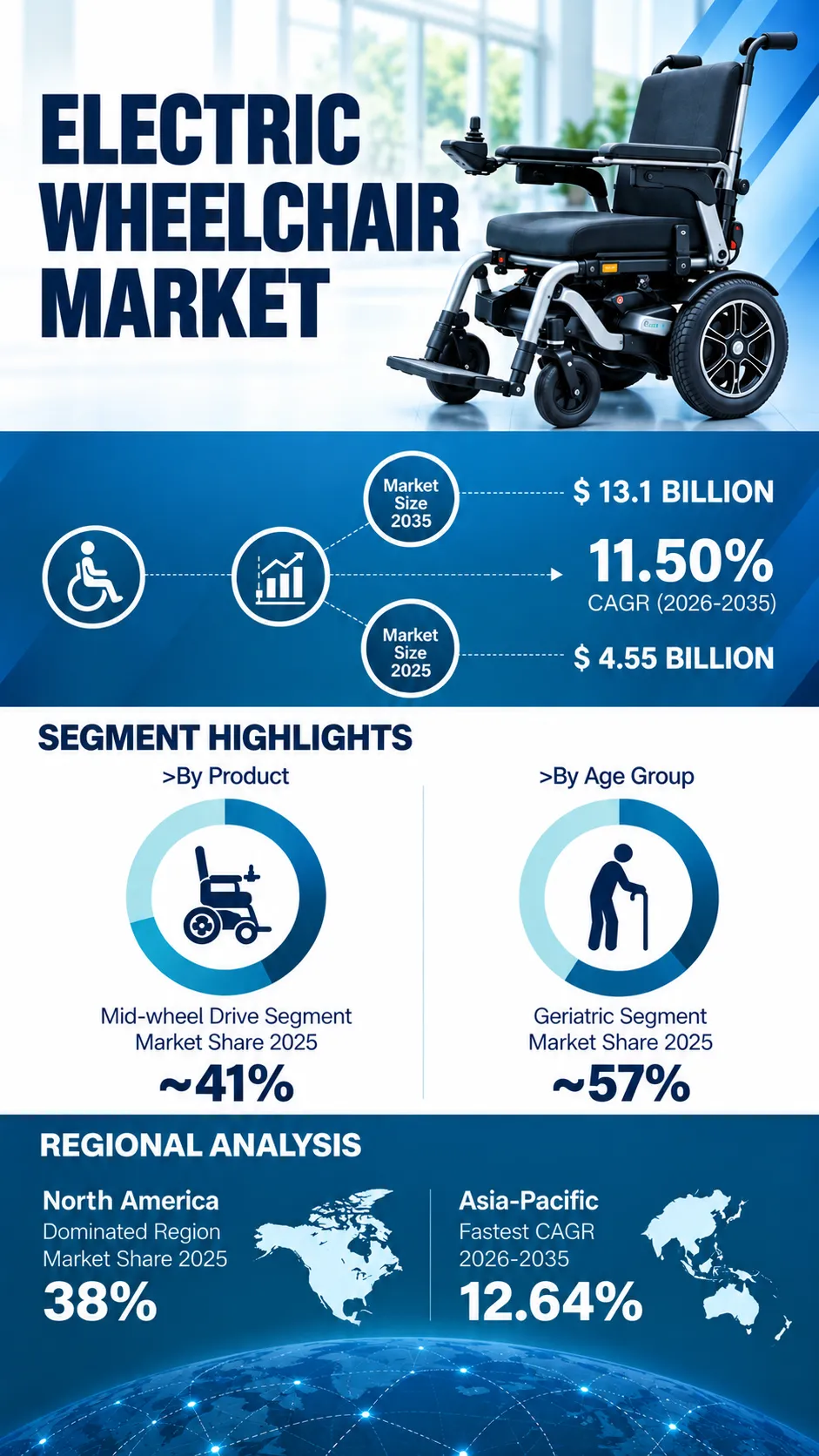
“According to a recent study by SNS Insider, the global Electric Wheelchair Market size valued at USD 4.55 billion in 2025, is anticipated to grow to USD 13.1 billion by 2035, registering a CAGR of 11.50% over the 2026–2035 forecast period.”
The market is being shaped by demographic change as well as improvements in assistive technology. A growing older population, increasing demand for rehabilitation services, and greater awareness of mobility equipment are expanding the addressable user base. The World Health Organization estimates that roughly 80 million people globally require wheelchairs, highlighting the scale of unmet mobility needs.
To Get Detailed Insights on the Electric Wheelchair Market – Request a Sample Report
Smart Mobility Features Reshape Product Development
Manufacturers are increasingly incorporating electronic controls, advanced drive configurations, improved batteries, and connected technologies into electric wheelchairs. These developments are intended to support easier navigation across homes, healthcare facilities, rehabilitation environments, and outdoor locations.
The shift toward smarter mobility equipment is also creating opportunities for integration with broader healthcare technology. GPS, remote monitoring, digital controls, and automated assistance can provide additional functionality for users and caregivers, although adoption will depend on affordability, clinical requirements, usability, and reimbursement availability.
Mid-Wheel Drive Leads as Portable Models Gain Momentum
The mid-wheel drive segment accounted for approximately 41% of the Electric Wheelchair Market in 2025. Its compact turning characteristics and suitability for indoor environments continue to support demand from residential and institutional users.
Rear-wheel drive is projected to be the fastest-growing product segment as manufacturers improve outdoor handling, stability, motor efficiency, and battery performance.
By age group, the geriatric segment held approximately 57% of market revenue in 2025. Population aging and the prevalence of mobility-related conditions are supporting demand among older users. The pediatric segment is expected to expand at the fastest rate as customized designs and lightweight equipment become more available.
Portability is another important product consideration. Standalone models represented approximately 69% of revenue in 2025, while portable wheelchairs are expected to register faster growth as consumers increasingly seek equipment that can be transported more easily.
Homecare Remains Central to Electric Wheelchair Demand
The homecare segment represented approximately 52% of market revenue in 2025. Growth in home-based care and the preference among many older adults to remain in familiar surroundings are supporting demand for personal mobility equipment.
Rehabilitation centers represent a faster-growing end-use category as healthcare providers expand post-surgical recovery, neurological rehabilitation, and mobility-support programs. Electric wheelchairs can form part of broader rehabilitation strategies where users require powered assistance during recovery or long-term mobility management.
North America Holds the Largest Regional Position
North America accounted for around 38% of the global Electric Wheelchair Market in 2025, supported by established healthcare infrastructure, reimbursement mechanisms, and strong availability of advanced mobility products. The United States represented approximately 89% of North American regional revenue.
The U.S. Electric Wheelchair Market was valued at USD 1.48 billion in 2025 and is projected to reach USD 4.26 billion by 2035, registering a CAGR of 11.1% during 2026–2035.
The Asia Pacific market is expected to record the fastest regional growth, with a projected 12.64% CAGR. Japan accounted for approximately 35% of regional revenue. Europe continues to benefit from an aging population and established rehabilitation infrastructure, with Germany representing 27% of regional revenue. Brazil accounted for 50% of Latin American revenue, while Saudi Arabia represented 40% of Middle East & Africa revenue.
Affordability and Reimbursement Remain Key Market Factors
Despite technological progress, the cost of advanced electric wheelchairs can restrict access in price-sensitive markets. Insurance eligibility, reimbursement limits, maintenance expenses, and battery replacement costs can also influence purchasing decisions.
At the same time, connected mobility solutions represent an important development opportunity. Integration of sensors, navigation technologies, remote monitoring, and intelligent controls could expand the functionality of powered mobility products while supporting caregivers and rehabilitation professionals.
Recent Product Developments Add Competitive Momentum
Product innovation continues to influence the competitive landscape. Permobil has continued developing powered-assistance and intelligent mobility solutions, while WHILL has expanded its personal mobility portfolio. However, developments in this category also underscore the importance of safety and regulatory oversight. For example, the U.S. FDA reported a 2025 recall involving the SmartDrive SpeedControl Dial because of safety and performance concerns.
Key companies operating in the global Electric Wheelchair Market include Invacare Corporation, Pride Mobility Products Corp., Permobil, Sunrise Medical, Ottobock, Drive Medical, Hoveround Corporation, Golden Technologies, Karman Healthcare, Meyra Group, WHILL, Merits Health Products, Shoprider Mobility Products, Heartway Medical Products, KD Smart Chair, EZ Lite Cruiser, DEKA Research & Development Corp., Mobius Mobility, Ekso Bionics, and Quantum Rehab.
An SNS Insider analyst Parry Kardani commented, “Electric wheelchair development is increasingly focused on combining mobility, portability, intelligent controls, and user-specific functionality. As healthcare delivery expands across homecare and rehabilitation settings, manufacturers are placing greater emphasis on practical design and technology integration.
About the Author

Get in touch