
Electric Wheelchair Market Report Scope & Overview:
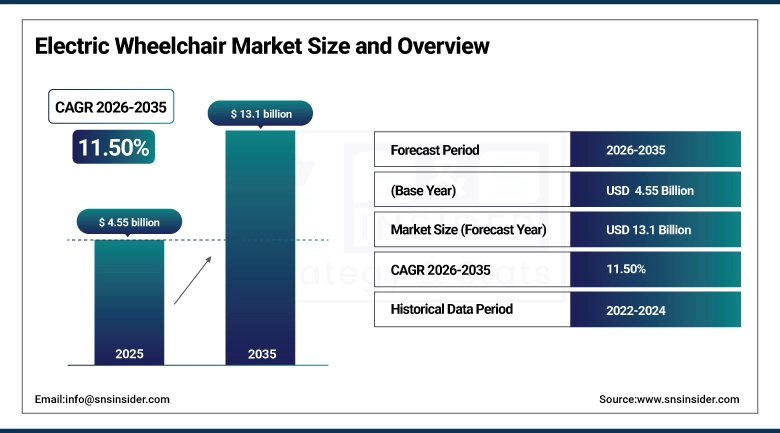
The Electric Wheelchair Market was valued at USD 4.55 billion in 2025 and is expected to reach USD 13.1 billion by 2035, growing at a CAGR of 11.50% from 2026-2035.
The Electric Wheelchairs Market is experiencing growth on account of the rise in the global geriatric population and an increase in the number of people with mobility disorders and other health issues. The increasing demand for home care and rehabilitation services has resulted in the uptake of modern mobility equipment. Factors such as technological developments in lightweight technology, battery life improvement, and navigation systems are contributing towards improving user experience.
The World Health Organization's 2023 World Report on Disability documents that approximately 80 million people globally require a wheelchair, yet less than 10% of those who need one have access to an appropriate device representing an enormous unmet need that growing manufacturing scale and healthcare coverage expansion are beginning to address.
The U.S. Census Bureau's American Community Survey documents that 38.3 million Americans have a disability that limits mobility, creating a domestic market foundation that sustains the U.S.'s position as the world's largest per-capita electric wheelchair consumer.
To Get more information on Electric Wheelchair Market - Request Free Sample Report
Electric Wheelchair Market Trends
-
Rising aging population and increasing prevalence of mobility impairments are driving the electric wheelchair market.
-
Growing adoption across hospitals, rehabilitation centers, and homecare settings is boosting market growth.
-
Expansion of healthcare infrastructure and assistive mobility programs is fueling product demand.
-
Increasing focus on user comfort, portability, and independent mobility is shaping adoption trends.
-
Advancements in lightweight materials, smart controls, AI-assisted navigation, and battery technologies are enhancing performance and usability.
-
Rising government support, reimbursement policies, and accessibility initiatives are supporting market expansion.
-
Collaborations between medical device manufacturers, healthcare providers, and technology companies are accelerating innovation and global adoption.
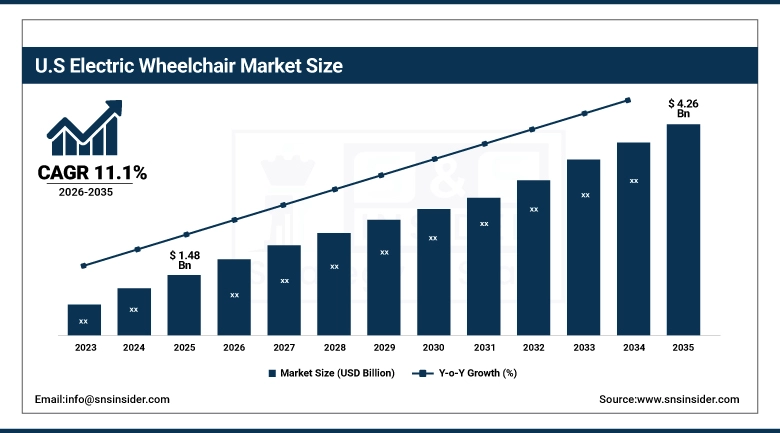
U.S. Electric Wheelchair Market was valued at USD 1.48 billion in 2025 and is expected to reach USD 4.26 billion by 2035, growing at a CAGR of 11.1% from 2026-2035.
The US electric wheelchair market is experiencing significant growth owing to an increase in elderly people, disabilities, and high demands for innovative mobility aids. The development of health facilities, favorable reimbursement policies, and fast acceptance of advanced electric wheelchairs are propelling the market's growth.
The Centers for Medicare & Medicaid Services documents that Medicare paid approximately USD 1.1 billion in power mobility device claims in 2023, with complex power chairs representing the highest average claim value at USD 6,200-8,000 per device.
The Assistive Technology Industry Association's market research documents that 73% of U.S. electric wheelchair purchases involve some form of insurance coverage - making reimbursement policy the single largest determinant of market access and market size in the U.S.
Electric Wheelchair Market Segment Analysis
-
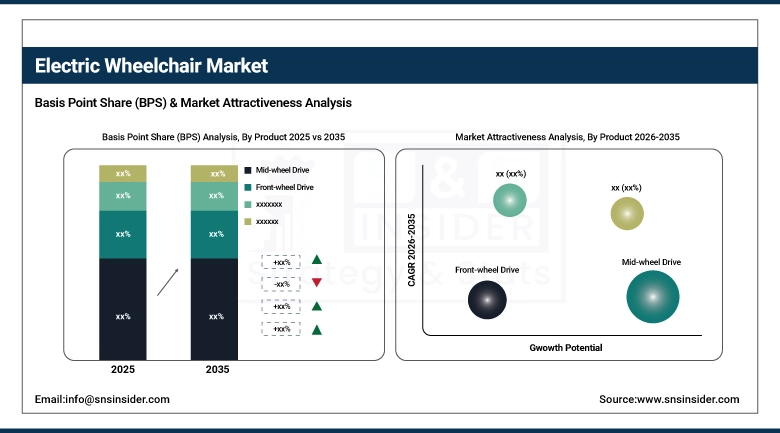
By Product, Mid-wheel Drive segment dominated the Electric Wheelchair Market in 2025 with ~41% share; Rear-wheel Drive segment fastest growing (CAGR).
-
By Age Group, Geriatric segment dominated the Electric Wheelchair Market in 2025 with ~57% share; Pediatric segment fastest growing (CAGR).
-
By Portability, Standalone segment dominated the Electric Wheelchair Market in 2025 with ~69% share; Portable segment fastest growing (CAGR).
-
By End Use, Homecare segment dominated the Electric Wheelchair Market in 2025 with ~52% share; Rehabilitation Centers segment fastest growing (CAGR).
By Product, Mid-wheel Drive segment dominates the Electric Wheelchair Market, Rear-wheel Drive segment expected to grow fastest
Mid-Wheel Drive segment held the major share in the Electric Wheelchair Market in 2025 due to the improved mobility of such wheelchairs, along with a compact turning radius and stability. Mid-wheel drive electric wheelchairs are more convenient to operate in indoor settings, including residential spaces, hospitals, nursing homes, and other facilities that require mobility support equipment. The advanced features and increased comfort in operation are some factors that are contributing to the rising adoption of mid-wheel drive wheelchairs among older people and people with disabilities.
Rear-wheel drive is the fastest-growing segment because there is a rising need for wheelchairs with improved mobility in an outdoor setting. There is a higher demand for electric wheelchairs with high speed and stability to ensure safe movement even in challenging terrains outdoors. The rising developments in motor efficiency, battery capacity, and ergonomic designs are adding to the rapid growth of this segment within the market.
By Age Group, Geriatric segment dominates the Electric Wheelchair Market, Pediatric segment expected to grow fastest
Geriatric Segment Led the Global Electric Wheelchair Market in 2025, attributable to the increase in the global geriatric population coupled with the higher incidence of age-related health issues associated with mobility problems like arthritis, osteoporosis, and muscle degeneration. The geriatric population forms the major user group for electric wheelchairs owing to the increasing demand for mobility, quality of life, and home care. An increasing health care expenditure coupled with favorable reimbursement policies has added value to this market segment.
The Pediatric Segment Is Expected to grow at the Fastest Growth Rate during the forecast period, owing to the increasing incidence of congenital disabilities, neurological disorders, and early mobility problems among the pediatric population. Increased awareness about pediatric care among parents along with the availability of lightweight and customized electric wheelchairs has contributed to the growth of this segment.
By Portability, Standalone segment dominates the Electric Wheelchair Market, Portable segment expected to grow fastest
Standalone is the dominant segment within the Electric Wheelchair market in 2025 owing to its superior design, increased durability, and ability to be used on a regular basis for years at a time. These wheelchairs provide more power than others, are comfortable, and offer more advanced control functions. They have proved useful for those who cannot move permanently because of their reliable nature and high performance.
The Portable segment is the fastest growing, owing to the rising demand for portable, folding, and travel-friendly electric wheelchairs. Rising mobility requirements of the user, increased preference for compact products, and developments in battery technology are some factors that contribute to increased use of such products. The reason behind their fast growth can be attributed to increased use while traveling and easy transportation capabilities.
By End Use, Homecare segment dominates the Electric Wheelchair Market, Rehabilitation Centers segment expected to grow fastest
Homecare was the leading market segment in the Electric Wheelchair Market in 2025 because of the prevailing trend of in-patient care at home and preference for aging at home by elderly patients. Electric wheelchairs allow elderly individuals to perform their daily activities independently and move around easily. The growth of home healthcare services, availability of reimbursement policies, and increasing incidence rates of chronic diseases have contributed to the dominance of the homecare market segment.
Rehabilitation Centers is the fastest-growing segment due to the increase in the number of individuals seeking mobility assistance programs and rehabilitation facilities after surgery. An increase in accident cases, neurological diseases, and orthopedic disorders has contributed to patient admissions in rehabilitation centers. The use of electric wheelchairs for treatment programs coupled with investments in rehabilitation centers is contributing to rapid growth in the segment.
Electric Wheelchair Market Regional Analysis
|
Region |
Major Country |
Share within Region (%) |
|---|---|---|
|
North America |
United States |
89% |
|
Europe |
Germany |
27% |
|
Asia Pacific |
Japan |
35% |
|
Middle East & Africa |
Saudi Arabia |
40% |
|
Latin America |
Brazil |
50% |
North America Electric Wheelchair Market Insights
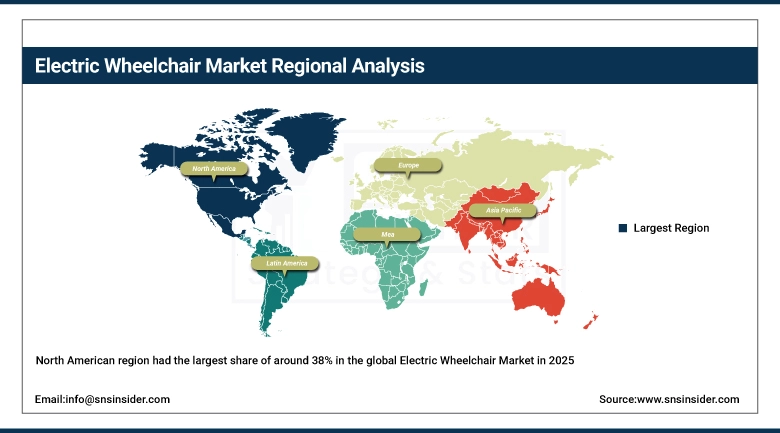
The North American region had the largest share of around 38% in the global Electric Wheelchair Market in 2025 owing to its well-established healthcare infrastructure, higher usage of innovative mobility aids, and presence of key companies. Increasing incidences of chronic ailments, disability, and aging population are contributing to the growth in demand. Favorable medical reimbursement programs and availability of insurance are providing impetus to wide product availability. Moreover, higher consumer awareness, innovation in technology related to smart and AI-powered wheelchairs, and investments in rehabilitation and home health care facilities are bolstering the regional dominance and growth potential.
Get Customized Report as per Your Business Requirement - Enquiry Now
Asia Pacific Electric Wheelchair Market Insights
The Asia Pacific region represents the fastest-growing Electric Wheelchair Market, with a projected CAGR of 12.64%. This is attributed to a growing elderly population, a rising number of people with disabilities, and improved healthcare facilities in the region. Increased awareness about assistive mobility devices along with the growth in home health care services is generating robust demand from both urban and semi-urban regions. The increasing pace of urbanization, increased health care expenditure, and government initiatives are further fueling growth in the market.
Japan's Ministry of Economy, Trade and Industry identifies assistive technology for aging including electric wheelchairs as one of its Society 5.0 economic priority sectors, with government-subsidized trials of AI-powered electric wheelchairs and remote monitoring platforms in elderly care facilities across all 47 prefectures.
China's National Healthcare Security Administration expanded electric wheelchair reimbursement under the Urban Employees' Basic Medical Insurance program in 2024, reducing out-of-pocket costs for covered users by an estimated 40%.
Europe Electric Wheelchair Market Insights
Growth of the Europe Electric Wheelchair Market is observed due to several reasons, which include high aging population, increasing incidence of mobility-related illnesses, and robust health care infrastructure. Increased acceptance of innovative mobility solutions such as mid-wheel drive and intelligent electric wheelchairs is contributing toward increased patient comfort and independence. Other factors that are fueling the demand for these devices include government incentives, which includes reimbursement and accessibility programs, and growing emphasis on rehabilitation services and homecare solutions.
Middle East & Africa and Latin America Electric Wheelchair Market Insights
The Electric Wheelchairs Market in the Middle East is experiencing growth with the Gulf countries developing their healthcare infrastructure and disability assistance system. The vision for 2030 in Saudi Arabia includes disability assistance services and the provision of assistive devices, which means that there will be government programs to buy electric wheelchairs from health ministries. There are subsidy programs in the UAE, which covers electric wheelchairs for qualified nationals under the jurisdiction of the Federal Authority for People with Disabilities. The Latin America region focuses on Brazil with the SUAS disability assistance program providing equipment to low-income members, while there are electric wheelchair insurance benefits in Mexico and Argentina.
Electric Wheelchair Market Growth Drivers:
-
Rising geriatric population, mobility disability prevalence, and rehabilitation demand driving sustained adoption of electric wheelchairs globally across healthcare systems
The growth of the aging population in the world has led to increased demand for electric wheelchairs because mobility issues are more common among aging people. Increased cases of diseases like arthritis, spinal injury, neurology disease, and muscular dystrophy have led to an increase in the need for mobility aids. Healthcare providers are working towards enhancing patients' ability to move around independently as well as improve their quality of life, resulting in increased use of electric wheelchairs. Increased awareness of assistive technology devices and the reimbursement policies by the government in some countries have helped in meeting this demand.
Electric Wheelchair Market Restraints:
-
High product cost and limited insurance coverage restricting affordability and adoption of electric wheelchairs in price-sensitive regions
The high initial price of electrical wheelchairs has proven to be one of the biggest hindrances to its widespread usage, especially in countries that cannot afford them due to their poor economic state. The latest types that have innovative features, greater battery capacity, and can be customized incur higher costs, thereby remaining out of reach to many potential buyers. Poor reimbursement plans by health care insurance companies prevent many people from purchasing them, and thus they opt to buy non-electrical models. Costs related to maintenance and the need for frequent battery replacement are other obstacles to the use of electric wheelchairs.
Electric Wheelchair Market Opportunities:
-
Expanding integration of smart healthcare technologies and IoT-enabled mobility solutions creating new growth opportunities in electric wheelchair innovation
The exponential progress being made in the area of smart healthcare technologies presents immense potential for the makers of electric wheelchairs to produce intelligent and connected mobility products. The use of internet-of-things, GPS, artificial intelligence navigation, and remote monitoring systems is improving the safety and autonomy of the users. They allow caregivers and health organizations to keep track of their mobility activities and provide assistance whenever required. An increase in the need for smart rehabilitation equipment at hospitals and in home care setups is driving innovations in personalized wheelchairs. Further, collaborations between healthcare facilities and IT firms are helping to drive advancements in advanced mobility technologies.
Recent Developments:
-
2025: Permobil launched its SmartDrive Assist powered add-on for manual wheelchairs and its updated M3 Corpus power wheelchair with PURE-i integrated autonomous assistance capability, enabling users with progressive conditions to smoothly transition between manual and powered assistance as their condition evolves - preventing the abrupt transition from manual to full-power chair that rehabilitation professionals have historically been unable to bridge.
-
2025: WHILL Inc. launched its Model Ci2 electric personal mobility device with 12.4-mile range, three-second fold time, and FAA carry-on approval, achieving consumer electronics retail distribution through Best Buy - the first electric mobility device to achieve mainstream consumer electronics retail placement, signaling a fundamental expansion of the accessible retail channel for electric wheelchair products.
-
2026: Sunrise Medical introduced the Quickie Q300 M Mini with mid-wheel drive 17-inch turning radius and a 320-pound weight capacity, targeting the bariatric mobility market segment where standard electric wheelchairs cannot accommodate users' weight requirements - a commercially underserved segment whose clinical need is growing proportionally with global obesity prevalence.
Electric Wheelchair Market Key Players
Some of the Electric Wheelchair Market Companies
-
Invacare Corporation
-
Pride Mobility Products Corp.
-
Permobil
-
Sunrise Medical
-
Ottobock
-
Drive Medical
-
Hoveround Corporation
-
Golden Technologies
-
Karman Healthcare
-
Meyra Group
-
WHILL
-
Merits Health Products
-
Shoprider Mobility Products
-
Heartway Medical Products
-
KD Smart Chair
-
EZ Lite Cruiser
-
DEKA Research & Development Corp.
-
Mobius Mobility
-
Ekso Bionics
-
Quantum Rehab
| Report Attributes | Details |
|---|---|
| Market Size in 2025 | USD 4.55 Billion |
| Market Size by 2035 | USD 13.1 Billion |
| CAGR | CAGR of 11.50% From 2026 to 2035 |
| Base Year | 2025 |
| Forecast Period | 2026-2035 |
| Historical Data | 2022-2024 |
| Report Scope & Coverage | Market Size, Segments Analysis, Competitive Landscape, Regional Analysis, DROC & SWOT Analysis, Forecast Outlook |
| Key Segments | • By Product (Front-wheel Drive, Mid-wheel Drive, Rear-wheel Drive, Others) • By Age Group (Adult, Pediatric, Geriatric) • By Portability (Standalone, Portable) • By End Use (Homecare, Hospitals, Ambulatory Surgical Centers, Rehabilitation Centers) |
| Regional Analysis/Coverage | North America (US, Canada), Europe (Germany, UK, France, Italy, Spain, Russia, Poland, Rest of Europe), Asia Pacific (China, India, Japan, South Korea, Australia, ASEAN Countries, Rest of Asia Pacific), Middle East & Africa (UAE, Saudi Arabia, Qatar, South Africa, Rest of Middle East & Africa), Latin America (Brazil, Argentina, Mexico, Colombia, Rest of Latin America). |
| Company Profiles | Invacare Corporation, Pride Mobility Products Corp., Permobil, Sunrise Medical, Ottobock, Drive Medical, Hoveround Corporation, Golden Technologies, Karman Healthcare, Meyra Group, WHILL, Merits Health Products, Shoprider Mobility Products, Heartway Medical Products, KD Smart Chair, EZ Lite Cruiser, DEKA Research & Development Corp., Mobius Mobility, Ekso Bionics, and other players. |
Frequently Asked Questions
Ans: Asia Pacific is growing at the fastest CAGR of approximately 12.64% in the Electric Wheelchair Market.
Ans: The Standalone segment dominated the Electric Wheelchair Market with approximately 69% share in 2025, while the Portable segment is the fastest growing.
Ans: The Geriatric segment dominated the Electric Wheelchair Market with approximately 57% share in 2025, while the Pediatric segment is the fastest growing.
Ans: The Electric Wheelchair Market was valued at USD 4.55 billion in 2025.
Ans: The Electric Wheelchair Market is expected to grow at a CAGR of 11.50% from 2026 to 2035.
