
Inventory Management Software Market Report Scope & Overview:
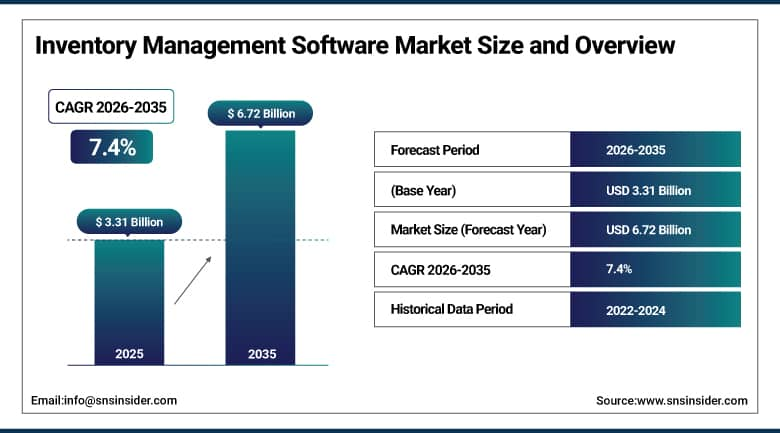
The Inventory Management Software Market was valued at USD 3.31 Billion in 2025 and is expected to reach USD 6.72 Billion by 2035, growing at a CAGR of 7.4% from 2026 to 2035.
Inventory management software in the global market is witnessing rapid growth, as there is an increasing need for automation, real-time tracking, and improved supply chain management. Organizations are opting for cloud-based inventory management software owing to increased complexity in supply chains and accelerated digitalization in all segments of enterprises. Inventory management software market is driven by increasing use of AI, machine learning, Internet of Things, and RFID technologies for real-time tracking, demand forecasting, and automated replenishment that eliminates the occurrence of stockouts and excess inventories. Companies such as Oracle, SAP, and Microsoft are incorporating the latest AI-driven analytical techniques, predictive demand sensing, and blockchain technology to improve inventory tracking at multiple locations of an enterprise. Omnichannel retailing, just-in-time inventory, and proliferation of e-commerce continue to exert pressure on organizations to adopt advanced inventory management systems.
In February 2024, Zoho Corporation launched Zakya, a point-of-sale and inventory management solution specifically designed for small and medium retail businesses, enabling streamlined retail operations, real-time inventory monitoring, and integrated sales analytics on a platform priced for SME budgets. The product launch demonstrates the commercial direction of inventory management software toward democratized cloud-based solutions that bring enterprise-grade inventory visibility and automation to the SME market segment whose digital transformation creates above-average first-time software adoption growth.
To Get More Information On Inventory Management Software Market - Request Free Sample Report
Inventory Management Software Market Trends
-
AI-powered demand forecasting is improving inventory optimization through predictive analytics that enhances stock accuracy and reduces inventory imbalances.
-
Blockchain-enabled inventory traceability is strengthening supply chain transparency, product authentication, and regulatory compliance across industries.
-
Autonomous warehouse integration is streamlining inventory operations through robotics, automated replenishment, and intelligent workflow management.
-
RFID and IoT-based real-time inventory tracking is enabling continuous stock visibility and improving fulfillment efficiency across retail and manufacturing sectors.
-
Omnichannel inventory management platforms are gaining adoption as businesses seek centralized inventory visibility across physical and digital sales channels.
The U.S. Inventory Management Software Market Outlook
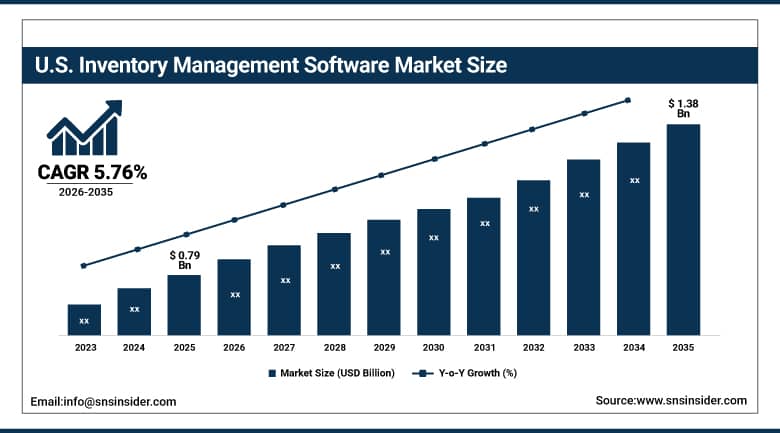
The U.S. Inventory Management Software Market was valued at approximately USD 0.79 Billion in 2025 and is expected to reach approximately USD 1.38 Billion by 2035, growing at a CAGR of approximately 5.76%.
The U.S. is the leading inventory management software market among the major North American regions. The key players that shape the domestic commercial landscape are Oracle's Fusion Cloud Supply Chain Management, SAP's IBP and ERP inventory modules, Microsoft's Dynamics 365 Supply Chain Management, IBM's Watson-based warehouse management, Zoho Inventory, and Fishbowl Inventory. U.S. businesses have been constantly working on incorporating the latest innovations like AI, IoT, and advanced analytics in their operations to enhance supply chain performance and elevate the level of customer service provided. An extremely fast expansion of U.S. e-commerce, with the revenue from retail e-commerce sales of the Q1 FY2024 equaled at $289.2 billion, ensures structural demand for advanced inventory management systems.
In September 2023, Afresh Technologies launched its inventory management platform tailored for fresh food categories in grocery retail, transforming ordering and inventory management within grocers’ fresh departments with intelligent and connected solutions that minimise waste, reduce ending inventory time, and improve order accuracy. The platform demonstrates the commercial direction of vertical-specific inventory management software whose domain expertise and category-specific algorithms create measurable operational improvement above general-purpose inventory management alternatives.
Inventory Management Software Market Segment Analysis
-
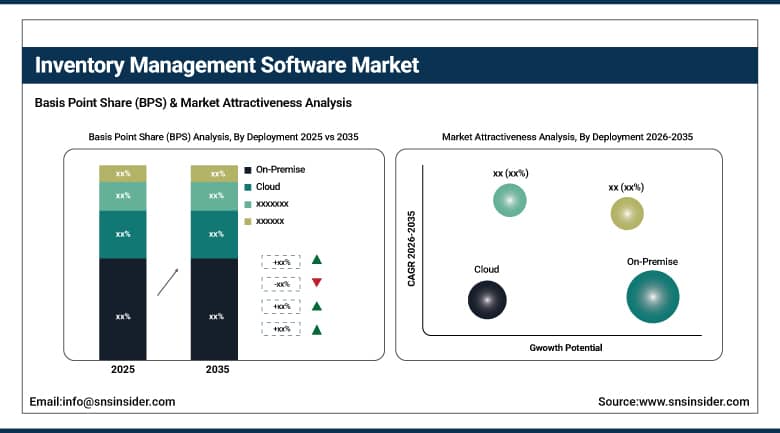
By Deployment, the on-premise segment dominated the inventory management software market with approximately 58% of the revenue share in 2025, while the cloud segment is projected to register the fastest CAGR of around 13.8% during 2026–2035.
-
By Type, the order management segment dominated the inventory management software market with the largest revenue share in 2025, while the inventory control & tracking segment is the fastest growing at approximately 8.5% CAGR.
-
By Enterprise Size, the large enterprises segment dominated the inventory management software market with the largest revenue share in 2025, while the small and medium-sized enterprises segment is the fastest growing.
-
By End Use, the manufacturing segment dominated the inventory management software market with the largest revenue share in 2025, while the retail & e-commerce segment is the fastest growing at approximately 8.05% CAGR.
By Deployment, on-premise dominates, cloud grows fastest
On-premise deployment retained the dominant position with the largest revenue share of the inventory management software market in 2025. The commercial primacy of on-premise deployment reflects the fundamental data security and customization requirement of large enterprise inventory management whose ERP system integration, proprietary workflow customization, and sensitive operational data sovereignty requirements create specification preference for locally controlled infrastructure. On-premise inventory management systems give users complete control and administrative access, enabling complex customized setups for intricate workflows that standardized cloud multi-tenant architectures cannot accommodate without extensive configuration. Regulated industries including healthcare, defense, and pharmaceutical manufacturing whose inventory management data contains patient information, classified materials, and quality system records create compliance-driven on-premise specification that sustains the deployment model’s commercial leadership.
Cloud deployment is the fastest growing model because the subscription economics, instant scalability, zero IT maintenance burden, and built-in integration marketplace that cloud-native inventory platforms provide create compelling total cost of ownership advantages that compound with the growing SME market’s digital transformation. Over 65% of companies are adopting cloud-based inventory management solutions to eliminate manual errors and enhance productivity. Each e-commerce business whose multi-channel selling creates inventory synchronization requirements beyond Excel or manual tracking creates a cloud inventory software procurement event whose economics favor subscription SaaS over capital expenditure on-premise alternatives.
By Application, order management dominates, inventory control grows fastest
Order management retained the dominant application position with the largest revenue share of the inventory management software market in 2025. The exponential rise of e-commerce and omnichannel retailing creates demand for sophisticated order management systems that handle complex fulfilment processes including split shipments, cross-channel allocation, returns management, and customer communication automation. The core function of automating and streamlining order processing, fulfilment, and returns management creates the most commercially prioritized inventory software capability investment because its direct impact on customer satisfaction, delivery promise accuracy, and operational cost efficiency creates a measurable ROI that justifies software investment across all enterprise size categories. Integration of order management with existing ERP and CRM systems streamlines operations, reduces errors, and creates unified customer data visibility that disconnected order processing cannot provide.
Inventory control and tracking is the fastest growing application at approximately 8.5% CAGR because IoT and AI-driven real-time stock visibility adoption is creating a technology substitution trend from periodic manual count cycles to continuous automated tracking whose operational benefits in stockout prevention, theft reduction, and stock accuracy improvement create above-average ROI justification. Each warehouse that deploys RFID readers, IoT shelf sensors, or mobile barcode scanning systems creates inventory control and tracking software procurement whose commercial value grows with the real-time data volume the tracking infrastructure generates. IBM’s Watson AI integration for IoT-enabled RFID tracking and Microsoft Dynamics 365’s AI-driven replenishment automation demonstrate the commercial scale of inventory control and tracking technology investment.
Regional Analysis
|
Region |
Major Country |
Share within Region, 2025 (%) |
|---|---|---|
|
North America |
United States |
87.4% |
|
Europe |
Germany |
22.3% |
|
Asia Pacific |
China |
44.8% |
|
Middle East & Africa |
UAE |
31.2% |
|
Latin America |
Brazil |
44.2% |
North America Inventory Management Software Market Insights
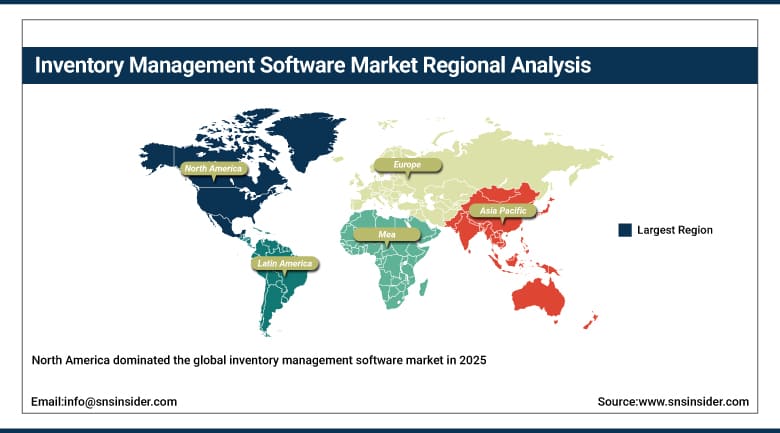
North America dominated the global inventory management software market in 2025, accounting for approximately 38% of the total market revenue share. This is driven by early adoption of advanced technologies, a strong presence of major software vendors, and a well-established retail and logistics infrastructure. The United States accounts for approximately 87.4% of North American revenues through Oracle, SAP, Microsoft, IBM, Zoho, and Fishbowl’s enterprise commercial relationships across retail, manufacturing, and logistics sectors.
Canada contributes approximately 12.6% of North American revenues through its retail sector’s inventory digitalization, the manufacturing industry’s ERP integration investment, and the growing e-commerce market’s demand for cloud-based inventory management platforms.
Get Customized Report as Per Your Business Requirement - Enquiry Now
Europe Inventory Management Software Market Insights
Europe is a technically sophisticated inventory management software market where the EU's supply chain due diligence regulation, sustainability reporting requirements, and digital transformation investment create structured institutional demand. Germany accounts for approximately 22.3% of European revenues through its manufacturing sector’s Industry 4.0 investment, SAP’s domestic enterprise leadership, and the retail sector’s omnichannel inventory management adoption.
The United Kingdom, France, and the Netherlands are significant secondary markets where e-commerce growth, Brexit-driven supply chain complexity, and the manufacturing sector’s digital transformation create consistent inventory software procurement. Sage Group's UK-based operations and DEAR Systems’ European customer base sustain regional supply.
Asia Pacific Inventory Management Software Market Insights
Asia Pacific is the fastest growing regional inventory management software market, driven by rapid industrialization and urbanization across China, India, Japan, South Korea, and Southeast Asia, rising investments in cloud infrastructure, and the extraordinary growth of e-commerce in the region. China accounts for approximately 44.8% of Asia Pacific revenues through its manufacturing sector’s digital transformation, the government's supply chain modernization investment, and the extraordinary domestic e-commerce market whose inventory management complexity creates consistent software procurement.
India represents the most commercially dynamic emerging market within Asia Pacific where IBEF documented e-commerce GMV reaching USD 60 billion in FY2023 reflecting a 22% increase, creating above-average inventory management software demand growth as Indian e-commerce and retail businesses invest in platforms capable of managing their rapidly expanding order volumes.
MEA & Latin America Inventory Management Software Market Insights
The UAE is a leader in MEA revenue with its highly developed retail and logistics industry, investment in the warehouse management system of the Dubai free zone, and increasing demand from the e-commerce industry for inventory visibility solutions. Retail modernization in Saudi Arabia under its Vision 2030 contributes significantly to complementing the demand. Brazil is a leader in Latin American revenue owing to its huge manufacturing and retail industries, the rise in the e-commerce industry, and investments in modernizing the supply chain in the industrial sector.
Market Dynamics
Growth Drivers: E-commerce growth creating omnichannel inventory complexity and AI-driven automation reducing operational costs
The rapid proliferation of e-commerce and omnichannel retailing is the most commercially potent structural demand generator for inventory management software. Every additional launch of an e-commerce channel, integration with a new marketplace platform, or introduction of a new same-day delivery service adds to the challenges of managing inventory visibility and synchronization that cannot be done with software alone. The U.S. Department of Commerce reported Q1 FY2024 retail e-commerce sales amounting to USD 289.2 billion, growing by 2.1% on a quarterly basis, which reflects the ongoing volume trend that causes inventory management complexity and thus drives procurement investments. More than 45% of companies experienced inventory shortages in 2023, which shows the impact of poor inventory management on the bottom line because it means revenue loss from stockout events.
AI-powered inventory automation resulting in measurable reductions in operating costs supports procurement investments independently of the launch of new channels. Every application of demand forecasting powered by artificial intelligence that eliminates safety stock, prevents stockouts, and maximizes reorder timing results in cost savings that can be measured in terms of reduced holding costs, prevention of lost sales, and more accurate order fulfillment.
Restraints: Data security concerns and high implementation cost for enterprise ERP integration
Data security concerns create adoption hesitation among enterprises whose inventory management data contains sensitive supplier pricing, demand intelligence, and operational capacity information that cloud hosting creates unauthorized access risk for. Each high-profile supply chain data breach that exposes inventory and procurement data creates market caution that moderates cloud adoption pace among security-conscious enterprise procurement teams.
High implementation cost for enterprise inventory management system ERP integration creates project risk and budget overrun exposure for deployments whose scope requires interfacing with legacy manufacturing, financial, and logistics systems. Each implementation that creates extended timelines and above-budget integration costs moderates the pace of legacy system replacement in cost-constrained enterprise environments.
Opportunities: SME cloud adoption and autonomous warehouse management integration
SME cloud inventory software adoption represents the most commercially accessible near-term market expansion opportunity whose democratization of sophisticated inventory management capability creates first-time procurement from the largest and most underserved enterprise population. Each SME whose manual tracking creates operational errors, stockouts, or excess inventory creates cloud inventory software adoption motivation whose commercial aggregate across millions of global SMEs sustains above-average market growth.
Autonomous warehouse management integration creating intelligent inventory systems represents the most commercially premium near-term technology development whose robotic process automation, computer vision picking, and AI-guided inventory positioning create operational efficiency improvements beyond conventional inventory tracking. Each autonomous warehouse deployment creates inventory management software procurement whose AI integration sustains premium platform pricing above conventional manual warehouse alternatives.
Recent Developments:
-
2024: Zoho Corporation launched Zakya in February 2024, a point-of-sale and inventory management solution for small and medium retail businesses, enabling streamlined retail operations and real-time inventory monitoring at SME-accessible pricing.
-
2024: Brain Corp partnered with JRTech Solutions in October 2024 to introduce autonomous inventory management solutions for retail, enabling robotic scanning platforms to perform automated shelf inventory audits without human intervention in live retail environments.
-
2023: Afresh Technologies launched its fresh food inventory management platform in September 2023, transforming ordering and inventory management in grocery fresh departments with AI-driven demand forecasting tailored for high-perishability inventory categories.
Inventory Management Software Market Key Players
-
Oracle Corporation
-
SAP SE
-
Microsoft Corporation
-
IBM Corporation
-
Zoho Corporation Pvt. Ltd.
-
Intuit Inc.
-
Acumatica Inc.
-
Fishbowl Inc.
-
NetSuite Inc.
-
Manhattan Associates Inc.
-
Kinaxis Inc.
-
Infor Inc.
-
Sage Group plc
-
Epicor Software Corporation
-
Lightspeed Commerce Inc.
-
DEAR Systems Pty Ltd.
-
Cin7 Ltd.
-
Brightpearl Ltd.
-
Unleashed Software Ltd.
-
TradeGecko
Inventory Management Software Market Report Scope:
| Report Attributes | Details |
|---|---|
| Market Size in 2025 | USD 3.31 Billion |
| Market Size by 2035 | USD 6.72 Billion |
| CAGR | CAGR of 7.4% From 2026 to 2035 |
| Base Year | 2025 |
| Forecast Period | 2026-2035 |
| Historical Data | 2022-2024 |
| Report Scope & Coverage | Market Size, Segments Analysis, Competitive Landscape, Regional Analysis, DROC & SWOT Analysis, Forecast Outlook |
| Key Segments | • By Deployment (On-Premise, Cloud) • By Type (Order Management, Inventory Control & Tracking, Scanning & Barcoding, Asset Management, Others) • By Enterprise Size (Large Enterprises, Small and Medium-sized Enterprises) • By End Use (Manufacturing, Retail & E-Commerce, Healthcare & Life Sciences, Automotive, Energy & Utilities, Others) |
| Regional Analysis/Coverage | North America (US, Canada), Europe (Germany, UK, France, Italy, Spain, Russia, Poland, Rest of Europe), Asia Pacific (China, India, Japan, South Korea, Australia, ASEAN Countries, Rest of Asia Pacific), Middle East & Africa (UAE, Saudi Arabia, Qatar, South Africa, Rest of Middle East & Africa), Latin America (Brazil, Argentina, Mexico, Colombia, Rest of Latin America). |
| Company Profiles | Oracle Corporation, SAP SE, Microsoft Corporation, IBM Corporation, Zoho Corporation Pvt. Ltd., Intuit Inc., Acumatica Inc., Fishbowl Inc., NetSuite Inc., Manhattan Associates Inc., Kinaxis Inc., Infor Inc., Sage Group plc, Epicor Software Corporation, Lightspeed Commerce Inc., DEAR Systems Pty Ltd., Cin7 Ltd., Brightpearl Ltd., Unleashed Software Ltd., and TradeGecko |
Frequently Asked Questions
On-Premise deployment dominated the Inventory Management Software Market in 2025.
The Inventory Management Software Market is expected to grow at a CAGR of 7.4% from 2026 to 2035.
Explosive e-commerce growth creating omnichannel inventory management complexity requiring real-time multi-channel synchronization, and AI-driven automation enabling measurable operational cost reduction through predictive demand forecasting, automated replenishment, and IoT-enabled real-time stock tracking.
The Inventory Management Software Market was valued at USD 3.31 Billion in 2025.
North America dominated the Inventory Management Software Market in 2025.
