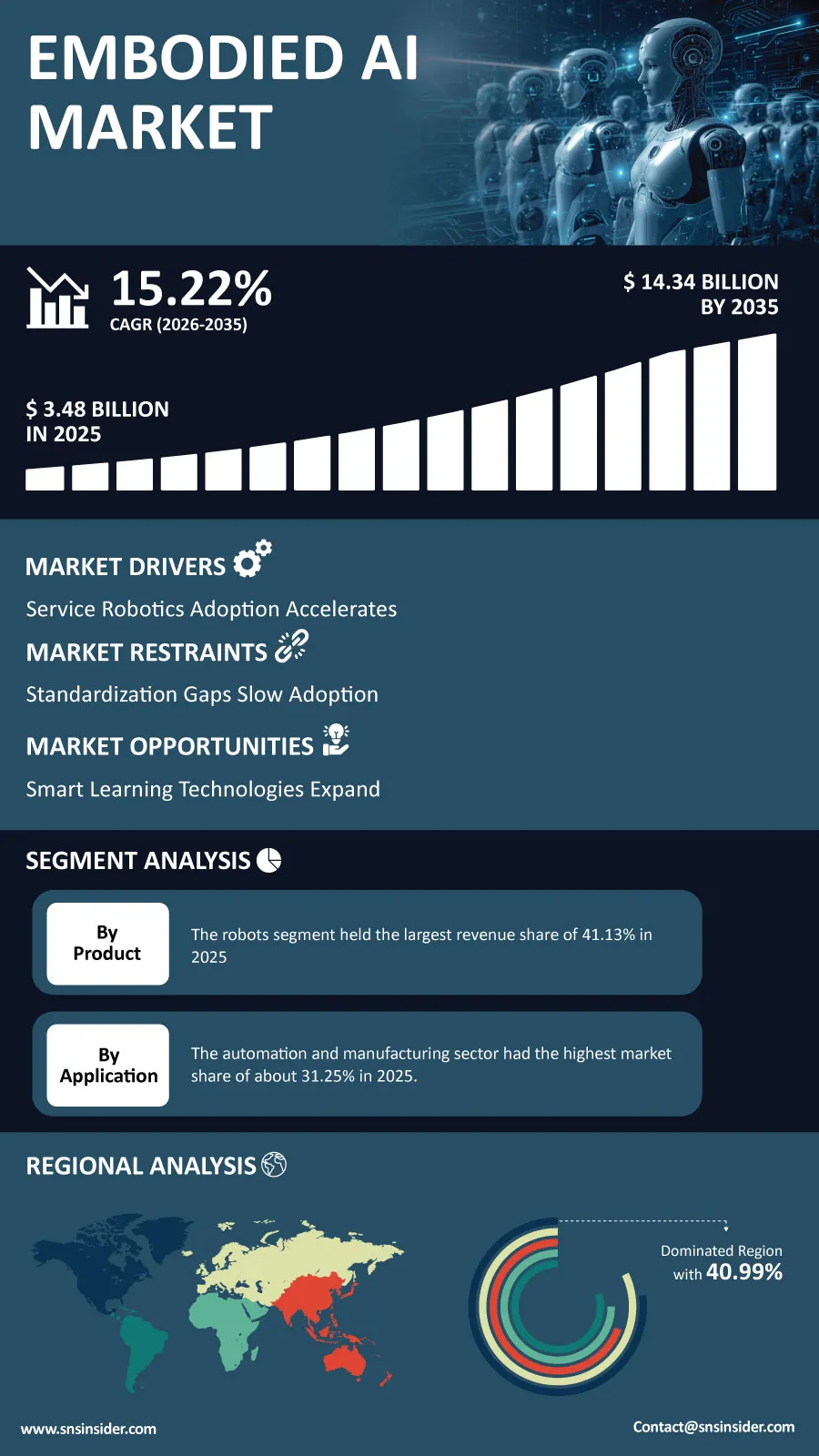
The global Embodied AI Market is entering a high-growth phase as advances in artificial intelligence, robotics, computer vision, and edge computing accelerate the development of machines capable of perceiving and responding to physical environments. According to a recent study by SNS Insider, the global Embodied AI Market size valued at USD 3.48 billion in 2025, is anticipated to grow to USD 14.34 billion by 2035, registering a CAGR of 15.22% over the 2026–2035 forecast period.
The increasing use of intelligent robots in industries like manufacturing, health care, logistics, retail, and consumers is fueling the demand for systems that have the capability to interact with humans and their surroundings. With advancements in sensing capabilities, machine learning, and autonomous decision-making, robots are becoming increasingly proficient in completing sophisticated tasks.
Due to shortages in the workforce, automation needs, and demands for customized services, businesses are looking into the potential of embodied AI as an enabling technology that can combine virtual intelligence with real-world action. These developments are presenting fresh prospects for robotics firms and technology vendors alike.
To Get Detailed Insights on the Embodied AI Market – Request a Sample Report
Intelligent Automation Opens New Growth Opportunities
The trend toward the implementation of automated systems that can adapt to changes in the environment, and not follow predefined instructions is gaining traction in industries. The integration of natural language processing, computer vision, tactile sensors, and autonomous navigation capabilities is helping in creating embodied AI systems that allow for flexible processes.
The healthcare industry presents itself as an area where intelligent systems are being considered in tasks ranging from rehabilitation, assisting senior citizens, logistics within hospitals, surgeries, and interacting with patients. Autonomous machines are also being utilized by manufacturers and logistics organizations in their production and distribution centers.
The education sector also represents an emerging opportunity as institutions explore AI-enabled learning assistants and interactive systems that can adapt to individual student needs. These applications could expand the role of embodied AI beyond industrial automation into human-centric environments.
Key Market Insights Highlight Shifting Demand Patterns
By product, robots accounted for approximately 41.13% of global market revenue in 2025, supported by broad adoption across manufacturing, healthcare, retail, education, logistics, and defense. Exoskeletons are projected to be the fastest-growing product category, registering a CAGR of approximately 16.47% through 2035 as demand increases for rehabilitation technologies, workplace assistance, elderly care, and human augmentation.
Based on application, automation and manufacturing held the largest share of approximately 31.25% in 2025. Growing adoption of intelligent machines for assembly, inspection, testing, and production optimization continues to support demand. Logistics and supply chain applications are expected to grow at the fastest pace, with a CAGR of approximately 16.83% from 2026 to 2035, driven by e-commerce expansion, warehouse automation, autonomous mobile robots, and intelligent material handling.
Human-Robot Collaboration Becomes a Strategic Priority
The development of embodied AI is moving automation beyond factory floors into collaborative workplaces where both humans and robots will have to coexist and perform their respective tasks. The progress in sensors and computing technologies will enhance the capacity of robots to sense their environment, identify objects and adapt to changing situations.
Collaborative robot-human interactions will become increasingly popular as firms will demand automation technologies that can function in ever-changing environments. Edge AI, which enables quicker decision-making due to local processing of the relevant data, will also contribute to the development of the trend.
While the future looks very promising, there are several issues that cannot be overlooked. Among them are data privacy, ethicality of robot behavior, unemployment, and lack of a consistent regulatory framework.
North America Leads with Over 40.99% Revenue Share While Asia Pacific Advances at a 16.43% CAGR
The North American region is set to make up more than 40.99% of the total market revenues globally in 2025, thanks to its advanced research abilities, highly-developed technology infrastructure, and widespread use of robots within the medical, defense, manufacturing, and commercial industries. The U.S. is currently leading all the regions as far as revenues are concerned, due to the heavy investment in artificial intelligence and robots.
In the Asia Pacific region, the growth rate is estimated to be the highest among all the regions, with a CAGR of about 16.43%. Labor shortages, aging demographics, industrial automation, and government investment in robotics and smart technology are behind this growth. China continues to play a central role in regional growth through its extensive manufacturing base and substantial investments in AI, robotics, and intelligent infrastructure.
Industry Participants Focus on Robotics Innovation
The competitive landscape remains dynamic as technology companies and robotics specialists invest in foundation models, autonomous navigation, advanced sensing, and machine intelligence. Strategic efforts are increasingly focused on developing robots that can operate effectively in unpredictable real-world conditions while supporting commercial-scale deployment.
Key companies operating in the global Embodied AI Market include Boston Dynamics, SoftBank Robotics, NVIDIA, KUKA AG, Toyota Motor Corporation, ABB, Agility Robotics, Apptronik, Covariant, and Avidbots.
An SNS Insider analyst Sushant Kadam commented, “The convergence of AI, robotics, and edge computing is creating a new generation of intelligent machines capable of operating in complex physical environments. As industries seek flexible automation and solutions to workforce challenges, companies that combine advanced perception, reliable autonomy, and safe human-robot collaboration will be well positioned to capture the next wave of embodied AI growth.”
About the Author

Get in touch