
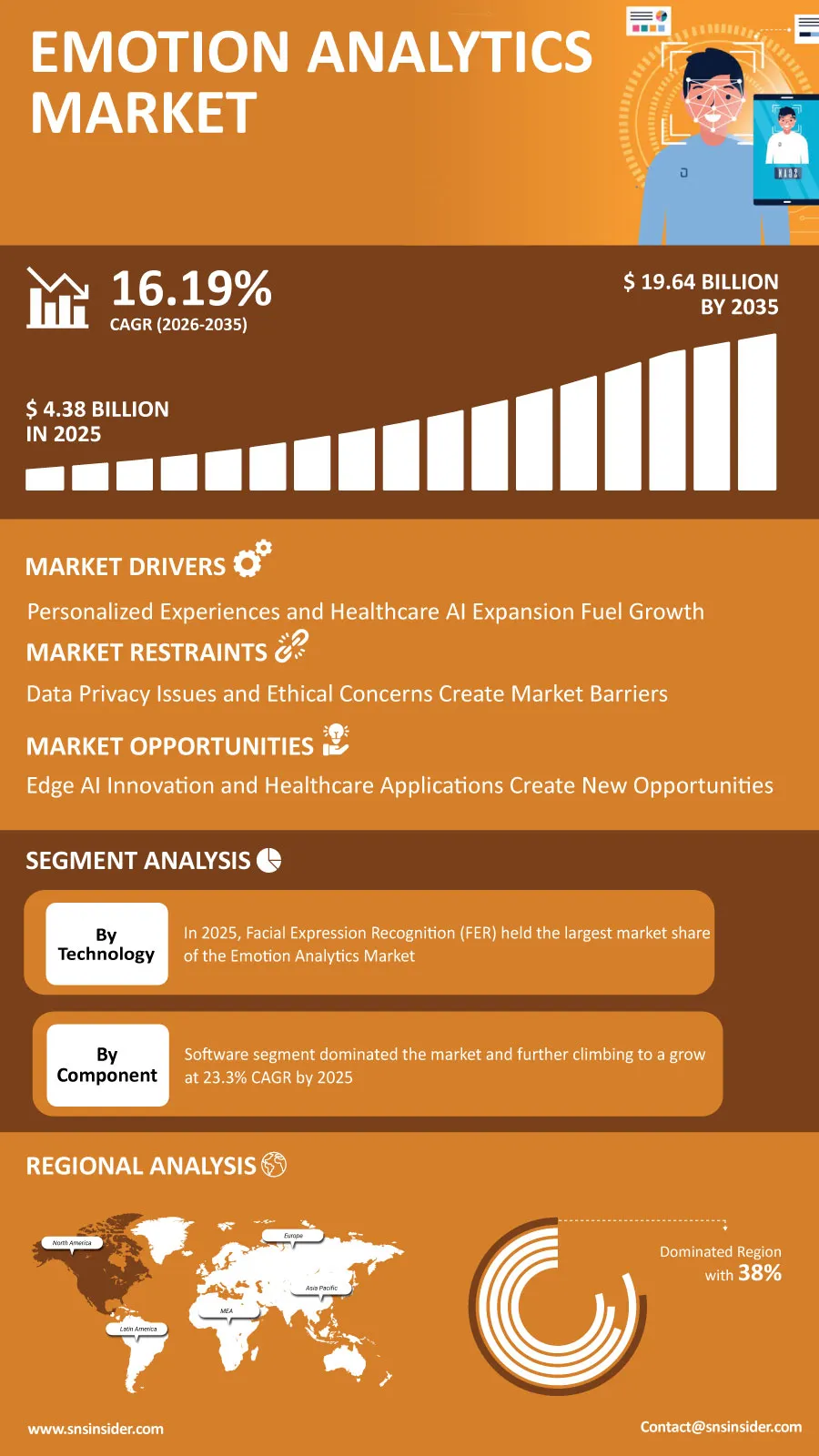
The global Emotion Analytics market is set to move into a period of expansion as companies integrate emotional intelligence into their digital transformations. “According to a recent study by SNS Insider, the global Emotion Analytics Market size valued at USD 4.38 billion in 2025, is anticipated to grow to USD 19.64 billion by 2035, registering a CAGR of 16.19% over the 2026–2035 forecast period.”
Businesses in every sector are going beyond conventional analytics by adopting technologies that can analyze human emotions based on how we engage in a digital interaction. Organizations are using these solutions to deepen customer relationships, promote service automation and optimization, optimize a mobile workforce and personalize digital experiences. Emotion-aware platforms be gone, as AI gets smarter, these are now becoming strategic enterprise tools rather than stand-alone analytic applications to address a specific need.
As organizations mature in Digital Transformation, the new volume of communication through online web channels, virtual meetings, contact center conversations and digital commerce gets so enormous that emotion analytics providers are constantly finding new opportunities. Organizations now put more importance on technologies that turn conversational, visual and behavioral data into actionable business intelligence, as well as provide faster execution in terms of a response to customers.
To Get Detailed Insights on the Emotion Analytics Market – Request a Sample Report
AI Innovation and Digital Customer Experience Investments Support Long-Term Market Expansion
Enterprises are still investing heavily in AI-driven technologies to help them better understand customers and operate more efficiently. Emotion analytics solutions are being increasingly embedded into customer relationship management platforms, digital marketing systems, and enterprise collaboration software to offer deeper visibility into the engagement lifecycle of customer sentiment.
Healthcare organisations are also fast becoming significant consumers of emotion-aware technologies. Hospitals, telehealth providers and behavioral health specialists are assessing AI-powered emotional assessment tools that help clinicians remotely monitor patient well-being and aid support for more personalized treatment strategies.
Automakers are ramping up spending on smart driver monitoring systems that can detect fatigue, distraction and stress. These technologies have been emerging for the last few years and are expected to become more prevalent as vehicle safety regulations advance and advanced driver-assistance systems (ADAS) continue to proliferate throughout the global automotive markets.
Key Market Insights Highlight Shifting Demand Patterns
On the basis of technology, face expression recognition captured the largest market share in 2025 due to increased deployment of vision-based AI-powered systems across retail, customer service and digital engagement spheres by enterprises. It is expected that speech and voice analytics will grow at fastest over the forecast period 2035, attributable to the growing adoption of these solutions across contact centers, virtual assistants and conversational AI.
Software was the largest revenue-generating component worldwide in 2025, driven by rising enterprise demand for scalable AI analytics platforms. During the forecast period, the strongest growth is expected for services because organizations need consulting and implementation, integration, and managed support from external partners to deploy complex AI solutions.
Based on deployment, cloud-based platforms continued to lead the market share and dominated the supply of enterprise-level accessibility by 2025. At the same time, edge and on-device deployments are forecasted to grow at fastest rate due to increasing importance of privacy-first AI processing and evolving data protection regulations.
On the basis of end user, in 2025, media & entertainment was expected to remain the leading revenue contributor in utilizing emotion analytics for audience engagement and effectiveness of advertisements. Demand for digital mental health solutions and solutions adopted in remote patient monitoring are widely expected to position healthcare as the fastest growing industry through 2035.
Multimodal AI and Privacy-Focused Innovation Transform Enterprise Emotion Intelligence
Providers of multimodal AI are racing to build unified analytical solutions in areas such as facial analysis, speech interpretation, behavioral signals, and natural language processing. These overall combined solutions yield greater emotional insights and also enhance analytical agreement across a broader scope of customer interactions.
Simultaneously, technology providers are developing a privacy-first architecture that processes emotional analytics directly on the devices, maintaining sensitive biometric data on-device and away from centralized cloud environments. Organisations are applying this strategy to enhance regulatory compliance, while building enterprise applications with high-performance AI capabilities.
Ongoing enhancements of ML models also allow for the real-time sense making of emotions within digital enterprise ecosystems, financial services, retail settings, health platforms and intelligent mobility systems giving rise to new commercial opportunities in virtually all industry verticals.
North America Held 38% of the Emotion Analytics Market Share in 2025; Asia Pacific Projected to Register the Fastest CAGR Through 2035
North America dominated the global market in 2025, holding about a 38% share of worldwide revenue due to continued large-scale investments in enterprise AI, advanced digital infrastructure along with widespread access and adoption of customer experience technologies. By leveraging its dominating artificial intelligence ecosystem and growing commercialization of emotion-aware enterprise platforms, the US remains dominant on regional innovation.
Asia Pacific is expected to experience the fastest growth in the forecast period as companies expedite their digital transformation efforts across China, India, Japan, Korea and Southeast Asia. Our analysis suggests that with the rise of e-commerce ecosystems in addition to speedy adoption of AI and increasing investments in intelligent customer engagement solutions, market growth will be strengthened across regions over the next ten years.
Europe will stay front and center of Enterprise innovation, but in the context of tight privacy frameworks which maintain a ‘social license’ for organisations to deploy biometric technologies responsibly. Similar trends are also being seen across Latin America, and the Middle East where businesses modernize digital customer engagement and smart city infrastructure.
Industry Participants Strengthen AI Capabilities Through Product Innovation
Competition in the emotion analytics industry worldwide has been heating up as vendors pour investments into Artificial Intelligence, multimodal analytics, cloud platforms, and privacy-built processing technologies. The focus continues to be on partnerships, improving product functionality and delivering tailored solutions for industry-specialization in the face of growing enterprise demand.
Key companies operating in the global Emotion Analytics Market include Affectiva (Smart Eye AB), iMotions A/S, Realeyes, Microsoft Corporation, IBM Corporation, Clarabridge (Qualtrics), Kairos AR Inc., Beyond Verbal, NViso SA, Heartbeat AI, Adoreboard, Entropik Technologies, Cognitec Systems GmbH, Eyeris Technologies (EmoVu), Noldus Information Technology, Receptiviti, Deloitte Digital, SAS Institute Inc., Uniphore Technologies, and Emozo Labs.
An SNS Insider analyst Sakshi Kale commented, "Organizations are increasingly recognizing emotional intelligence as a strategic business asset that enhances customer engagement, operational performance, and digital healthcare outcomes. Continued advancements in artificial intelligence, privacy-preserving analytics, and multimodal data processing are expected to unlock substantial long-term opportunities across the global Emotion Analytics Market."
About the Author

Get in touch




