
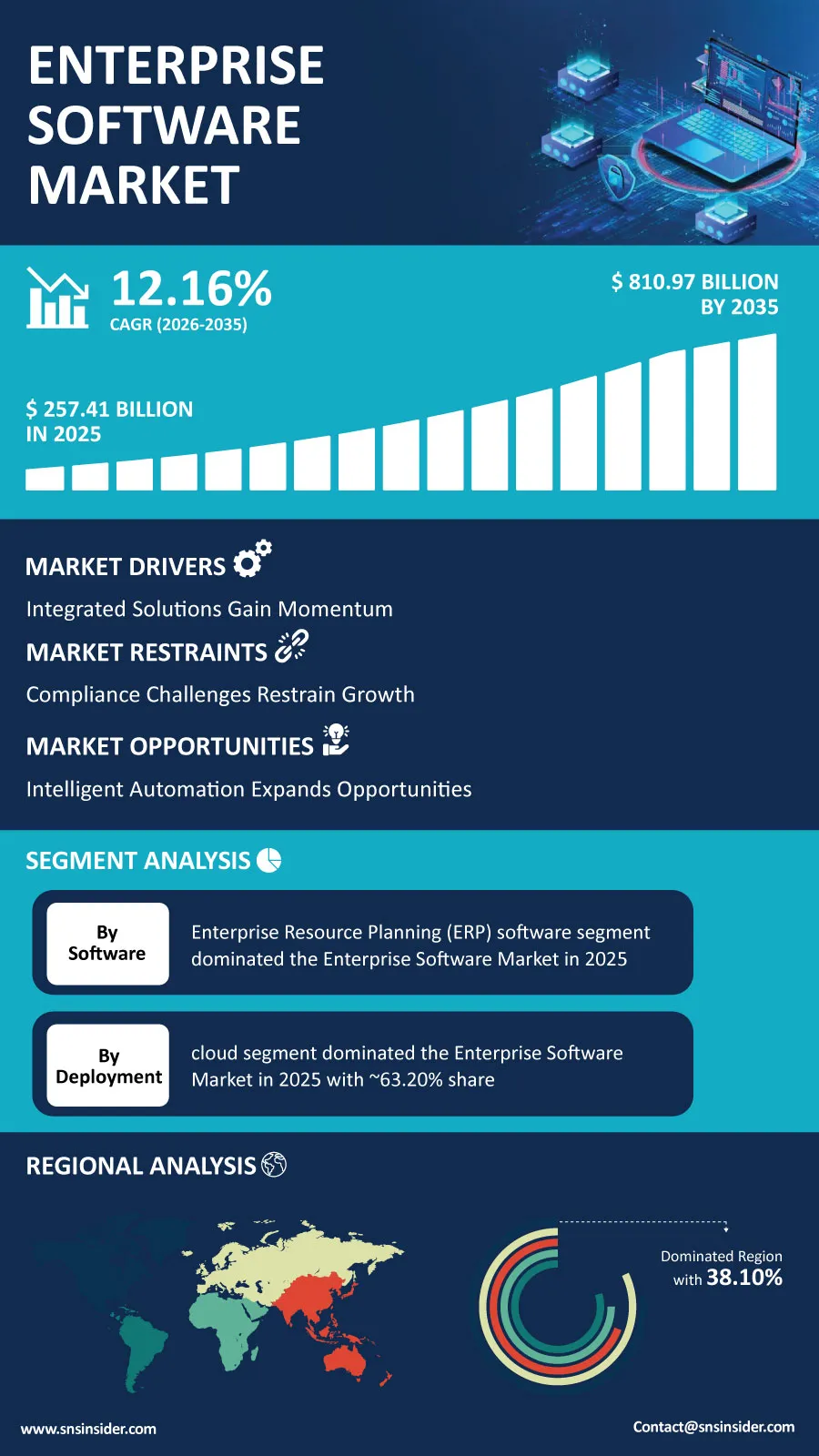
The global enterprise software market is entering a new phase of expansion as organizations modernize business operations through intelligent digital platforms. “According to a recent study by SNS Insider, the Enterprise Software Market size valued at USD 257.41 billion in 2025, is anticipated to grow to USD 810.97 billion by 2035, registering a CAGR of 12.16% over the 2026–2035 forecast period.”
In every industry, software investments that make life easier, promote cooperation and help in making decisions have become a priority for companies. In order to adapt to new environments, companies are moving from disjointed legacy solutions to unified digital solutions that help with finance, customer relationship, supply chain management, human resource management and data analytics.
The use of cloud-based applications, hybrid working arrangements and data-driven strategies have changed the way businesses are spending on technology around the world. Also, the use of artificial intelligence is helping companies with automation of mundane tasks and forecasting.
To Get Detailed Insights on the Enterprise Software Market – Request a Sample Report
AI-Driven Business Platforms Create Long-Term Growth Opportunities
Investments in intelligent automation present significant opportunities for enterprise software vendors. Companies are using more AI-powered applications that can optimize their workflow, find inefficient areas in it, and help make business decisions faster. As digital transformation efforts continue to develop, software platforms that feature analytics and automation will likely play an integral role in the work of enterprises.
Cloud computing also drives momentum in the market through the ability of companies to deploy apps faster and minimize infrastructure complexity. Subscription models of software delivery allow companies to update their software continuously, scale it easily, and manage it better.
One other area for growth is related to the adoption of software by small and medium-sized enterprises. Inexpensive cloud-based services and software-as-a-service make it possible for SMEs to use enterprise-level apps that have been previously available to large companies only.
Key Market Insights Highlight Shifting Demand Patterns
Based on software, Enterprise Resource Planning (ERP) accounted for approximately 28.60% of global revenue in 2025, supported by increasing demand for integrated business management platforms. Customer Relationship Management (CRM) software is projected to register the fastest expansion through 2035 as organizations strengthen customer engagement and personalized sales strategies.
By deployment model, the cloud segment represented nearly 63.20% of market revenue in 2025 while also remaining the fastest-growing category. Enterprises continue migrating workloads to cloud environments to improve scalability, operational agility, and long-term cost efficiency.
In terms of enterprise size, large enterprises contributed around 58.10% of total market revenue in 2025 due to extensive digital transformation initiatives and complex operational requirements. Meanwhile, small and medium-sized enterprises are expected to record the strongest growth as cloud technologies become increasingly accessible.
Among end-use industries, the IT and telecom sector generated approximately 26.70% of market revenue during 2025 owing to early technology adoption and extensive software integration. The BFSI sector is anticipated to witness the fastest growth as financial institutions accelerate digital banking, intelligent risk management, and customer experience initiatives.
Intelligent Automation and Cloud Innovation Reshape Enterprise Technology
It is evident that software companies are quickly moving into developing intelligent solutions that integrate AI technology, machine learning, analytics, and automation in a single business ecosystem. This will ensure that the company can analyze large amounts of data, automate some aspects of the business, and conduct better strategic planning.
Additionally, there is increasing focus by software developers on low-code software, AI assistants, enhanced security, and integration among different enterprise applications. This is enabling businesses to pursue their digital transformation projects and stay resilient.
North America Held 38.10% of the Enterprise Software Market Share in 2025; Asia Pacific Projected to Register the Fastest 13.05% CAGR Through 2035
North America had a market share of 38.10% in 2025 with its highly evolved digital infrastructure, wide-scale enterprise cloud usage, and consistent investments made in artificial intelligence, automation, and software innovation. The market presence of North America is sustained by its technologically advanced ecosystem and large enterprises spends on technology.
The Asia Pacific region is anticipated to grow with an approximate CAGR of 13.05% until 2035 owing to rapid digitalization taking place in the economies of the region, growth in cloud infrastructure, software adoption by SMEs, and efforts by the governments to foster digitalization.
The European market is continuing its healthy growth with the efforts for enterprise modernization, regulatory compliance measures, and increasing adoption of cloud-based enterprise software. At the same time, Latin America and Middle East and Africa are consistently building their enterprise software ecosystems with the help of their digital infrastructure, smart government policies, and enterprise technology adoption.
Industry Participants Focus on AI Integration and Cloud Expansion
Competition within the enterprise software market continues to intensify as technology providers invest in artificial intelligence, cloud-native architectures, cybersecurity, workflow automation, and industry-specific software platforms. Strategic product innovation and platform integration remain central to helping organizations improve operational efficiency while supporting increasingly complex digital environments.
Key companies operating in the global Enterprise Software Market include Microsoft Corporation, Oracle Corporation, SAP SE, Salesforce, Inc., IBM Corporation, ServiceNow, Inc., Workday, Inc., Adobe Inc., Atlassian Corporation, Intuit Inc., Accenture plc, Cisco Systems, Inc., Hewlett Packard Enterprise (HPE), Zoho Corporation, Infor, Epicor Software Corporation, Pegasystems Inc., Software AG, Freshworks Inc., and Sage Group plc.
An SNS Insider analyst Sakshi Kale commented, "Enterprise software is evolving into the digital foundation of modern organizations as artificial intelligence, cloud computing, and intelligent automation redefine how businesses operate. Vendors delivering secure, scalable, and AI-enabled platforms will be well positioned to capture future growth opportunities across global industries."
About the Author

Get in touch




