
Epinephrine Market is about to experience another wave of growth due to increased attention paid by healthcare facilities, the government, and the pharmaceutical industry to prepare for the cases of serious allergic reactions. Availability of sophisticated devices for drug administration, increased access, and constant developments in the field of allergy treatment have resulted in higher demand for epinephrine products.
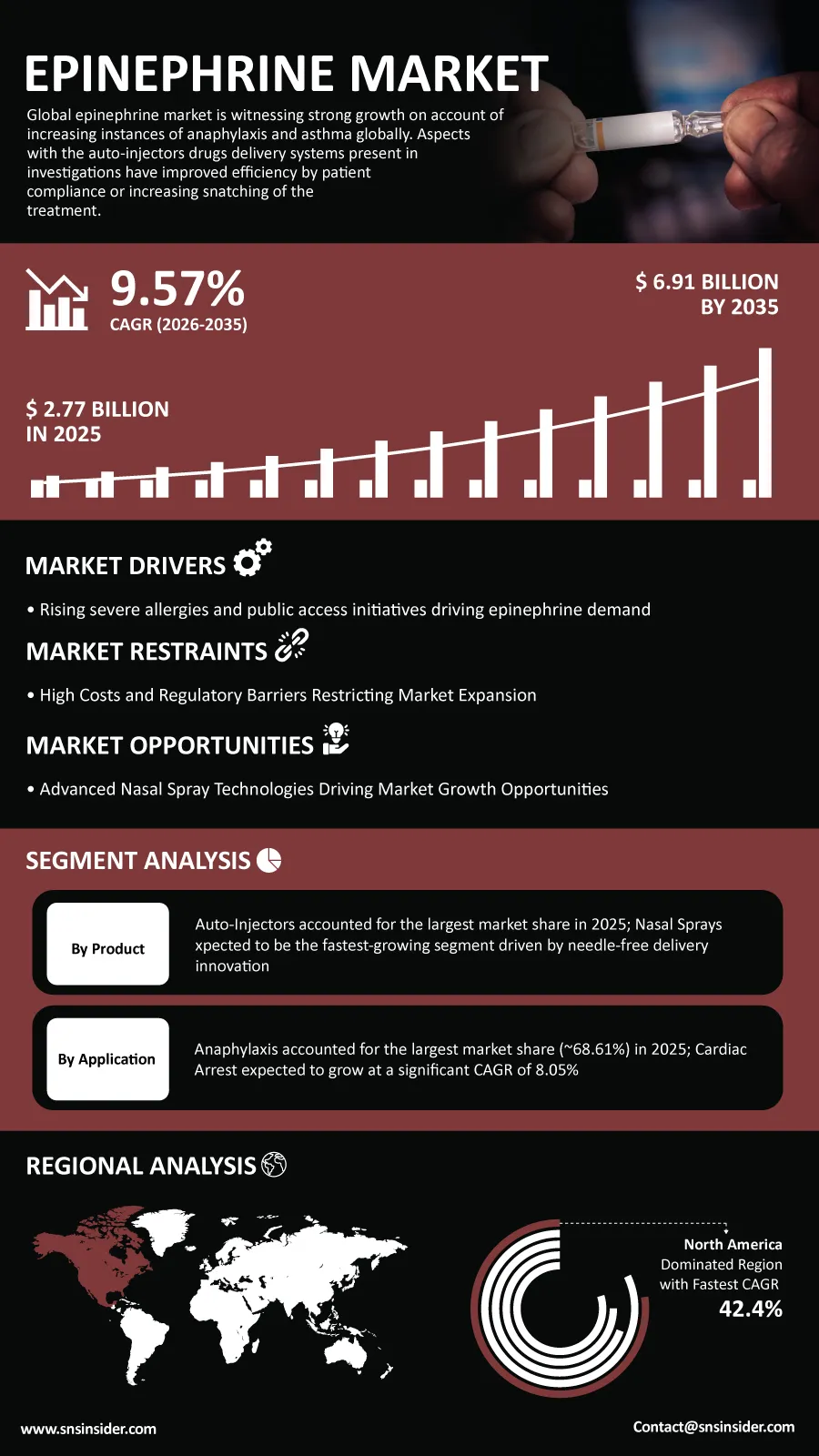
According to a recent study by SNS Insider, the global Epinephrine Market size valued at USD 2.77 billion in 2025, is anticipated to grow to USD 6.91 billion by 2035, registering a CAGR of 9.57% over the 2026–2035 forecast period. The market is benefiting from increasing awareness of severe allergic conditions, growing adoption of user-friendly emergency drug delivery systems, and expanding healthcare policies that encourage wider availability of life-saving medications.
Product development is moving at a quick pace for manufacturing companies in the development of products that include needle-free products, digital monitoring technology, and affordable generic products. It is expected that the next decade will bring changes within emergency allergy treatment.
To Get Detailed Insights on the Epinephrine Market – Request a Sample Report
Advanced Drug Delivery Technologies Reshape Emergency Care
Innovation continues to play a vital role in driving the growth of markets as the drug manufacturing industries transition from using traditional auto-injectors to innovative modes of administration. Some of the innovations include needle-free spray solutions for administering emergency medications, auto-injector devices that integrate with smartphones, wearable drug administration technologies, and digital alerts.
There is an increased interest among healthcare professionals for prefilled syringes as they are used in emergencies within hospitals and ambulances where efficiency is of the essence. On the other hand, telemedicine portals and mobile applications for managing allergies are enabling proper treatment adherence through prescription alerts and expiry alerts.
Market Highlights Reflect Expanding Treatment Adoption
By product type, auto-injectors remained the largest revenue-generating segment in 2025, supported by widespread adoption in homes, schools, and public facilities where immediate treatment is essential. Nasal spray formulations are projected to register the fastest growth through 2035 as needle-free delivery gains acceptance among children, caregivers, and patients with injection anxiety.
Based on application, anaphylaxis accounted for approximately 68.61% of global market revenue during 2025, reflecting the continued importance of epinephrine as the primary emergency treatment for severe allergic reactions. The cardiac arrest segment is forecast to expand at a CAGR of 8.05%, supported by increasing use of hospital-grade epinephrine formulations in emergency and critical care settings.
Across distribution channels, retail and online pharmacies represented approximately 77.64% of market revenue in 2025 owing to expanding generic availability and convenient prescription refill programs. Hospital pharmacies are expected to record the strongest future growth as healthcare institutions increase procurement for emergency departments and intensive care units.
Accessibility and Digital Health Create New Growth Opportunities
The market is still growing due to improved accessibility and greater patient participation. The launch of generic products is making the process cheaper and more common in developed as well as emerging markets. On the other hand, digital health care systems are revolutionizing allergy treatment through the use of medication tracking, emergency notifications, and personal health monitoring systems.
Government initiatives requiring epinephrine availability in educational institutions, transportation hubs, sports venues, restaurants, and other public facilities are creating additional procurement opportunities beyond traditional prescription markets, supporting sustained long-term demand.
Regional Markets Continue to Expand
The dominance of North America has been sustained during 2025 with around 42.4% market revenue globally. It is due to high-quality healthcare infrastructure, efficient reimbursement schemes, and emergency response programs. In the region, the U.S. held an approximate share of 42% in revenue generation. The U.S. Epinephrine Market size has been estimated to be worth USD 1.06 billion in 2025 and expected to reach USD 2.13 billion by 2035 with a CAGR of 9.13%.
The Asia Pacific region is projected to dominate all other regional markets and register a highest growth rate of CAGR 10.03%. Increasing healthcare spending, improving awareness on allergy management, and use of emergency treatment devices have been driving the Asia Pacific market. China held around 38% share in revenue generation for the region in 2025.
In Europe, Germany represented approximately 28% of regional revenue, while Brazil contributed approximately 44% of Latin American sales. Saudi Arabia accounted for around 30% of Middle East & Africa revenue, reflecting continued investment in healthcare infrastructure and emergency medicine capabilities.
Industry Participants Strengthen Competitive Position
Competition continues to intensify as manufacturers invest in innovative delivery technologies, expanded manufacturing capacity, and strategic partnerships. During 2025, Amphastar Pharmaceuticals strengthened its injectable portfolio through the acquisition of Bausch Health's epinephrine injection business, while ALK-Abelló advanced development of a Phase III nasal spray alternative for anaphylaxis treatment. Glenmark Pharmaceuticals introduced a generic multiple-dose epinephrine injection vial in the U.S., improving affordability and patient access. Earlier developments also included Kaleo's next-generation AUVI-Q auto-injector and expanded generic distribution initiatives by Viatris and Pfizer across emerging markets.
Major companies operating in the global epinephrine market include Viatris Inc., Pfizer Inc., Teva Pharmaceutical Industries Ltd., Sanofi S.A., Bausch Health Companies Inc., Amneal Pharmaceuticals LLC, ARS Pharmaceuticals Inc., Kaleo Inc., Amphastar Pharmaceuticals, Inc., ALK-Abelló A/S, Adamis Pharmaceuticals Corporation, Fresenius Kabi AG, Glenmark Pharmaceuticals, Hikma Pharmaceuticals, Impax Laboratories, Lincoln Medical Ltd., Amedra Pharmaceuticals LLC, Harvest Pharmaceuticals, Sandoz (Novartis), and Abbott Laboratories.
An SNS Insider analyst Parry Kardani commented, "The future of the epinephrine market will be defined by greater accessibility, smarter drug delivery technologies, and continued innovation that enables patients and caregivers to respond more confidently during life-threatening allergic emergencies. Companies that combine affordability with advanced delivery platforms are expected to remain at the forefront of industry growth.
About the Author

Get in touch




