
Ethylene Oxide Sterilization Services Market is poised to experience rapid growth due to the need for reliable sterilization services by producers of medical devices and drugs and healthcare organizations for their products that do not support normal heat-based methods of sterilization. Increased production of advanced medical equipment and increased usage of disposable healthcare products will drive demand.
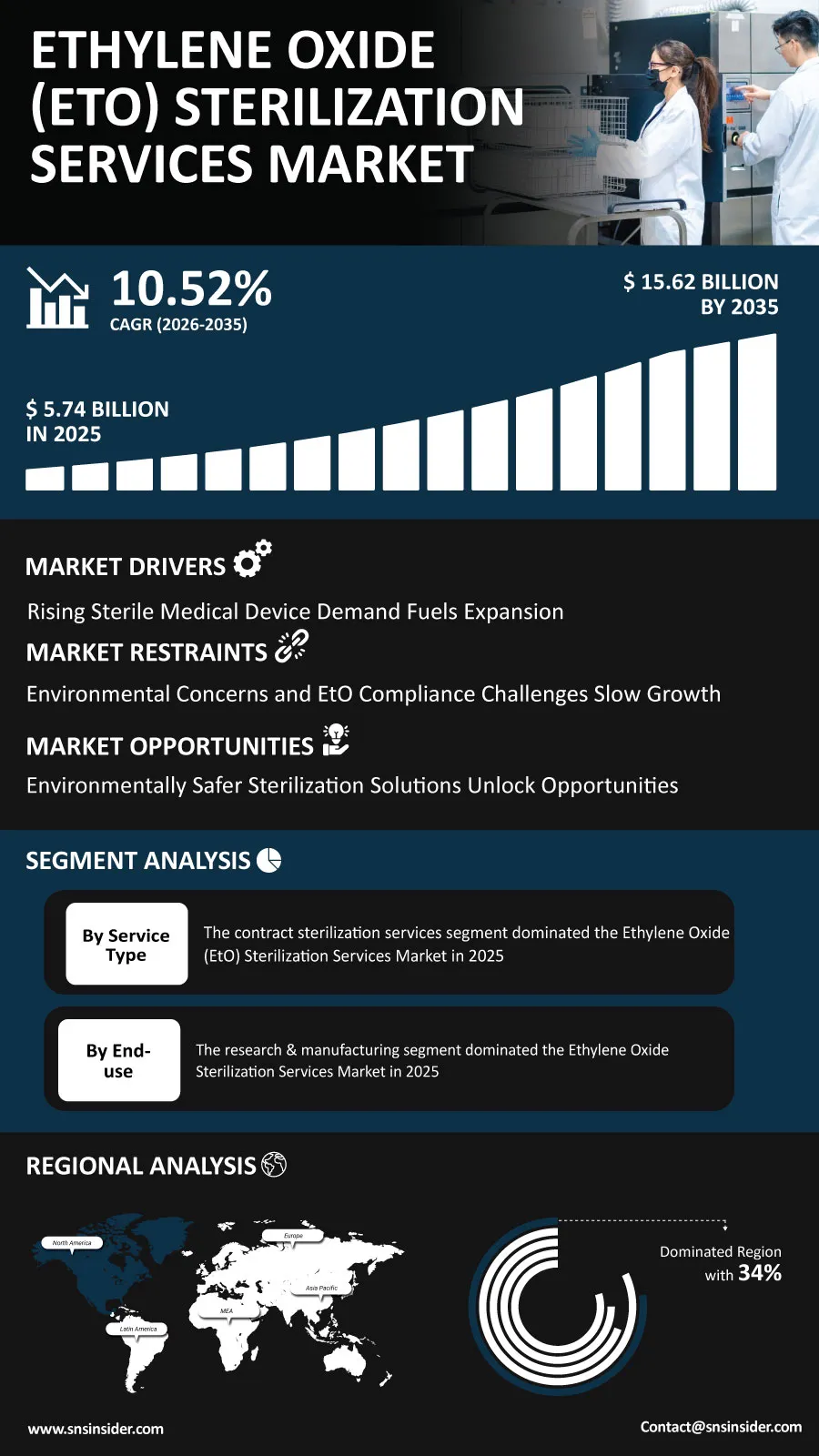
According to a recent study by SNS Insider, the global Ethylene Oxide Sterilization Services Market size valued at USD 5.74 billion in 2025, is anticipated to grow to USD 15.62 billion by 2035, registering a CAGR of 10.52% over the 2026–2035 forecast period. The market is estimated at USD 6.35 billion in 2026, with 2025 as the base year, a 2026–2035 forecast period, and 2022–2024 historical data.
Outsourcing Reshapes Sterilization Capacity
Medical device manufacturers are increasingly outsourcing their services to specialists in this area as opposed to running all their sterilization processes in-house. The approach ensures that they get to use equipment that is proven to be reliable and have adequate capacity to handle their work without having to invest in facilities.
This is even more important when it comes to delicate medical devices, pharmaceuticals and healthcare products that could be affected by heat and humidity. It is this ability to reach into such complicated products that makes EtO very relevant.
According to the Food and Drug Administration, it is estimated that about 50% of all sterile medical devices used in the U.S. are sterilized by using EtO, thus showcasing its well-known use in the medical industry.
To Get Detailed Insights on the Ethylene Oxide Sterilization Services Market – Request a Sample Report
Contract Services Lead as Validation Gains Importance
Contract sterilization services held a 61% market share in 2025, making it the leading service category. Manufacturers can use external providers to handle sterilization requirements at scale while maintaining access to established quality and regulatory systems.
Sterilization validation and re-validation is projected to be the fastest-growing service segment. Changes in device designs, production processes, equipment, and regulatory requirements are increasing the need for documented evidence that sterilization cycles remain effective throughout a product's lifecycle.
By end use, research and manufacturing captured 49% of the market in 2025. The outpatient facilities segment is expected to expand at the fastest pace as healthcare systems continue shifting selected procedures toward ambulatory settings.
By delivery mode, off-site sterilization services accounted for 73% of market revenue in 2025. Hybrid sterilization models are emerging as the fastest-growing approach as organizations seek greater flexibility, continuity, and control over sterilization logistics.
Regulation Creates Both Pressure and Investment Opportunities
Environmental compliance is becoming an ever more significant factor for EtO services providers. Tighter emission restrictions were introduced by the U.S. Environmental Protection Agency in 2024, forcing commercial sterilization facilities to implement more stringent control measures.
The move to stricter regulation raises costs for facilities but opens doors for companies that develop more efficient emission management systems, chambers, and monitoring technology, as well as new sterilization methods.
For services providers, the capacity to integrate validated performance with environmental compliance is becoming a competitive advantage.
North America Retains Market Leadership
North America is set to enjoy the most prominent regional position during 2025, generating approximately 34% of the total revenue share worldwide. Strong existing healthcare infrastructure, presence of established bases for manufacturing of medical devices, and stringent regulations will help sustain regional demand. The United States is responsible for 82.5% of the North American revenue.
The United States Ethylene Oxide Sterilization Services Market is estimated to be valued at approximately USD 1.61 billion during 2025 and forecast to grow to USD 4.38 billion during 2035 at 10.52% CAGR.
Asia Pacific is expected to register highest growth rate among regional markets till 2035. China accounted for 40.6% of total Asia Pacific revenue due to growing healthcare infrastructure and manufacturing of medical devices. The growth of medical technology in India is helping to generate further demand for professional sterilization services.
Germany constituted 24.6% of total European revenue. The UAE accounted for 22.8% of total Middle East & Africa revenue, while Brazil generated 43.8% of Latin America revenue.
Medical Technology Expansion Supports Long-Term Demand
Increasing use of minimally invasive, robotic, and disposable medical devices creates an increased inventory of items that need to be sterilized. Increased pharmaceutical production is yet another factor causing an increased need for sterilization of equipment used to produce products.
The recent developments in the market indicate that there are changes taking place in terms of competition in the industry. In 2025, the EPA issued an interim decision setting a maximum concentration level at 600 mg/L for sterilization cycle emissions by 2035. In 2024, Sterigenics US Inc. settled its dispute with the South Coast Air Quality Management District due to permit violation. In 2024, Allentown LLC, a company owned by Aterian Investment Partners, bought ClorDiSys Solutions.
Providers Invest in Scale and Compliance
Competition spans global sterilization specialists, technology companies, and healthcare service providers. Key participants include STERIS plc, Sotera Health Company, Sterigenics International LLC, E-BEAM Services, Inc., Andersen Sterilizers, Inc., Nelson Laboratories, LLC, Cosmed Group, Inc., Microtrol Sterilisation Services Pvt. Ltd., BGS Beta-Gamma-Service GmbH & Co. KG, MMM Group, Noxilizer, Inc., Cantel Medical Corporation, Matachana Group, SteriPack Group, Cretex Medical, Eschmann Technologies Ltd., Baxter International Inc., Getinge AB, Advanced Sterilization Products (ASP), and STERIMED Group.
An SNS Insider analyst Parry Kardani commented, "The sterilization services industry is being shaped by two simultaneous priorities: dependable processing for increasingly complex healthcare products and stronger environmental performance. Providers capable of delivering validated capacity while meeting evolving emission standards are likely to capture the strongest opportunities as global healthcare manufacturing expands.
About the Author

Get in touch




