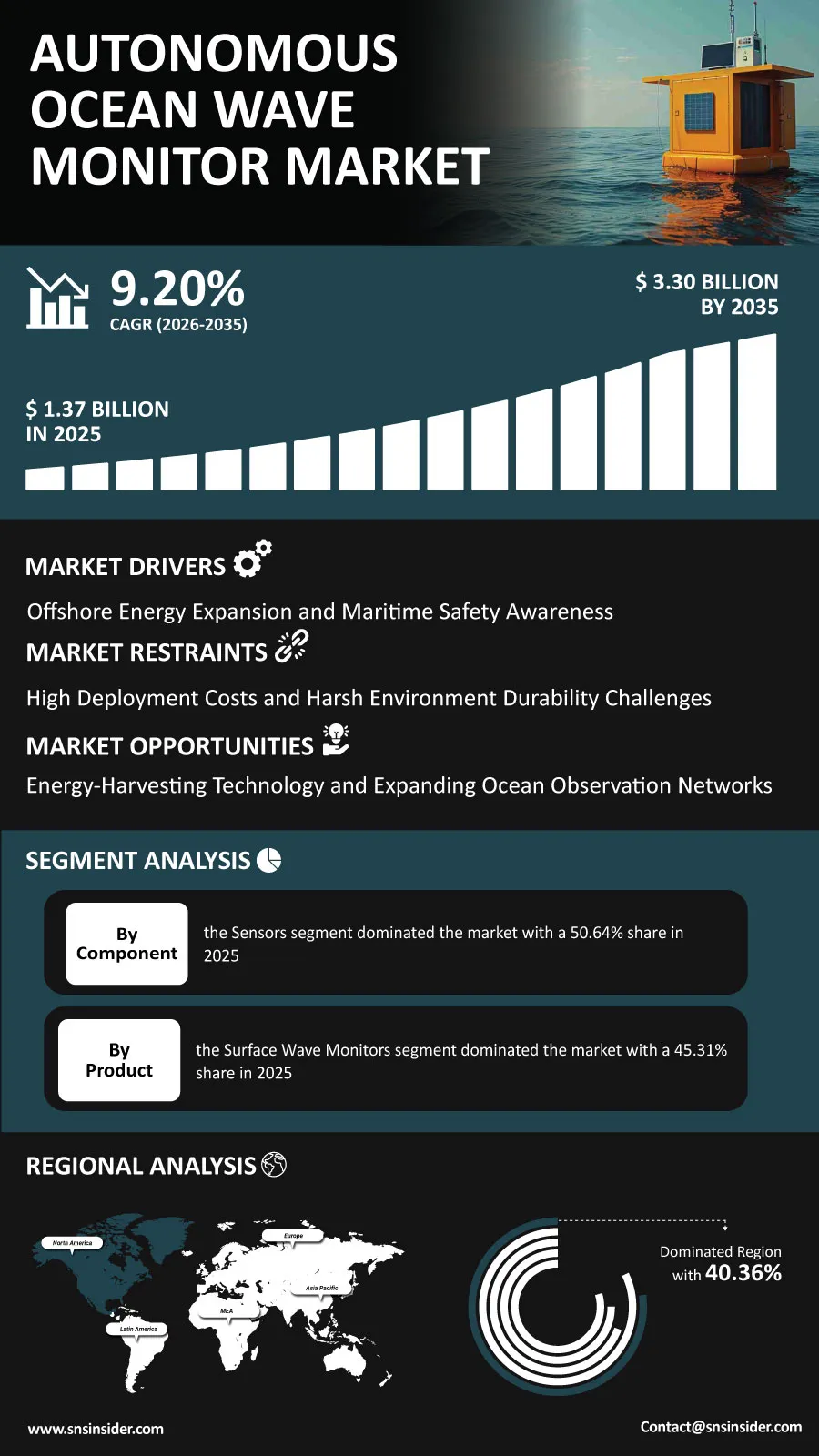
Government agencies and offshore energy operators around the world continue to invest in increasingly sophisticated wave monitoring technology as offshore energy project activity accelerates and maritime safety awareness grows. “According to a recent study by SNS Insider, the global Autonomous Ocean Wave Monitor Market, valued at USD 1.37 billion in 2025, is projected to reach USD 3.30 billion by 2035, registering a CAGR of 9.20% across the 2026-2035 forecast period.”
This sustained expansion reflects the convergence of two distinct forces: rising global offshore energy and maritime safety investment, and a wave of sensor and communication innovation extending well beyond conventional standalone surface buoys. Operators are no longer satisfied with platforms that simply measure wave height; they increasingly require energy-harvesting, satellite-connected systems capable of delivering real-time, multi-parameter oceanographic data from the most remote ocean locations. Manufacturers are responding accordingly, advancing integrated monitoring platforms and extended-life power systems that complement the surface wave monitors that have long defined this market.
To Get Detailed Insights on the Autonomous Ocean Wave Monitor Market – Request a Sample Report
Offshore Energy Expansion Fuels Sustained Demand
The growing use of sophisticated monitoring systems designed for deep-sea and coastal and offshore activities continues to drive autonomous wave monitor consumption across government, research, and commercial applications worldwide. Rising maritime safety awareness further compounds this trend, as shipping operators and coastal authorities increasingly value real-time wave data supporting navigation safety decisions.
Manufacturers are responding by prioritising investment in energy-harvesting and satellite communication technology ahead of legacy battery-dependent configurations, positioning themselves to serve operators seeking both proven measurement accuracy and genuine reduced-maintenance operational economics.
Segment Findings Point to a Market in Transition
Surface Wave Monitors held the highest market share position in 2025 due to their ease of deployment and well-established measurement accuracy. The Integrated Wave Monitoring Systems have been witnessing rapid development as the research and defense sectors seek platforms that offer multiple parameter measurements.
Sensors continued to occupy the largest component share due to their importance in collecting wave measurements data, and Communication Systems witnessed rapid development due to the increased need for satellite data transmission in real-time. The Government & Defense sector occupied the largest end-use segment due to its importance in financing national ocean observing systems, and Research Institutes narrowed the gap rapidly due to increased global research and climate investment.
North America Leads, Asia Pacific Set to Grow Fastest
North America represented the biggest market share on a worldwide basis in 2025, with 40.36% owing to consistent funding in federal ocean observation programs and the presence of major wave monitoring solutions vendors based in this region. The United States determines the demand in the region due to its extensive coastal and open water monitoring system along with offshore energy production activities.
Asia Pacific is projected to expand at the fastest rate of any region through 2035, at a CAGR of 9.86%, as China, Japan, India, and South Korea continue investing in offshore energy projects and environmental monitoring programs. Europe remains a significant contributor, anchored by Germany's marine technology and offshore wind energy base, while Latin America and the Middle East & Africa continue building adoption at a more gradual pace.
Energy-Harvesting Innovation Reshapes Competitive Dynamics
Competition within this market increasingly centers on which manufacturers can pair reliable wave measurement accuracy with genuinely differentiated energy-harvesting and satellite communication capability, and on the degree to which companies can demonstrate validated durability across demanding open-ocean deployment environments. Companies pursuing deeper investment in integrated, multi-parameter monitoring platforms continue to position themselves favourably for the next phase of industry growth.
Some of the major companies operating in the global autonomous ocean wave monitor market include Sofar Ocean Technologies, Inc., Fugro N.V., Sonardyne International Ltd., Valeport Ltd., Blue Ocean Monitoring, HydroMet, BioSonics, Inc., Teledyne Marine, Nortek AS, and RBR Ltd.
An SNS Insider Analyst, Sushant Kadam commented, “This market continues to benefit from a genuine convergence of offshore energy expansion and maturing autonomous sensing technology. Manufacturers that can pair proven measurement accuracy with genuinely differentiated energy-harvesting and communication capability are best positioned to capture the next phase of demand, particularly across Asia Pacific's fast-growing offshore energy investment and North America's continued leadership in federal ocean observing infrastructure.”
About the Author

Get in touch