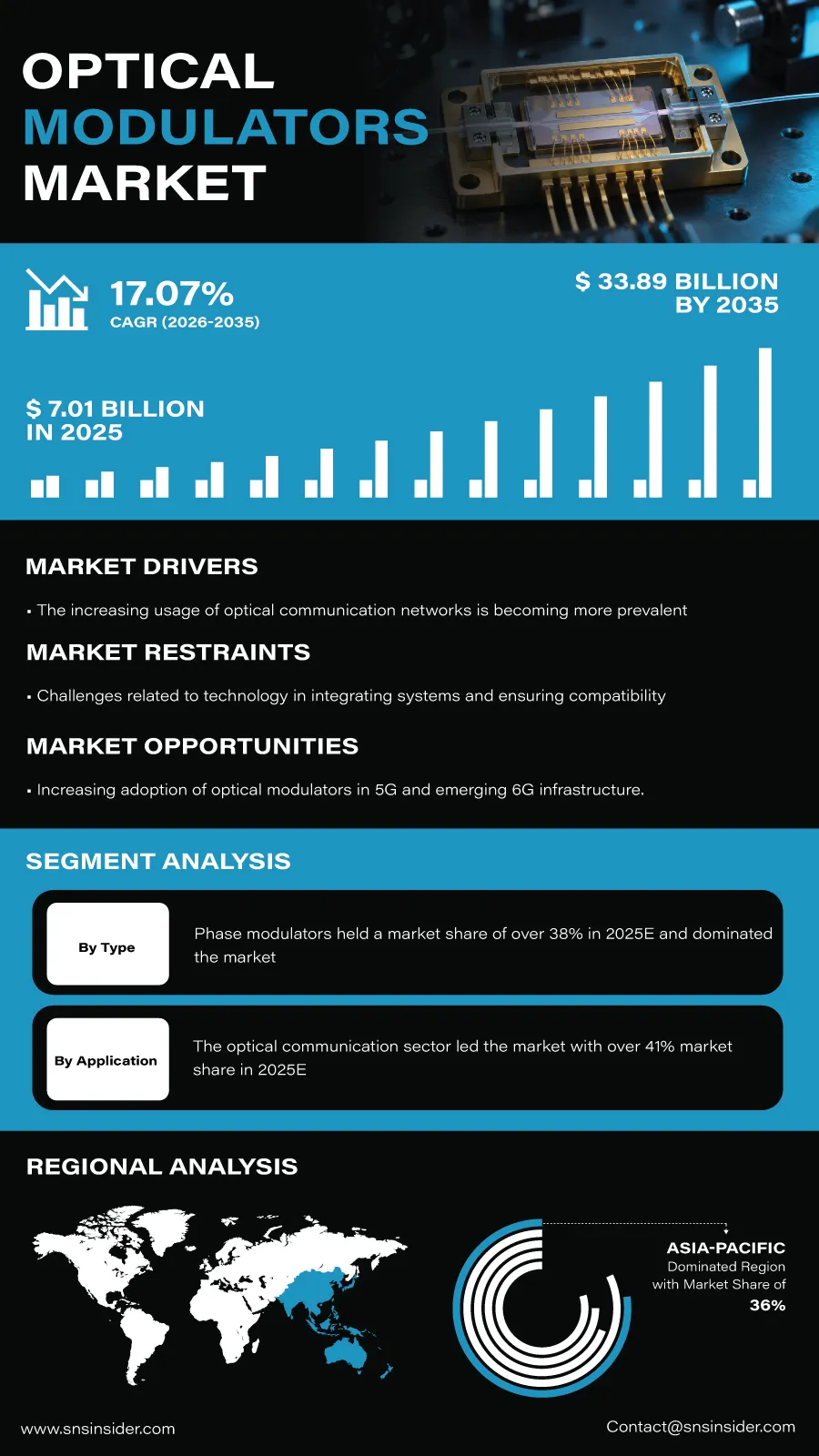
The global Optical Modulators Market is positioned for substantial growth as telecommunications providers, cloud infrastructure operators, and technology companies invest in high-speed optical communication networks and next-generation data transmission technologies. “According to a recent study by SNS Insider, the Global Optical Modulators Market size, valued at USD 7.01 billion in 2025, is anticipated to reach USD 33.89 billion by 2035, registering a CAGR of 17.07% over the forecast period 2026–2035.”
The increasing demand for high-bandwidth connectivity, rapid expansion of fiber-optic infrastructure, and growing deployment of 5G networks are accelerating the adoption of advanced optical modulation technologies. Optical modulators enable the precise control of light signals, supporting efficient data transmission across telecommunications networks, hyperscale data centers, and enterprise communication systems.
As artificial intelligence, cloud computing, video streaming, and connected devices generate increasing volumes of data traffic, network operators are investing in optical technologies capable of delivering higher transmission speeds and improved energy efficiency. Advancements in silicon photonics, electro-optic modulation, and integrated optical components are further strengthening the market's long-term growth prospects.
To Get Detailed Insights on the Optical Modulators Market – Request a Sample Report
Expanding Optical Communication Networks Create New Growth Opportunities
The increasing deployment of high-speed optical communication networks is driving demand for advanced modulators capable of supporting greater bandwidth and reliable long-distance data transmission. Telecommunications operators are upgrading their fiber-optic infrastructure to accommodate growing internet traffic, while hyperscale cloud providers are investing in faster optical interconnects to support increasingly demanding computing workloads. Optical modulators play an important role in these systems by encoding information onto light signals and enabling efficient transmission across fiber networks.
Growing adoption of 5G infrastructure and emerging interest in 6G technologies are creating additional opportunities for optical modulator manufacturers. High-capacity transport networks are essential for connecting cellular infrastructure, supporting cloud applications, and managing increasing data traffic from connected devices. Meanwhile, the expansion of artificial intelligence data centers is encouraging investments in high-performance optical transceivers and photonic integrated circuits. These developments are creating opportunities for suppliers offering compact, energy-efficient modulation technologies compatible with next-generation communication architectures.
However, complex integration requirements and compatibility challenges continue to influence market adoption. Optical modulators must operate effectively alongside lasers, photodetectors, amplifiers, and electronic signal-processing components. Integrating different optical materials and semiconductor platforms can increase design complexity and manufacturing costs. Technology providers are responding through improvements in photonic integration, standardized interfaces, and advanced packaging solutions designed to improve signal performance and simplify deployment.
Key Market Insights Highlight Shifting Demand Patterns
By type, Phase Modulators accounted for approximately 38% of global Optical Modulators Market revenue in 2025, reflecting their importance in advanced optical communication and precision photonics applications. These devices modify the phase of light signals, enabling sophisticated modulation formats used in high-speed data transmission and optical signal processing. Their ability to deliver accurate and stable modulation supports adoption across telecommunications, research, and specialized optical systems. Liquid Crystal Modulators are anticipated to register the fastest growth through 2035 as demand increases for programmable optical control in holographic displays, optical imaging, microscopy, and beam-shaping applications. Advances in liquid crystal materials and spatial light modulation technologies are expanding their industrial and scientific applications.
Based on application, Optical Communication dominated the market with approximately 41% of global revenue in 2025, supported by expanding fiber-optic infrastructure, rising data center traffic, and increasing demand for high-capacity telecommunications networks. Optical modulators are essential components in modern communication systems, helping encode information onto optical carriers for transmission through fiber networks. Continued investment in cloud infrastructure and high-speed connectivity is reinforcing the segment's leading position. The Space and Defense segment is expected to register the fastest growth during the forecast period, driven by increasing demand for advanced satellite communications, secure optical links, and precision optical technologies used in defense and aerospace applications.
AI Data Centers and Silicon Photonics Strengthen Demand for Advanced Optical Technologies
The growing importance of high-speed data transmission is encouraging telecommunications providers and hyperscale operators to adopt increasingly sophisticated optical communication systems. Artificial intelligence workloads require substantial movement of information between computing resources, placing greater demands on network bandwidth, power efficiency, and transmission reliability. Advanced optical modulators enable high-speed signal encoding and contribute to the performance of optical transceivers used in data center interconnects and long-distance communication networks.
The integration of optical modulators with silicon photonics and other photonic integrated circuit technologies is also transforming the development of communication equipment. These technologies can support compact optical architectures, improved manufacturing integration, and higher data transmission capacity. Industry developments involving 800G and 1.6T optical connectivity demonstrate the growing importance of advanced photonic components in supporting next-generation networking requirements. As cloud providers expand AI infrastructure and telecommunications operators modernize their networks, demand for scalable and power-efficient optical modulation solutions is expected to strengthen.
Asia Pacific Leads Optical Modulators Market with Over 36% Share as North America Registers Fastest Growth Through 2035
Asia Pacific maintained its leading position in the global Optical Modulators Market, accounting for more than 36% of global market revenue in 2025. The region's dominance is supported by extensive telecommunications infrastructure development, strong electronics manufacturing capabilities, and increasing investments in high-speed optical communication technologies. China, Japan, and South Korea remain important contributors, supported by expanding 5G networks, growing data center capacity, and established photonics industries. Companies such as Fujitsu and Sumitomo Electric contribute to the region's optical technology ecosystem, while continued digital infrastructure development in India and other emerging economies is creating additional opportunities for optical component suppliers.
North America is anticipated to register the fastest regional growth from 2026 to 2035, supported by expanding hyperscale data centers, increasing demand for AI infrastructure, and sustained investment in fiber-optic communication networks. The United States remains a major contributor, with its Optical Modulators Market valued at approximately USD 2.24 billion in 2025 and projected to reach USD 10.84 billion by 2035. Strong demand for high-speed optical connectivity among cloud service providers, telecommunications operators, and enterprise customers continues to drive regional investment. The presence of established photonics companies, advanced research institutions, and a growing emphasis on energy-efficient networking technologies is further strengthening North America's growth outlook.
Industry Participants Focus on High-Speed Modulation and Photonic Integration
Competition in the Optical Modulators Market is increasingly centered on bandwidth performance, modulation efficiency, device miniaturization, and compatibility with advanced optical communication systems. Manufacturers are investing in electro-optic technologies, integrated photonic components, and innovative materials to improve transmission capacity and reduce power consumption. Companies are also strengthening their product portfolios to address growing requirements across telecommunications, AI data centers, industrial laser systems, and scientific instrumentation.
In March 2026, Coherent highlighted developments in its indium phosphide photonics portfolio, including 800G and 1.6T IQ modulators designed for advanced optical transmission applications. The company's technology developments reflect increasing demand for high-performance optical components capable of supporting next-generation data center connectivity. Lumentum continues to expand its coherent optical technology portfolio, including high-bandwidth driver-modulators for advanced transmission systems. These developments demonstrate the industry's growing emphasis on optical performance, integrated architectures, and scalable solutions for increasingly demanding communication networks.
Key companies operating in the global Optical Modulators Market include Coherent Corp., Lumentum Holdings Inc., Fujitsu Limited, QUBIG GmbH, Schäfter + Kirchhoff GmbH, IBM Corporation, Agiltron Inc., Cisco Systems Inc., Intel Corporation, Gooch & Housego PLC, Jenoptik AG, Inrad Optics Inc., IPG Photonics Corporation, Newport Corporation, MKS Instruments Inc., Thorlabs Inc., Brimrose Corporation of America, Conoptics Inc., VIAVI Solutions Inc., and Sumitomo Electric Industries Ltd.
An SNS Insider analyst, Sushant Kadam, commented, “The rapid expansion of artificial intelligence infrastructure, increasing demand for high-bandwidth communication, and continued investment in fiber-optic networks are strengthening the role of optical modulation technologies in modern digital infrastructure. As network operators prioritize faster data transmission, improved energy efficiency, and greater connectivity reliability, manufacturers that deliver advanced photonic integration, high-performance modulation, and scalable optical solutions will be well positioned to benefit from the continued expansion of the global optical modulators market.”
About the Author

Get in touch