
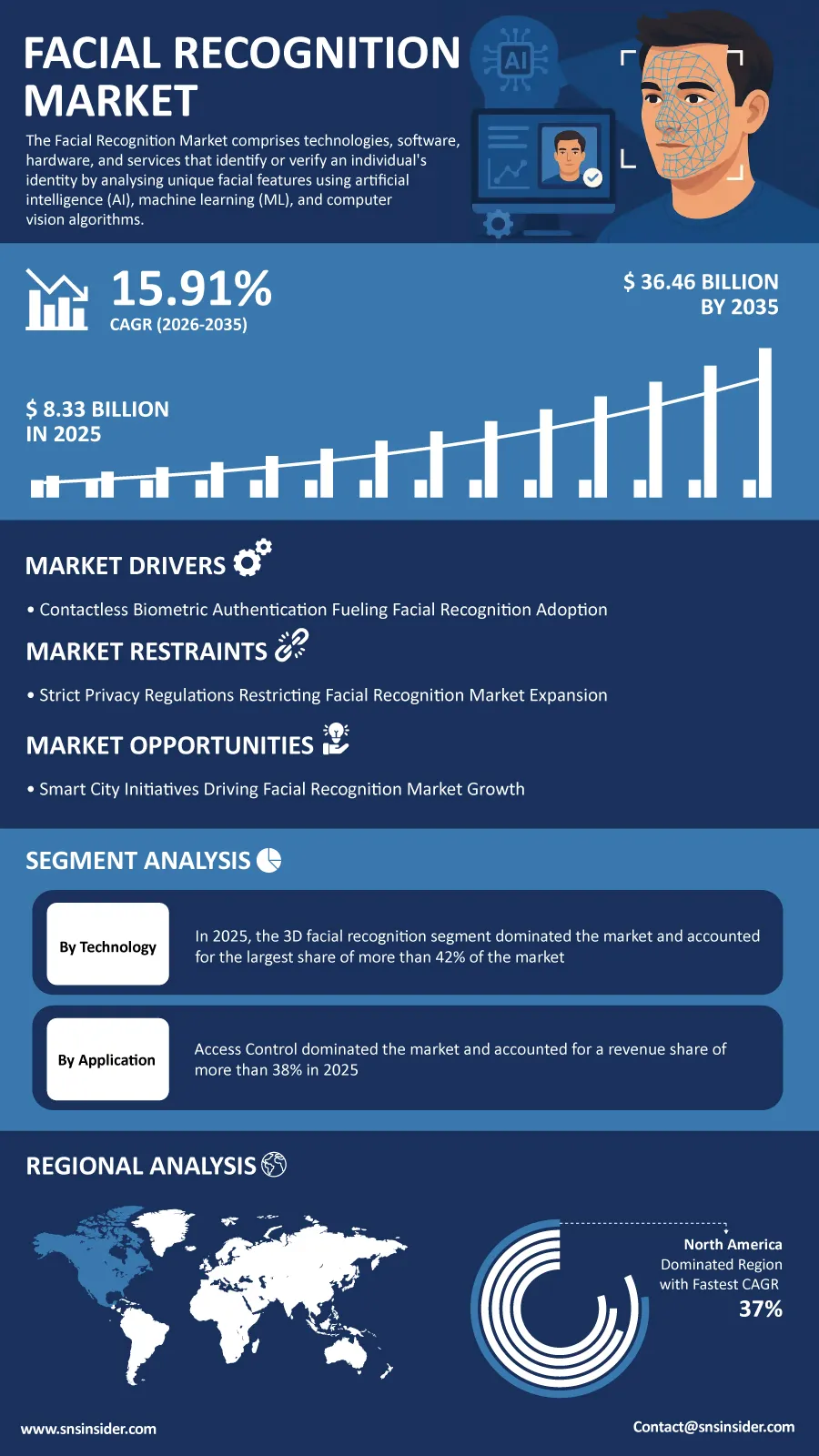
The global Facial Recognition Market is entering a high-growth phase as organizations increasingly adopt biometric technologies for identity verification, secure access, fraud prevention, and automated authentication. According to a recent study by SNS Insider, the global Facial Recognition Market size valued at USD 8.33 billion in 2025, is anticipated to grow to USD 36.46 billion by 2035, registering a CAGR of 15.91% over the 2026–2035 forecast period.
The fast development of artificial intelligence, deep learning, and computer vision has contributed to the better capability of face recognition technology to recognize people in various operating conditions. The demand for such systems is growing in finance, retail, healthcare, transport, security, etc. due to the convenience of using them and their capability to work without physical interaction.
Simultaneously, however, the emerging trend toward cloud-based biometric solutions allows organizations to implement facial recognition services in a distributed manner without significant on-site installation. Nonetheless, privacy, consent, data security and compliance with the regulations still remain among the factors that have to be taken into consideration.
To Get Detailed Insights on the Facial Recognition Market – Request a Sample Report
Smart Infrastructure and Digital Identity Expansion Create New Growth Opportunities
Smart city developments have opened up new possibilities for facial recognition vendors. Government bodies and infrastructure companies are investigating options for the use of biometrics in transportation centers, restricted entry premises, and security systems, whereas companies are using biometrics in order to enhance their identity verification and customer service processes.
Another sector that is helping to fuel market growth is banking and financial services due to the surging need for more robust digital onboarding and authentication processes. Facial recognition technology could play a significant role in identity verification through the remote process and help eliminate password usage, among other physical credentials.
Furthermore, advancements in three-dimensional facial mapping and AI-powered analytics are enabling the market to go beyond traditional authentication processes. The use cases related to customer engagement, behavior analysis, and security intelligence are expected to provide more opportunities during the forecast period.
Key Market Insights Highlight Shifting Demand Patterns
In terms of technology, it is anticipated that 3D facial recognition will constitute more than 42% of revenue generated by the market in 2025 based on its capability to determine the structure and depth of the face. Facial analytics will be the fastest growing market through 2035 as Sretailers, health care professionals, and marketers will be utilizing AI-based solutions to extract information based on facial structures and behaviors.
According to its application, it is projected that the access control application will account for more than 38% share of total market revenue by 2025. Biometric access control systems are being used at corporate sites, banks, government departments, and other restricted areas in place of traditional identification systems. The security and surveillance application is forecasted to witness the highest growth rate due to increasing use of video systems that leverage artificial intelligence technology.
According to end use, retail and ecommerce applications will continue to remain in the lead in 2025 due to the requirement of providing personalized customer experience, protecting against losses, reducing frauds, and carrying out transactions in an automated way. Healthcare is set to witness the highest growth rate among all end users since hospitals and digital health companies will deploy biometric authentication for their patients.
AI Innovation Strengthens Authentication and Security Applications
New developments in machine learning are making facial recognition systems work more effectively under difficult conditions as well as reducing their susceptibility to fake identification attempts. The use of facial recognition in combination with video analytics, cloud computing, and Internet of Things technology is expanding its use cases further.
However, even today, the market still faces some hurdles associated with the acquisition and analysis of biometric data. Issues of data protection laws, ethics, and diverse regulations in different countries are pushing the technology vendors and their users to adopt responsible practices in the use of the technology.
North America Leads with Over 37% Revenue Share While Asia Pacific Accelerates AI Security Adoption
The North American region is estimated to have contributed over 37% of the global market revenue by 2025, owing to large-scale investment in the field of artificial intelligence, well-established digital infrastructure, and wide application of facial recognition across various sectors. The United States of America is another significant country driving demand within the region due to increasing use of facial recognition technologies.
The Asia Pacific region will become the most rapidly growing regional market up to 2035 due to rapid urbanization, smart cities development, digital identity projects, and increasing investments into AI-powered security infrastructures. The growth of the market in China, India, Japan, and other countries of the region will create new opportunities.
On the other hand, Europe is progressing steadily due to the delicate balancing act carried out by these organizations to meet biometric security needs without violating strict data privacy and protection laws. Latin America and the Middle East and Africa, on the other hand, are experiencing a gradual increase in the use of biometrics.
Industry Participants Focus on Secure Biometric Innovation
The competitive environment still remains quite volatile, since technology firms still continue to make investments in AI algorithms, biometric technologies, cloud computing, and privacy-oriented authentication products. The focus of market players is now on boosting accuracy of recognition, enhancing cybersecurity, increasing use cases, and ensuring compliance with regulations.
Key companies operating in the global Facial Recognition Market include Apple Inc., NEC Corporation, Cognitec Systems GmbH, Thales Group, Aware, Inc., FaceFirst, Inc., IDEMIA, Microsoft Corporation, Amazon Web Services (AWS), Google LLC, IBM Corporation, Clearview AI, AnyVision, TrueFace, Herta Security, and Vintra Inc.
An SNS Insider analyst Sushant Kadam commented, “The convergence of artificial intelligence, digital identity, and connected security infrastructure is accelerating demand for facial recognition across commercial and public-sector applications. Providers that prioritize accuracy, cybersecurity, privacy safeguards, and responsible deployment will be best positioned to capture opportunities as biometric authentication becomes increasingly embedded in digital services.”
About the Author

Get in touch




