
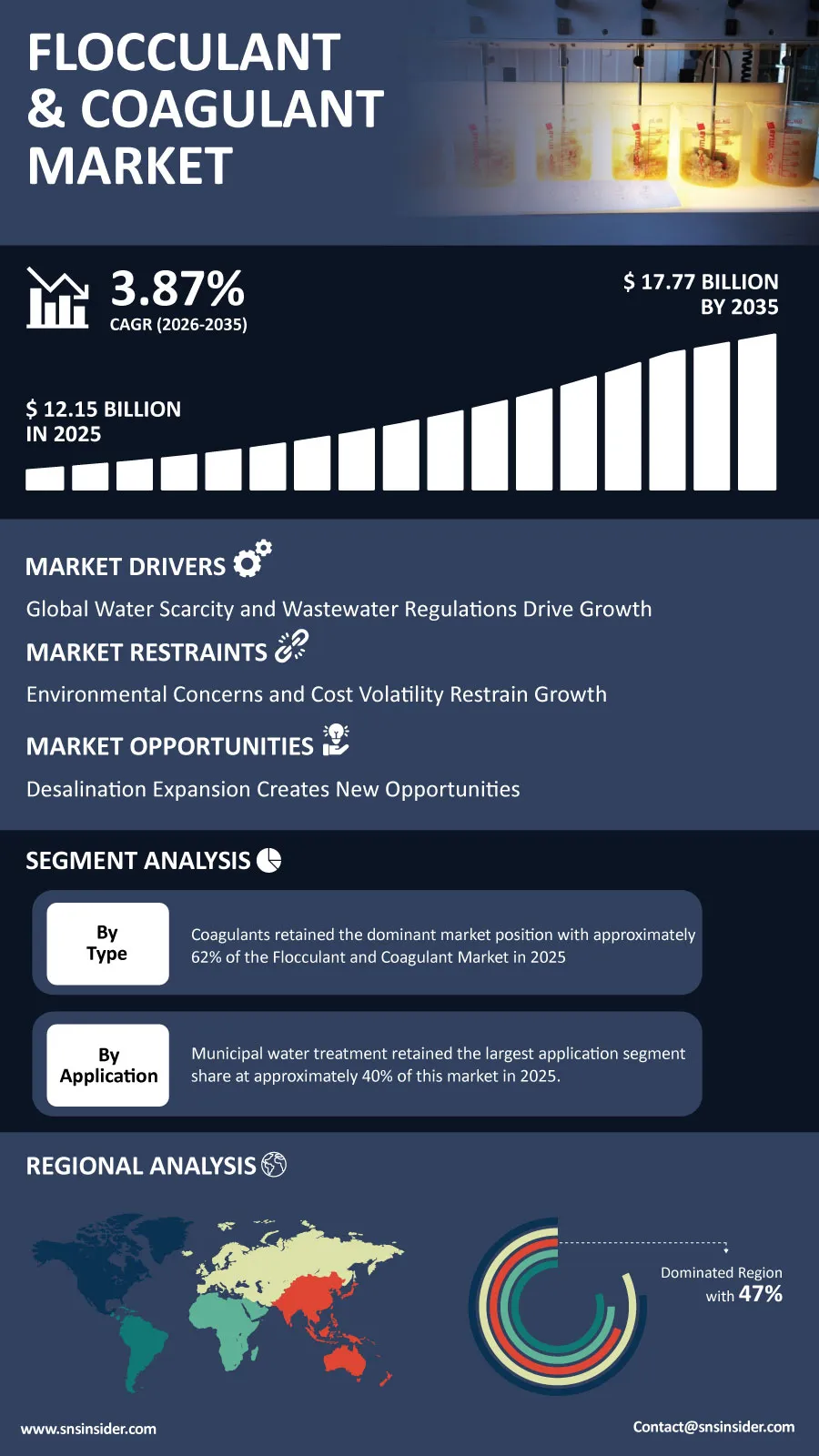
The Flocculant and Coagulant Market around the globe is growing continuously owing to the increasing focus of governments, municipalities, and industries on improving water quality and enhancing wastewater treatment facilities. “According to a recent study by SNS Insider, the global Flocculant & Coagulant Market size valued at USD 12.15 Billion in 2025, is anticipated to grow to USD 17.77 Billion by 2035, registering a CAGR of 3.87% over the 2026–2035 forecast period.”
The strong demand for advanced water treatment chemicals continues to be driven by growing pressure on global freshwater resources coupled with continually tightening environmental regulations. Municipal authorities are upgrading outdated treatment facilities, while industries are adopting next-gen capital-effective water recycling systems to cut their freshwater consumption and align themselves with the set-in-stone compliance regulations increasingly becoming more stringent.
Increasing adoption in mining, power generation, food processing, oil & gas, pulp and paper and chemical manufacturing which all require good solid-liquid separation to operate economically and sustainably is also fuelling the market. Innovation in treatment chemistry is an ongoing process, allowing operators to maximize purification while minimizing chemicals used.
To Get Detailed Insights on the Flocculant & Coagulant Market – Request a Sample Report
Water Sustainability and Industrial Recycling Create Long-Term Growth Opportunities
Growing demand for sustainable water infrastructure worldwide is generating revenue potential for flocculants and coagulants manufacturers. With urbanization and the rising population, there is a growing burden on governments to increase municipal treatment capacity and improve distribution networks.
At the same time industrial sectors are investing in state of art water recovery techniques that can significantly lower operating costs and meet ever tightening waste discharge regulations. High performance treatment chemicals are used in increasing volumes across manufacturing facilities globally, driven by zero-liquid-discharge systems, water reuse projects and circular water management strategies.
Innovation is propelled by new market opportunities where company development of biodegradable polymers, bio-based coagulants and green formulations that continue unsustainable objectives & high-efficiency treatment performance. Such solutions are gaining appeal for utilities and industrial operators looking for reduced environmental footprints.
Key Market Insights Highlight Changing Demand Patterns
By type, Coagulants accounted for over 62% of total market revenue in 2025 owing to the necessity of primary water clarification at both municipal and industrial treatment facilities. Flocculants are anticipated to register the maximum growth through 2035, as industries focus on improving sludge dewatering, increasing water recovery, and developing high-capacity treatment operational.
Municipal Water Treatment held about 40% of global market revenue in 2025 and will exceed USD 180 billion as of recent trends focused on continued investment in drinking water infrastructures worldwide. As manufacturing industries bolster wastewater management and resource recovery programs, it is anticipated that Industrial Wastewater Treatment will show the most growth during the forecast period.
By 2025, Liquid accounted for the highest share of global sales as they are easy to handle, vanish quickly and are mainly utilized in big scale treatment plants. Dry formulations are likely to see steady growth in smaller treatment plants and in developing economies that want cost-efficient transport and storage.
Advanced Treatment Technologies Strengthen Industry Innovation
Technological advancement continues to change the water treatment chemical industry. Innovative manufacturers are also serving with high-performance formulations that can deliver better treatment efficacy across different water quality conditions while using less sludge and chemicals.
Operational performance is being enhanced by digital transformation as automated dosing systems for water treatment, real-time monitoring platforms, and AI-assisted treatment optimization have become critical parts of the new utility toolkit. These smart solutions will enable utilities and industrial sites to operate more efficiently, with lower operating costs, create stable processes within their plants, effectively meet regulatory challenges and drive long-term sustainability goals.
Asia Pacific Captured 47% of Water Treatment Chemicals Market Revenue in 2025; North America and Europe Accelerate Advanced Water Infrastructure Investments
In 2025, Asia Pacific was the largest regional market with over 47% of global revenue share, propelled by major investments in municipal water infrastructure along with rapid industrialization and growing manufacturing activity & wastewater treatment capacity across China, India and Southeast Asian countries. Upscaling of urban development initiatives and government-aided water conservation measures are likely to cement the regional leadership.
With a high demand for sophisticated municipal treatment systems, industrial water recycling, and exploitation of rigid environmental regulations, North America continues to be an important market. Stable regional demand continues to be aided by the ongoing modernization of treatment facilities along with growing emphasis on developing impurities in water.
Europe continues to drive robust market growth with its stringent environmental regulations, better sustainable water management practices and widespread adoption of advanced wastewater treatment technologies while the Middle East & Africa are poised to gain substantially led by strong desalination capacity expansion and industrial water infrastructure development.
Industry Participants Focus on Sustainable Chemistry and Smart Water Solutions
The competition in the flocculant and coagulant market, on a global scale continues to revolve around innovation, sustainability and operational efficiency. Today, leading companies are still investing in a variety of bio-based treatment chemicals, polymer technologies geared toward high performance, digital water management platforms to optimize municipal and industrial non-residential applications, and broader manufacturing capacity to meet the evolving needs of their customers.
Key companies operating in the global Flocculant and Coagulant Market include Kemira Oyj, SNF Group, BASF SE, Ecolab Inc., Solenis LLC, Chemtrade Logistics Inc., Suez Water Technologies & Solutions, Veolia Water Technologies, Solvay S.A., Evoqua Water Technologies, Feralco AB, GEO Specialty Chemicals, Nouryon, Corteva Agriscience, Hychem Inc., PQ Group Holdings Inc., Kurita Water Industries Ltd., Accepta Ltd., Tidal Vision, and Aries Chemical Inc.
An SNS Insider analyst, Himanshu Sharma, commented, "Growing investments in water security, industrial wastewater treatment, and sustainable resource management are creating resilient long-term demand for advanced flocculant and coagulant technologies. Companies developing environmentally responsible formulations, intelligent dosing systems, and high-performance treatment solutions are expected to strengthen their competitive position as global water infrastructure continues to evolve."
About the Author

Get in touch




