
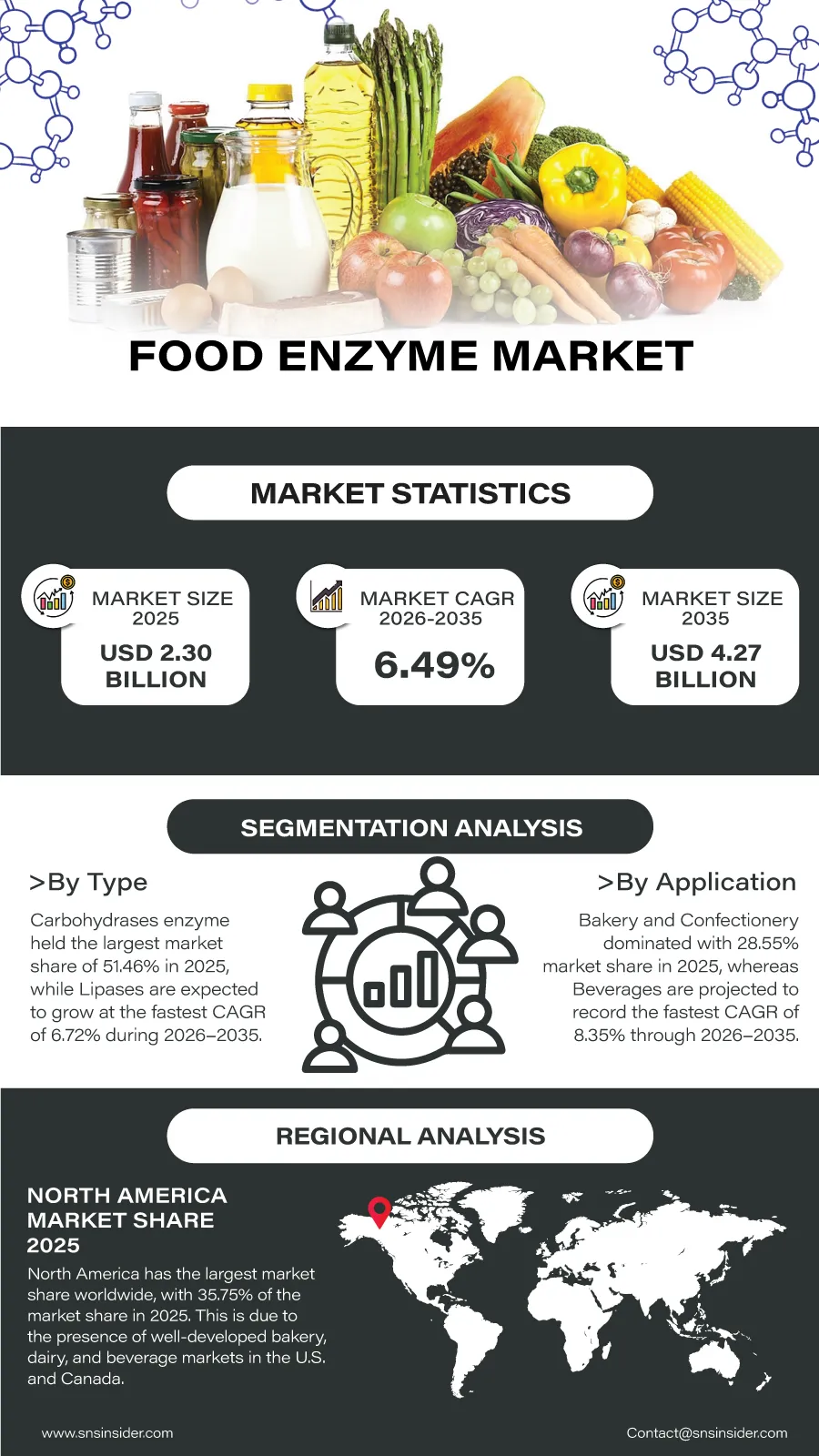
The global market of Food Enzymes is expected to register substantial growth due to the growing use by food processors of enzymes that help ensure better quality of products, streamline production processes, and satisfy consumer demands for health-friendly foods. “According to a recent study by SNS Insider, the global Food Enzyme Market size valued at USD 2.30 billion in 2025, is anticipated to grow to USD 4.27 billion by 2035, registering a CAGR of 6.49% over the 2026–2035 forecast period.”
The change in food habits, rise in use of processed foods, and constant advancements in food processing are providing the ideal setting for the use of enzymes in several types of foods. Food processors are employing the latest enzyme technologies in order to enhance the quality of their products and make the manufacturing process more eco-friendly.
As the global food industry continues to prioritize ingredient transparency and product quality, enzyme technologies are becoming an essential component of modern food processing.
To Get Detailed Insights on the Food Enzyme Market – Request a Free Sample Report
Innovation and Sustainable Processing Shape Industry Growth
Technology investments made by food companies are now being directed towards increasing manufacturing efficiencies while catering to the rising needs of consumers regarding natural products and ingredients. Advanced enzymes have become the tools which enable manufacturers to decrease processing times, increase consistency, and optimize resource usage without affecting performance.
Advances in biotechnology, fermentation, and enzyme engineering are bringing in new opportunities in the domains of baking, dairy processing, beverages, alternative protein sources, and nutrition. The sector is also observing the emergence of sustainable production processes including precision fermentation.
Growing interest in functional foods, protein-enriched products, and dairy alternatives is expected to further strengthen long-term demand for innovative enzyme solutions.
Key Market Findings Highlight Growth Opportunities
By different types of enzymes, carbohydrases made up the largest market share of 51.46% of global market revenue in 2025, due to their wide range of applications within the commercial food manufacturing industry.
In the meantime, the growth rate of lipases is expected to be the highest through 2035, growing at a CAGR of 6.72% on the back of rising demand for flavor development, milk products, and functional foods.
With regard to application, trends change as the number of products offered increases. The bakery & confectionery market was valued at 28.55% of total market revenue in 2025, leading other markets because of extensive use of the enzyme in the development of texture, better performance of dough, and more consistency. In the meantime, beverages market is predicted to grow at the highest CAGR of 8.35% in the forecast period due to innovations within the field of functional and premium beverages.
Based on the source, the microbial segment accounted for 63.12% of market revenue in 2025, due to its efficiency of production and popularity among consumers. In the meantime, the segment with the highest CAGR of 6.55% is expected to be plant-based enzymes due to growing demand for plant-based products.
When discussing the trend in formulations, powder formulations held the largest market share of 67.72% of total market revenue in 2025. Liquid formulations are predicted to have the highest CAGR of 7.78%, driven by increasing adoption across beverage processing and dairy manufacturing.
An Infographic Representation of the Global Food Enzyme Market
Consumer Preferences Continue to Drive Market Expansion
The increasing need for healthy foods and foods that contain natural ingredients is still influencing the way the food industry manufactures its products. Companies are now opting to use enzymes in place of traditional process aids that will not only help them in manufacturing but will also make their ingredient declarations cleaner.
Investment in innovations in food science, reformulation of products, and sustainable production is predicted to provide further avenues for enzyme producers in response to evolving consumer trends and regulatory standards around the world.
Regional Markets Continue to Expand
In North America, the market revenue share stood at 35.75% in 2025 due to the presence of robust food manufacturing facilities, innovative abilities, and wide use of enzymes in bakery, dairy, and beverages industry. Investments into producing high quality food products and ingredients would sustain the dominance of this region in the market.
At the same time, Asia Pacific region will become the most rapidly developing segment of the market. It is expected that its CAGR will reach 8.69% until 2035. Growth in urban population, rise in disposable income, and increased popularity of plant nutrition are the major factors stimulating development in this region.
Leading Companies Focus on Innovation and Sustainable Solutions
Competition within the food enzyme market remains dynamic as manufacturers continue investing in biotechnology innovation, production capacity expansion, and strategic partnerships to strengthen their global presence. Industry participants are developing next-generation enzyme solutions that improve manufacturing efficiency while supporting sustainability objectives across the food value chain.
Key companies operating in the global food enzyme market include Novozymes, DSM-Firmenich, Archer Daniels Midland, Cargill, Kerry Group, International Flavors & Fragrances, BASF, Amano Enzyme, Advanced Enzyme Technologies, and Nagase & Co..
An SNS Insider analyst Santosh Bhul commented, "The food enzyme industry is evolving rapidly as manufacturers seek technologies that improve production efficiency, enhance product quality, and support sustainable food manufacturing. Continued innovation in enzyme engineering and biotechnology will remain central to the market's long-term growth trajectory."
About the Author

Get in touch




