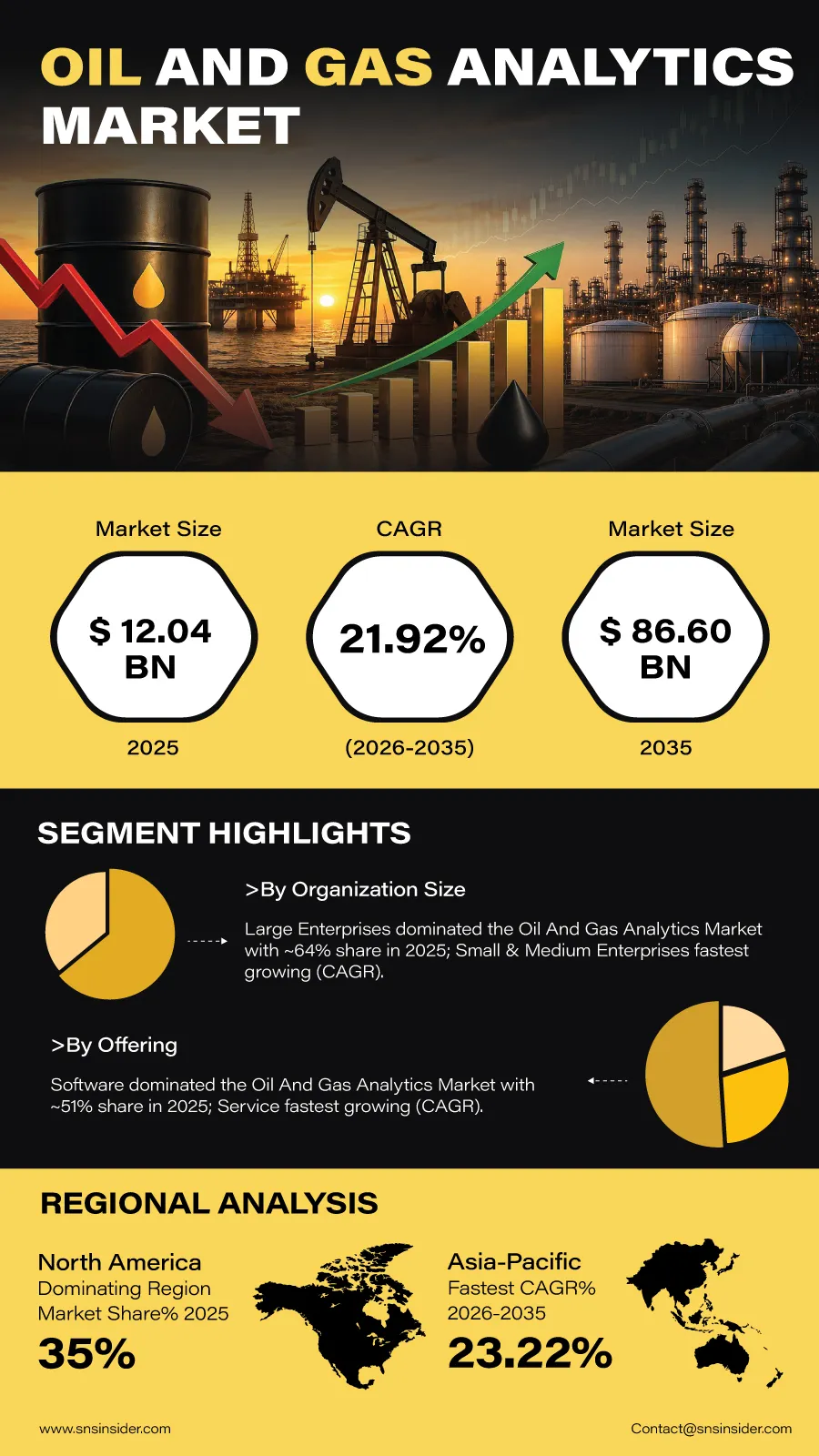
The global Oil And Gas Analytics Market is poised for remarkable expansion as energy companies accelerate digital transformation initiatives to improve operational efficiency, optimize production, and strengthen decision-making across complex upstream, midstream, and downstream operations. According to a recent study by SNS Insider, the global Oil And Gas Analytics Market size valued at USD 12.04 billion in 2025, is anticipated to grow to USD 86.60 billion by 2035, registering a CAGR of 21.92% over the 2026–2035 forecast period.
With more companies adopting advanced analytics platforms to analyze huge amounts of operational data collected across their upstream, midstream, and downstream operations, digital intelligence is set to become an integral part of today’s energy infrastructure.
To Get Detailed Insights on the Oil and Gas Analytics Market – Request a Free Sample Report
Increasing popularity of artificial intelligence, machine learning, cloud computing and Internet of Things (IoT) technology allows energy producers to better predict equipment failures, optimize reservoir management and streamline production workflows. This helps companies maintain profitability amid challenging market conditions.
Digital Transformation Continues to Unlock New Growth Opportunities
Energy producers are making significant investments in cloud-based analytics platforms able to deliver real-time operational intelligence across multiple facilities deployed across different locations.
The increasing convergence of AI-powered analytics, digital twins, automation and visualization tools enables better forecasting capabilities and proactive asset management. This not only improves operational decisions but also safety and environmental performance.
Furthermore, the increased collaboration between energy producers, technology vendors and analytics providers accelerates innovation within the industry. Companies continue investing in intelligent data ecosystems which increase operational resilience and help companies meet their sustainability goals.
Key Market Insights Highlight Shifting Demand Patterns
Based on organization size, large enterprises are expected to capture around 64% of global market revenues in 2025 owing to their considerable investments in digital infrastructure, enterprise analytics platforms and optimization initiatives. Small and medium enterprises are expected to exhibit the highest growth rate through 2035.
On the basis of application, upstream operations are anticipated to contribute nearly 50% of market revenues in 2025 driven by the wide use of analytics in the areas of seismic interpretation, drilling optimization and reservoir management. The downstream segment is expected to demonstrate the highest growth driven by the increased adoption of intelligent analytics solutions in optimizing logistics, production planning and customer operations.
With respect to offerings, software is estimated to contribute around 51% of revenue in the market in 2025 due to its importance in processing, analyzing, and visualization of data associated with operations. The services segment is predicted to be the fastest growing one as there will be growing demand for implementation, consulting, integration, and managed analytics.
According to the type of analytics, predictive analytics will generate about 28% of revenue in the market in 2025 as firms would want to predict any failures of equipment, forecast productions, and manage risks. AI and machine learning analytics will experience rapid growth over the forecast period as there is growing need for automation and decision-making in real time.
With respect to deployment mode, cloud-based deployment will dominate the market with approximately 60% of revenue in 2025 and the fastest growth rate in the forecast period.
An Infographic Representation of the Global Oil and Gas Analytics Market
Intelligent Analytics Reshape Energy Operations
Energy companies are not sticking to old ways of measuring their operations but are shifting to intelligent systems, which can analyze the performance in all stages of value creation in real time. With the help of algorithms and automation, the reaction to changes in production becomes quicker and operational disruptions become less frequent.
Cybersecurity, environmental protection, and emission monitoring are some of the factors leading organizations to develop an analytics ecosystem, which provides safe and transparent operations of companies.
Regional Markets Demonstrate Strong Digital Investment
The North American region is likely to hold a share of around 35% of the market revenues globally by 2025 owing to extensive use of artificial intelligence, cloud computing, and modern IT infrastructure within the region’s oil and gas industry. The presence of robust technology ecosystems, innovations, and significant investments in digitization is helping the region maintain its dominance in the market.
The Asia-Pacific region is likely to grow at the highest CAGR of around 23.22% through 2035 due to rapid industrialization, energy demand, explorations, and digital transformation initiatives in the region.
As the governments and energy firms become more focused on efficiency, cost reduction, and sustainable resource utilization, there will be an increasing demand for intelligent analytics solutions in the mature as well as emerging energy markets.
Industry Participants Focus on AI-Driven Innovation
The competitive environment is constantly changing due to the fact that technology vendors are developing their product portfolio by means of artificial intelligence, cloud computing, predictive analytics, cybersecurity, and enterprise data management. Companies are developing digital solutions for the effective intelligent asset management and real-time monitoring, as well as enterprise-level operations optimization.
Leading players on the global Oil And Gas Analytics market include IBM Corporation, Oracle Corporation, SAP SE, Halliburton, Schlumberger Limited, Accenture PLC, SAS Institute Inc., Hitachi Vantara Corporation, General Electric Company, Microsoft Corporation, Teradata Corporation, Siemens AG, Capgemini SE, Cisco Systems, Inc., Intel Corporation, TIBCO Software Inc., Palantir Technologies Inc., Amazon Web Services, Inc., Northwest Analytics, and Essar Oils.
SNS Insider analyst Santosh Bhul commented, "Rapidly converging technologies such as artificial intelligence, cloud computing and advanced analytics can revolutionize the way that energy companies can optimize their operations along the entire value chain in the oil and gas industry. The companies that make an investment in digital platforms, predictive intelligence and real-time visibility are more likely to grow and become efficient."
About the Author

Get in touch