
Food Enzyme Market Report Scope & Overview:
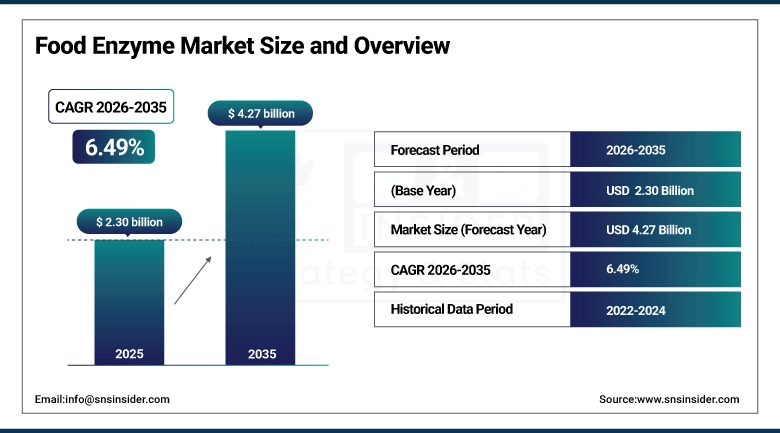
The Food Enzyme Market size is valued at USD 2.30 Billion in 2025 and is projected to reach USD 4.27 Billion by 2035, growing at a CAGR of 6.49% during the forecast period 2026–2035.
The report for the analysis of the Food Enzyme market includes various segments such as food enzymes, application, source, and formulation, among others. Factors such as the increasing demand for processed and convenient food, the trend for using natural ingredients, and the development in technology for food enzymes produced by microorganisms and recombinant technology are some of the factors that are positively affecting the Food Enzyme market, which is expected to grow at a high rate between 2026 and 2035.
In 2025, Food enzyme usage exceeded 3.2 million metric tons in 2025, this surge reflects the expanding role of enzymes in improving quality, shelf-life, and sustainability.
Market Size and Forecast:
-
Market Size in 2025: USD 2.30 Billion
-
Market Size by 2035: USD 4.27 Billion
-
CAGR: 6.49% from 2026 to 2035
-
Base Year: 2025
-
Forecast Period: 2026–2035
-
Historical Data: 2022–2024
To Get more information on Food Enzyme Market - Request Free Sample Report
Food Enzyme Market Trends:
-
Enzymes are replacing synthetic additives, enabling “clean-label” claims in bakery, dairy, and beverages.
-
Recombinant/engineered enzymes are emerging strongly, offering tailored properties and higher efficiency for industrial-scale applications.
-
Powdered forms dominate due to stability and shelf life and Liquid formulations are the fastest-growing especially in beverages and dairy.
-
Advances in precision fermentation and enzyme engineering are enabling sustainable production.
-
Encapsulation technologies are improving enzyme stability and controlled release in bakery and confectionery.
-
Compliance with GRAS (U.S.), EFSA (Europe), FSSAI (India) is critical.
-
Kosher, Halal, and Organic certifications for faster approvals.
U.S. Food Enzymes Market Insights:
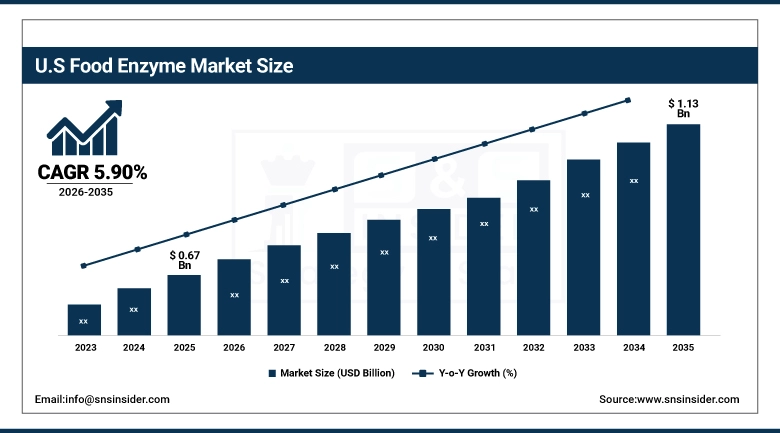
The U.S. Food Enzymes Market is projected to grow from USD 0.67 Billion in 2025 to approximately USD 1.13 Billion by 2035, at a CAGR of 5.90% during 2026–2035. Growth is driven by strong demand in bakery, dairy, and beverage applications, widespread adoption of microbial and recombinant enzyme sources, and increasing consumer preference for clean-label, organic, functional foods, FDA GRAS approvals.
Food Enzyme Market Growth Drivers:
-
Growing awareness about the nutritional benefits of digestive enzymes is a key driver of the Food Enzymes Market.
Increasing consumer awareness of healthy food items, which can be attributed to urbanization, pollution, health issues, and changes in food habits, is contributing to the increasing demand. Government initiatives to raise awareness in rural areas, the increasing number of women and professionals in the labor force, and the lack of time to prepare healthy meals have fueled the demand for healthy and convenient food. Food enzymes are significant in increasing the nutrient content and digesting food by hydrolyzing proteins, fats, and carbohydrates.
Over 2025, food enzyme usage exceeding 3.2 million metric tons, underscoring their growing importance in modern food processing and nutrition.
Food Enzyme Market Restraints:
-
High R&D costs, regulatory hurdles, and limited awareness in emerging markets are key restraints on the Food Enzymes Market.
Stringent approval procedures by various regulatory bodies such as FDA, EFSA, and FSSAI also lead to higher time-to-market costs. Apart from this, the requirement for developing separate facilities for enzyme production also leads to a high capital cost. Apart from this, competition from synthetic food additives and fluctuations in raw material costs are also a threat to the profitability of this industry. Low consumer awareness in developing countries about the nutritional benefits of using enzymes is also a drawback.
In 2025, regulatory compliance costs accounted for over 12% of total production expenses for leading food enzyme manufacturers, highlighting the significant impact of these restraints on market expansion.
Food Enzyme Market Opportunities:
-
Expanding applications in functional foods and beverages, coupled with rising demand for clean-label and sustainable products.
The industry is also using microbial and recombinant enzyme technology to offer new and innovative products in bakery, dairy, beverages, and infant nutrition. The increasing demand for lactose-free dairy products, protein-fortified snacks, and fortified food products is driving the market. In addition, precision fermentation and encapsulation technology have been used to develop efficient enzymes.
In 2025, food enzyme usage exceeded 3.2 million metric tons globally, highlighting the scale of opportunity for manufacturers to innovate and expand into new nutritional and functional food categories.
Food Enzyme Market Segments:
-
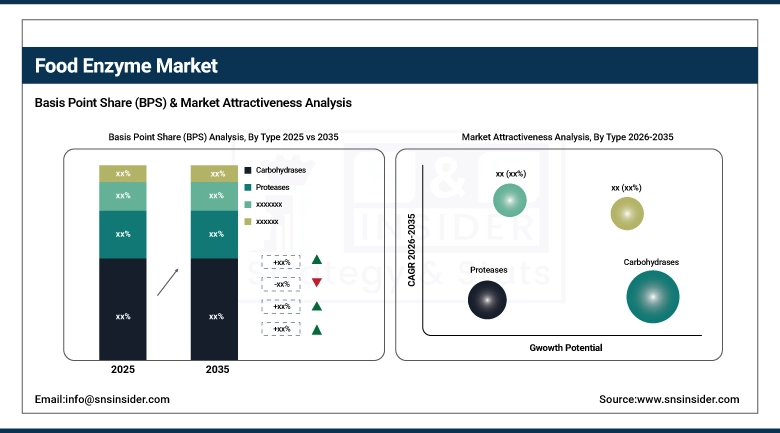
By Type, Carbohydrases enzyme held the largest market share of 51.46% in 2025, while Lipases are expected to grow at the fastest CAGR of 6.72% during 2026–2035.
-
By Application, Bakery and Confectionery dominated with 28.55% market share in 2025, whereas Beverages are projected to record the fastest CAGR of 8.35% through 2026–2035.
-
By Source, Microbial Sources accounted for the highest market share of 63.12% in 2025, while Plant Based Sources are expected to grow at the fastest CAGR of 6.55% during the forecast period.
-
By Formulation, Powdered Forms dominated with a 67.72% share in 2025, while Liquid Formulations are anticipated to expand at the fastest CAGR of 7.78% through 2026–2035.
Food Enzyme Market Segment Analysis:
By Type, Carbohydrases Dominate While Lipases Grow Rapidly:
Carbohydrase segments have been at the core of food enzyme market growth, given their use in bakery, confectionery, and beverage products, where they have been successfully used to improve texture, sweetness, and shelf life. In 2025, the use of carbohydrases was at an impressive figure of over 1.4 million metric tons, showing the high dependence of food manufacturers on these enzyme-based food products.
Lipases have been the fastest-growing segment in the food enzyme market, given their increasing use in dairy products, fats, and oils, as well as in functional foods that require improved flavor and digestibility. In 2025, the use of lipases was at an impressive figure of over 0.6 million metric tons
By Application, Bakery & Confectionery Dominate While Beverages Grow Rapidly:
Bakery & Confectionery segment accounted for the major share in the food enzymes market, as it is used for improving the texture, stability, and shelf-life of bread, cakes, and pastries with in effectiveness in enhancing product quality. In 2025, the utilization rate for bakery & confectionery enzymes was over 1.1 million metric tons, reflecting their significance in mass production.
Beverages are the fastest-growing segment, driven by expanding applications in brewing, juices, and functional drinks where enzymes improve clarity, flavour, and nutritional value. Adoption surged in 2025, with beverage enzyme usage surpassing 0.7 million metric tons, reflecting their rising importance in clean-label and health-focused beverage categories.
By Source, Microbial Enzymes Dominate While Plant-Based Enzymes Grow Rapidly:
The microbial sources segment was dominant in the food enzyme market, as these sources are widely used in the food industry, including the bakery, dairy, and beverage segments. The efficiency of these sources has been proven over the years, and as such, they are the backbone of enzyme production worldwide. The use of microbial enzyme sources was over 2 million metric tons in 2025, which speaks to their significance in industrial manufacturing.
The plant-based sources segment is growing at the fastest rate due to the rise in the demand for plant-based sources. The use of plant-based enzyme sources exceeded 0.5 million metric tons in 2025. The demand for plant-based products has been growing as more and more people are opting for vegan products.
By Formulation, Powdered Forms Dominate While Liquid Formulations Grow Rapidly:
Powdered forms segment holds a considerable market share in the food enzymes market in 2025. Powdered forms have been used in food products on a larger scale due to their reliability. Their ability to ensure their effectiveness in baked goods, confectionery, and processed food products makes powdered forms the most preferred form. In 2025, powdered forms of enzyme usage exceeded 2.4 million metric tons.
Liquid forms segment is growing at a fast pace due to their ease of use in beverage and dairy products. Liquid enzyme usage has seen significant adoption in 2025, exceeding 0.8 million metric tons.
Food Enzyme Market Regional Analysis:
North America Food Enzymes Market Insights:
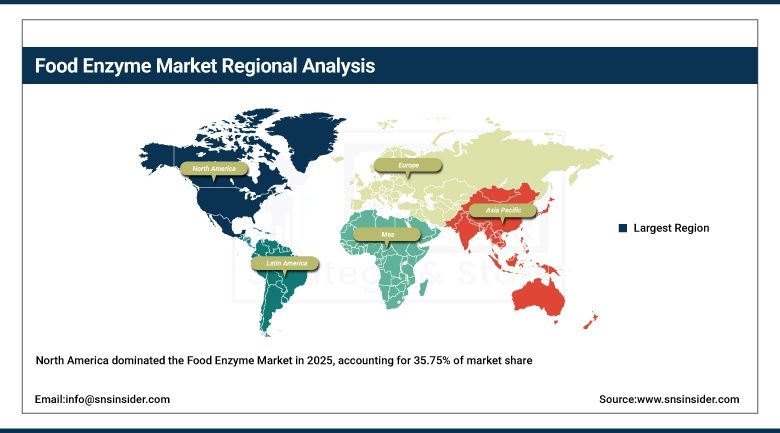
North America has the largest market share worldwide, with 35.75% of the market share in 2025. This is due to the presence of well-developed bakery, dairy, and beverage markets in the U.S. and Canada. The U.S. market has seen significant use of the enzyme in bread, pastries, and lactose-free dairy products. In Canada, there has been an emerging trend of craft brewing and fortified foods. The enzyme has also been used in meat products and nutritional supplements, hence showing its potential uses. The total consumption was over 1.3 million metric tons.
Get Customized Report as per Your Business Requirement - Enquiry Now
U.S. Food Enzymes Market Insights:
The market in the U.S. is driven by bread, snack food production, and dairy alternatives. Enzymes find wide usage in industrial bakery chains, cheese production, and beverage processing, including beer and juice. Strong FDA GRAS support, advanced food processing capabilities, and consumer preference for clean label products are driving factors for innovation in this market.
Asia-Pacific Food Enzymes Market Insights:
The Asia-Pacific market has the fastest growth rate, at 8.69% CAGR. Urbanization and increased middle-class spending are driving demand for baked goods, beverages, and dairy substitutes in India, China, and Japan. Enzymes are increasingly being used to produce soya-based drinks, rice-based baked products, and fortified foods. The use of microbial sources of enzymes is dominant, but plant-based sources are also rising in vegan diets. The pace of innovation in dairy substitutes and drinks underscores the growth rate of the market.
China Food Enzymes Market Insights:
China is the largest contributor in Asia-Pacific, fueled by the increasing consumption of bread and pastry in urban cities like Shanghai and Beijing. Enzymes are used in the brewing industry, in products like soy milk, and in fortified nutrition. Microbial enzymes are used in the production of enzymes, but plant-based enzymes are becoming popular due to their increasing demand in the market.
Europe Food Enzymes Market Insights:
Europe, as a market, is considered to be a developed but developing market. Countries such as France and Italy are major demand creators for this market, considering their long history of bread-making. Countries such as Germany and the Netherlands are major innovation creators for dairy and beverage products. This market has shown good penetration for enzyme use in artisan bread, cheese, brewing, and confectionery, considering their food culture. This market will be helped by effective regulation through EFSA, ensuring safe and sustainable food products. Clean label and green food processing will continue to support Europe as a leader in the enzyme market.
Germany Food Enzymes Market Insights:
Germany has also turned out to be one of the major hubs for the advancements of enzyme technology and food processing. Enzymes are also playing a major role in the production of bakery items like bread, pretzels, and pastries, which are major areas of bakery culture in Germany. Dairy-free foods, like oat and soy-based foods, are also gaining popularity, owing to the increasing demand for plant-based nutrition. Beer production also ranks high, with the help of efficient enzyme technology, along with sound R&D, EFSA regulations, and sustainable production processes.
Latin America Food Enzymes Market Insights:
Latin America is considered an emerging market, and it is constantly growing. The demand in Brazil is driven by its high bakery market, in which enzymes are used in bread, cake, and confectionery production. Mexico presents significant usage in dairy and meat processing, where enzymes are used to enrich cheese and protein digestibility in meat products. Argentina and Chile add to this demand by their rising beverage market, especially in wine and beer production, where enzymes are used to clarify and enrich flavor.
Middle East & Africa Food Enzymes Market Insights:
Middle East & Africa, which is considered to be in the early stages of adoption, is developing, and the key segments are bakery and dairy. In the Middle East, Saudi Arabia and the UAE have high demand for Western-style baked goods, and in Africa, South Africa has high demand for dairy enzymes. Among the enzymes, carbohydrates dominate, and microbial is the primary source, in the form of powdered. Nutrition and increasing urban population are key growth drivers, and this region has high growth potential due to increasing urbanization, consumption of processed foods, and government initiatives that foster food innovation.
Food Enzyme Market Competitive Landscape:
Novozymes A/S is a leading Danish biotechnology company and the global pioneer in industrial enzymes, with a strong presence in the food enzymes market. Its portfolio includes carbohydrases, proteases, and lipases widely used in bakery, beverages, and dairy applications. Novozymes’ long-standing leadership is reinforced by substantial R&D investments, innovations in microbial and recombinant enzyme technologies, and sustainability-driven manufacturing strategies. Geographic expansion and partnerships with food manufacturers further strengthen its dominant position.
-
September 2025, Novozymes launched a next-generation baking enzyme designed to improve dough stability and extend shelf-life, enhancing product quality for global bakery producers.
Royal DSM (DSM-Firmenich), headquartered in the Netherlands, is a major player in food enzymes, offering diverse solutions across bakery, dairy, beverages, and nutrition. Its strong expertise in microbial fermentation and enzyme engineering has positioned DSM as a leader in clean-label and functional food innovations. Strategic acquisitions, lifecycle management, and global distribution networks reinforce its competitive edge.
-
July 2025, DSM-Firmenich announced the expansion of its enzyme production facility in Europe to meet rising demand for sustainable and plant-based food solutions.
Archer Daniels Midland (ADM), a U.S.-based multinational, is a key force in food processing and enzyme applications. ADM leverages its extensive agricultural supply chain and advanced bioprocessing capabilities to deliver enzyme solutions for bakery, dairy, and beverage industries. Its integrated approach, spanning raw material sourcing to enzyme innovation, ensures efficiency and scalability.
-
November 2025, ADM introduced a new enzyme blend tailored for dairy alternatives, supporting the booming plant-based market and enhancing nutritional profiles of soy and oat-based products.
Food Enzyme Market Key Players:
-
Novozymes A/S
-
Royal DSM (DSM-Firmenich)
-
Archer Daniels Midland (ADM)
-
Palsgaard
-
Riken Vitamin
-
Engrain
-
Associated British Foods
-
Cargill
-
David Michael
-
Kerry Group
-
International Flavors & Fragrances (IFF)
-
Sunson Industry Group Co. Ltd.
-
Purac Biochem
-
BASF
-
Advances Enzymes
-
Amano Enzyme
-
Dyadic International Inc.
-
Lumis Biotech Pvt. Ltd.
-
Maps Enzymes Ltd.
-
Nagase and Co. Ltd.
| Report Attributes | Details |
|---|---|
| Market Size in 2025 | USD 2.30 Billion |
| Market Size by 2035 | USD 4.27 Billion |
| CAGR | CAGR of 6.49% From 2026 to 2035 |
| Base Year | 2025 |
| Forecast Period | 2026-2035 |
| Historical Data | 2022-2024 |
| Report Scope & Coverage | Market Size, Segments Analysis, Competitive Landscape, Regional Analysis, DROC & SWOT Analysis, Forecast Outlook |
| Key Segments | • By Type: (Carbohydrases, Proteases, Lipases, Phytases, Others) • By Application: (Bakery & Confectionary, Beverages, Dairy & Desserts, Meat, Poultry & Seafood, Others) • By Source: (Microbial sources, Plant-Based Sources, Animal-derived Sources, Recombinant/Genetically Engineered, Others) • By Formulation: (Powdered forms, Liquid Formulations, Granular/Encapsulated, Customized Blends, Others) |
| Regional Analysis/Coverage | North America (US, Canada), Europe (Germany, UK, France, Italy, Spain, Russia, Poland, Rest of Europe), Asia Pacific (China, India, Japan, South Korea, Australia, ASEAN Countries, Rest of Asia Pacific), Middle East & Africa (UAE, Saudi Arabia, Qatar, South Africa, Rest of Middle East & Africa), Latin America (Brazil, Argentina, Mexico, Colombia, Rest of Latin America). |
| Company Profiles | Novozymes A/S, Royal DSM (DSM-Firmenich), Archer Daniels Midland (ADM, Palsgaard, Riken Vitamin, Engrain, Associated British Foods, Cargill, David Michael, Kerry Group, International Flavors & Fragrances (IFF), Sunson Industry Group Co. Ltd., Purac Biochem, BASF, Advances Enzymes, Amano Enzyme, Dyadic International Inc., Lumis Biotech Pvt. Ltd., Maps Enzymes Ltd., Nagase and Co. Ltd. |
Frequently Asked Questions
The Food Enzyme Market is expected to grow at a CAGR of 6.49% during 2026–2035.
The market was valued at USD 2.30 Billion in 2025 and is projected to reach USD 4.27 Billion by 2035.
The key drivers of the Food Enzyme Market include rising demand for processed foods, clean-label products, digestive health, bakery, dairy, and beverage applications.
The Carbohydrase segment dominated during the projected period.
North America dominated the Food Enzyme Market in 2025.
