
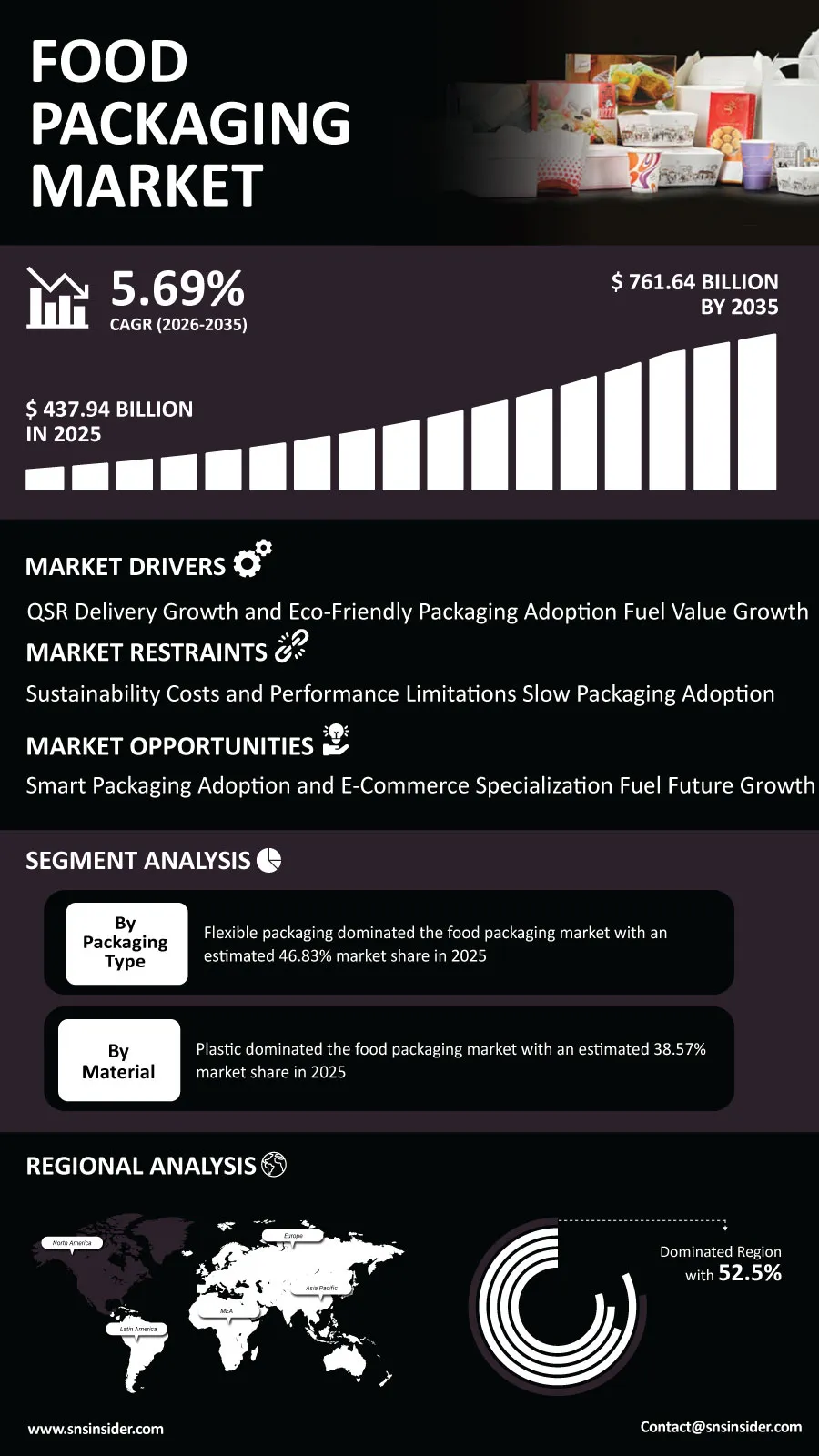
The Food Packaging Market is witnessing growth on a global level as food manufacturers and retail companies make increased efforts for adopting sustainable and high performance packaging solutions. “According to a recent study by SNS Insider, the global Food Packaging Market size valued at USD 437.94 Billion in 2025, is anticipated to grow to USD 761.64 Billion by 2035, registering a CAGR of 5.69% over the 2026–2035 forecast period.”
The continued increase in the consumption of packaged foods, the growth of organized retailing, and the increasing popularity of food delivery systems will keep on influencing packaging needs around the globe. There is an increasing trend of the use of recyclable materials, high barrier systems, and smart packaging that enhance food safety and shelf life. With the increasing emphasis of sustainability within brands' strategies, packaging innovation has become a key differentiator in the global food business.
To Get Detailed Insights on the Food Packaging Market – Request a Sample Report
Sustainable Packaging Innovation Creates Long-Term Growth Opportunities
The trend towards recyclable and fiber-based packaging solutions, which do not negatively affect the environment yet provide efficient protection to products, is being pushed by governments, retailers, and international food brands. Developments in mono-material flexible packaging, recyclable high-barrier films, and renewable packaging materials offer tremendous opportunities to packaging companies to introduce innovations in their product line that meet current environmental regulations.
Digital transformation is another direction that brings new prospects for packaging manufacturers thanks to smart packaging solutions. Information about the product on QR-code labels, freshness indicators, tamper-evident solutions, active packaging with oxygen scavengers and antimicrobial technology help improve traceability, reduce waste, and increase consumers’ trust. The rapid growth of online grocery delivery services stimulates the need for packaging solutions that can preserve the quality of the product in more complicated transportation processes.
Key Market Insights Highlight Changing Packaging Preferences
Flexible Packaging held around 46.83% of the global market revenue in 2025, and this is attributed to Lightweight nature, low cost platform, and wide usage across snacks, bakery, frozen food, dairy & pet food applications since all these products are lightweight & fragile. Instead Semi-rigid Packaging is anticipated to post the fastest growth throughout 2035, on the back of growing demand for prepared meals, fresh produce and high-end chilled food items.
Plastic was the most roleable material, accounting for around 38.57% of total revenue in 2025 due to its exceptional barrier function, ease of use and a relative low cost per unit. On the other hand, Paper and Paperboard are expected to grow most rapidly due to increasing PFAS restrictions, sustainability regulations, and end-use product demand for renewable surface treatment materials spurring uptake across a wide spectrum of food domains.
Based on the type of food, Meat and Seafood held the largest market share of close to 24.63% in 2025 due to high end applications of modified atmosphere packaging and high-barrier preservation technologies. On the other hand, Fruits and Vegetables are expected to remain dominant with the highest growth due to increasing demand for breathable films, anti-fog packaging and fresh produce preservation products. Quick Service Restaurants (QSRs) garnered 34.72% of the overall market revenue and remained the fastest-growing category in terms of end-use with continuous expansion of online food delivery platforms worldwide.
Smart Technologies Transform Modern Food Packaging
Intelligent technologies that bolster food safety, improved supply chain visibility and consumer engagement are now finding their way into packaging manufacturers. From smart labels to digital product passports, from NFC contact-based connectivity with each garment to full on blockchain-enabled traceability of textiles from field to store, brands are also using processes and formularies that help meet regulatory scrutiny when it is put in place.
At the same time, active packaging innovations are maintaining shelf life with more refined oxygen management, moisture control and antimicrobial protection. The continuing advancements in high-performance recyclable materials are offering manufacturers enhanced options to meet sustainability targets while still matching the needed barrier performance for fresh, frozen and processed food applications.
Regional Markets Continue Expanding Through Sustainability and Food Industry Growth
Asia Pacific was the largest regional market during 2025, propelled by rapid urbanization as well as a growing capacity for food manufacturing and increasingly widespread packaged food consumption and disposable income growth throughout China, India, Japan and Southeast Asia. As the leading sector in food processing and packaging manufacturing across Asia, China's forte continues to lead the region's dominance on the global stage.
The fastest-growing regional market over the forecast period is projected to be North America. The market in the region continues characteristics such as robust regulatory support for sustainable packaging, high usage of recyclable materials and cold-chain infrastructure as well as significant R&D focusing on sustainable polymer and plastic materials developed by prominent players. Europe continues to be an important area of innovation as regulatory initiatives drive recyclable packaging, circular economy efforts, and fiber-based substitutions.
Industry Participants Accelerate Sustainable Product Development
The competition for the global Food Packaging Market continues around sustainable materials, DLPs, lightweight products, and recycling performance. Major manufacturers stay committed to investing in advanced barrier materials, mono-material packaging platforms and intelligent packaging solutions to enable food producers achieve ever higher environmental and operational targets.
Key companies operating in the global Food Packaging Market include Amcor plc, Sealed Air Corporation, Berry Global Group Inc., Tetra Pak International SA, Smurfit Kappa Group plc, Mondi plc, Sonoco Products Company, WestRock Company, DS Smith plc, Huhtamaki Oyj, Constantia Flexibles Group GmbH, Bemis Company Inc. (Amcor), Coveris Group, CCL Industries Inc., Silgan Holdings Inc., Graphic Packaging Holding Company, Ardagh Group SA, Crown Holdings Inc., Ball Corporation, and AptarGroup Inc.
An SNS Insider analyst Himanshu Sharma commented, "The global transition toward recyclable materials, intelligent packaging technologies, and advanced food preservation solutions is reshaping the competitive landscape of the food packaging industry. Companies investing in sustainable material science, smart packaging platforms, and high-performance barrier technologies are expected to capture significant growth opportunities as food manufacturers continue modernizing packaging across global supply chains."
About the Author

Get in touch




