
Food Safety Testing Market Report Scope & Overview:
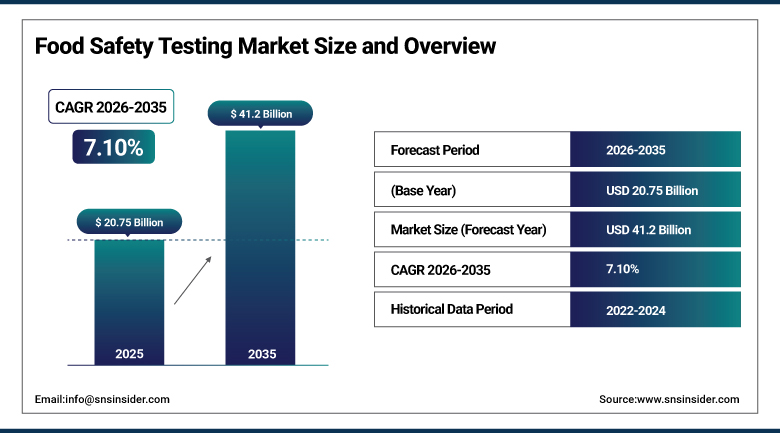
The Food Safety Testing Market was valued at USD 20.75 Billion in 2025 and is expected to reach USD 41.2 Billion by 2035, growing at a CAGR of 7.10% from 2026 to 2035.
The Food Safety Testing Market is expanding at an extremely fast rate due to high foodborne disease outbreaks, stringent regulatory requirements, and complex food trade across the globe. The process of food safety testing includes tests in laboratories and rapid tests that help detect any pathogens, allergens, chemical contamination, GMOs, or toxins in meat, poultry, seafood, dairy products, and processed foods, thereby ensuring compliance with regulations and safety of consumers. Moreover, the market growth is further propelled by increasing demands of consumers for greater transparency, rapid advances in PCR and biosensor tests for greater accuracy and quick diagnoses, and rapid point-of-need diagnosis tests that eliminate expensive product recalls.
Processed foods worth more than 800 billion dollars moved across borders in 2024, forcing exporters to secure certificates acceptable in at least three jurisdictions per shipment, while enforcement waves including the U.K.'s National Food Crime Unit opening 39 investigations involving adulterated spices and China's SAMR quarantining 1,100 tons of mislabeled whey protein continue steering budget toward comprehensive, product-specific testing.
To Get more information Food Safety Testing Market - Request Free Sample Report
Food Safety Testing Market Trends
-
Rising commercialization of rapid, point-of-need diagnostics is reducing testing turnaround time, enabling food processing companies to more quickly identify and address contamination risks.
-
Growing integration of blockchain for verifiable traceability is enhancing supply chain transparency, supporting consumer demand for detailed product origin and safety information.
-
Increasing adoption of subscription and outsourcing models for recurring testing services is providing food manufacturers cost-effective access to comprehensive safety testing capability.
-
Expanding technological advancements in PCR-based assays and biosensors are significantly improving the speed and accuracy of pathogen and contaminant diagnostics.
-
Strategic partnerships among testing laboratories, food manufacturers, and regulatory bodies are supporting development of increasingly efficient, comprehensive food safety verification systems.
U.S. Food Safety Testing Market Outlook
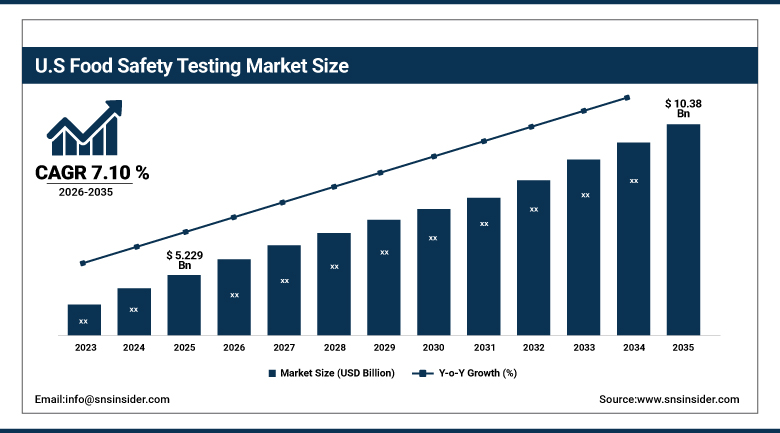
The U.S. Food Safety Testing Market was valued at USD 5.229 Billion in 2025 and is projected to reach USD 10.38 Billion by 2035, growing at a CAGR of 7.10% during 2026–2035.
The leading food safety testing labs in the country are constantly increasing their capacity owing to the FDA FSMA regulations that mandate science-based preventive controls at food facilities. An increase in food-borne disease outbreaks, as well as an increase in complexities in global food trade, continues to support domestic demand for food safety testing.
The United States holds the largest market share in the region, comprising about 60% of the total North American food safety testing market owing to the FDA FSMA regulations mandating science-based preventive controls at food facilities.
Food Safety Testing Market Segment Analysis
-
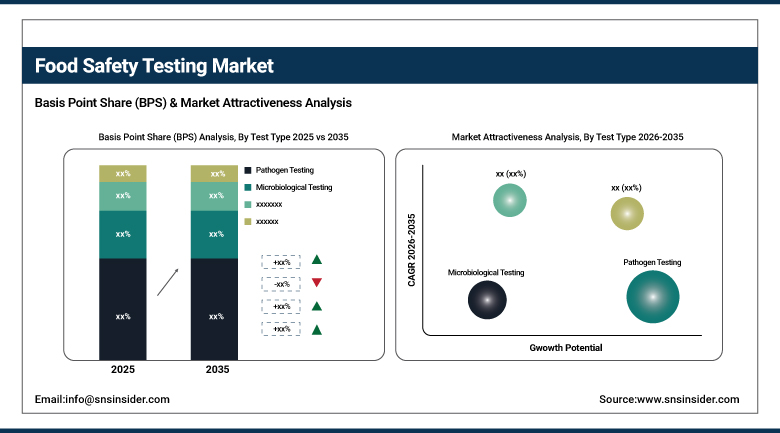
By Test Type, Pathogen Testing dominated the Food Safety Testing Market with a 44.00% share in 2025, while Microbiological Testing is the fastest-growing test type segment with a CAGR of 8.80% from 2026–2035.
-
By Application, Food dominated the Food Safety Testing Market with a 83.66% share in 2025, while Pet Food & Animal Feed is the fastest-growing application segment with a CAGR of 8.13% from 2026–2035.
-
By Technology, Traditional dominated the Food Safety Testing Market with a 62.60% share in 2025, while Rapid is the fastest-growing technology segment with a CAGR of 8.30% from 2026–2035.
-
By Contaminant Type, Microbial dominated the Food Safety Testing Market with a 43.30% share in 2025, while Pesticide & Residues is the fastest-growing contaminant type segment with a CAGR of 8.60% from 2026–2035.
By Test Type, Pathogen Testing dominated the Food Safety Testing Market, while Microbiological Testing is the fastest-growing segment.
The Pathogen Testing Segment leads the Food Safety Testing Market, representing about 44% of the global market share in 2025, owing to the mandatory requirement of testing Salmonella, Listeria, and E. coli. The Pathogen Testing Segment will continue to lead owing to strict regulations that require thorough bacterial contamination testing of meats, poultry, dairy, and ready-to-eat food products.
The Microbiological Testing Segment will increase from USD 3.5 Billion in 2024 to USD 7.5 Billion in 2035 and is projected to have the highest growth rate. Increasing regulatory pressure along with the advancement in PCR based assays and biosensor technology leading to faster diagnostics is fueling the growth in the microbiology testing segment.
By Application, Food dominated the Food Safety Testing Market, while Pet Food & Animal Feed is the fastest-growing segment.
On the basis of application, the food sector accounted for 83.66% of the 2025 revenue. The food applications segment is still the leading one because of the importance of food safety testing in meat, poultry, seafood, dairy, and processed food production which constitutes the biggest and the most mature application segment in terms of food safety testing requirements globally.
Pet food and animal feed are growing at a CAGR of 8.13% up to 2031. Rising awareness about the safety of nutrition of pets, as well as increasing regulations on the issue of contamination of animal feed, are the factors pushing the growth of the segment because of the involvement of pet food producers into safety testing.
By Technology, Traditional dominated the Food Safety Testing Market, while Rapid is the fastest-growing segment.
Traditional testing methods remain the dominant technology category owing to their established, widely validated laboratory protocols meeting the majority of regulatory certification requirements, representing the standard testing approach across the majority of comprehensive food safety verification programs worldwide.
The rapid segment is expected to grow at a considerable CAGR of 8.3% from 2026 to 2033. Technological advancements in testing techniques, such as PCR-based assays and biosensors, have enhanced the speed and accuracy of food safety diagnostics, driving rising demand for rapid testing solutions that reduce turnaround time and support point-of-need contamination screening.
By Contaminant Type, Microbial dominated the Food Safety Testing Market, while Pesticide & Residues is the fastest-growing segment.
The microbial contamination segment dominated the global food safety testing market by capturing 43.3% of share in 2025 with the persistent threat of pathogenic bacteria in perishable and ready-to-eat foods. According to the World Health Organization, Salmonella, Campylobacter, and Listeria monocytogenes are responsible for over 70% of foodborne illness cases linked to contaminated animal products and fresh produce.
The Pesticide & Residues segment is expected to register the fastest CAGR of 8.60% during the forecast period 2026-2035. Growing global food trade complexity and increasingly stringent sanitary and phytosanitary protocols requiring comprehensive scientific substantiation are driving rising demand for pesticide residue testing across increasingly diverse international food export supply chains.
Regional Analysis
|
Region |
Major Country |
Share within Region, 2025 (%) |
|---|---|---|
|
North America |
United States |
60.00% |
|
Europe |
Germany |
27.60% |
|
Asia Pacific |
China |
44.60% |
|
Middle East & Africa |
UAE |
25.60% |
|
Latin America |
Brazil |
37.70% |
North America Food Safety Testing Market Insights
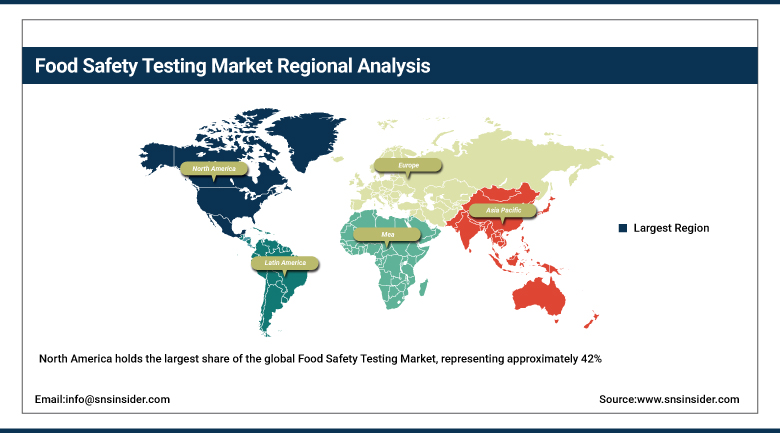
North America holds the largest share of the global Food Safety Testing Market, representing approximately 42% of the global market in 2025, driven by stringent regulatory frameworks and a highly developed food safety infrastructure.
The US was the leading country within the North America Food Safety Testing Market in 2025, capturing approximately 60% of the North American market share, supported by the FDA's FSMA regulations. Canada is contributing to regional growth through its own expanding food safety regulatory infrastructure and growing food export compliance requirements.
Get Customized Report as per Your Business Requirement - Enquiry Now
Europe Food Safety Testing Market Insights
The Europe Food Safety Testing Market was a major contributor in 2025. This is attributed to the region's strong regulatory frameworks, including the European Commission's Rapid Alert System for Food and Feed recording 412 notifications in 2023 related to processed foods, with 48% citing microbiological hazards.
Germany is one of the major markets in Europe owing to its strong food processing manufacturing base and stringent regulatory compliance requirements. Other countries such as the United Kingdom, where the National Food Crime Unit opened 39 investigations involving adulterated spices, are also contributing to market growth through expanding food fraud enforcement activity.
Asia Pacific Food Safety Testing Market Insights
Asia Pacific is expected to register the highest CAGR during the forecast period, driven by growing food trade complexity, rising foodborne illness awareness, and expanding food processing manufacturing capacity across the region.
China is one of the main growth drivers in the Asia Pacific Food Safety Testing Market, with China's SAMR quarantining 1,100 tons of mislabeled whey protein reflecting the region's growing enforcement activity. India and Southeast Asian nations, including major shrimp and poultry export supply chains, are also contributing to regional growth through expanding food safety testing infrastructure.
Middle East & Africa and Latin America Food Safety Testing Market Insights
Middle East & Africa and Latin American regions are gradually expanding food safety testing adoption as food processing and export infrastructure investment grows across both regions, supported by increasing regional regulatory compliance requirements.
Brazil is set to be a prominent Latin American market fueled by growing domestic food processing capacity and rising export compliance requirements. The Middle East & Africa region has UAE and Saudi Arabia investing in modern food safety testing infrastructure that is expanding access to comprehensive testing services across their growing food import and export sectors.
Market Dynamics
Growth Drivers: Rising foodborne illness outbreaks and regulatory compliance requirements driving market growth
Some of the key factors driving the growth of the Food Safety Testing Market include the increasing incidences of foodborne disease outbreaks, the need for stricter regulations, rising demand for food products from other countries, and the growing complexities of the food supply chains. Rising consumer demand for transparency and traceability is fueling the adoption of tests in increasingly complex global food supply chains.
There is an increase in stringent regulation globally that results in the need for high quality testing service of foods. There have been advancements in technology particularly in technologies such as polymerase chain reaction and biosensors that have led to increased accuracy and speed in the process of testing for diagnostic purposes. Moreover, there is the demand for packaged foods by consumers.
Restraints: High equipment costs and skilled workforce shortages limiting market expansion
High costs associated with advanced diagnostic technologies and reagents remain a major factor limiting widespread use of the technology, particularly by smaller food processors and laboratories due to lack of financial resources.
Furthermore, shortage of skills in handling such sophisticated technology and analyzing results remains another limitation in the use of advanced diagnostic technology. Time consumption when conducting laboratory testing also becomes another challenge, which calls for increased efforts to develop point-of-need diagnostic technology.
Opportunities: Expansion of rapid diagnostics and digital traceability creating new growth avenues
Commercialization of rapid, point-of-need diagnostics represents a substantial market opportunity, as manufacturers increasingly develop faster, more accessible testing technology addressing food processing companies' need for rapid regulatory compliance verification.
There is a considerable growth opportunity in the continued integration of blockchain for verifiable traceability and subscription and outsourcing models for recurring testing services. The expansion of food export compliance requirements and testing infrastructure investment in emerging markets across Asia Pacific and Latin America is likely to unlock substantial new demand throughout the forecast period.
Recent Developments:
-
2025: Bureau Veritas expanded its Singapore hub capacity to 7,000 multi-residue LC-MS runs each week, primarily to clear Southeast Asian shrimp and breaded chicken destined for Europe and the Gulf.
-
2025: The U.K.'s National Food Crime Unit opened 39 investigations involving adulterated spices, while China's SAMR quarantined 1,100 tons of mislabeled whey protein, reflecting intensifying food fraud enforcement worldwide.
-
2026: Eurofins Scientific expanded its PCR-based pathogen testing laboratory network across North America, strengthening its ability to supply growing demand for rapid, accurate contamination screening.
-
2026: Neogen Corporation launched an updated rapid allergen detection kit for food processing applications, offering manufacturers enhanced speed and accuracy for allergen contamination screening.
Food Safety Testing Market key players are:
-
SGS S.A.
-
Eurofins Scientific SE
-
Bureau Veritas SA
-
Intertek Group plc
-
Thermo Fisher Scientific Inc.
-
Agilent Technologies, Inc.
-
Bio-Rad Laboratories, Inc.
-
ALS Limited
-
Mérieux NutriSciences Corporation
-
Microbac Laboratories, Inc.
-
Neogen Corporation
-
Romer Labs Division Holding GmbH
-
Charm Sciences, Inc.
-
TÜV SÜD AG
-
DNV GL
-
Q Laboratories, Inc.
-
Silliker, Inc. (Mérieux)
-
AsureQuality Limited
-
ALS Food & Pharmaceutical
-
ALS Environmental
Food Safety Testing Market Report Scope:
| Report Attributes | Details |
|---|---|
| Market Size in 2025 | USD 20.75 Billion |
| Market Size by 2035 | USD 41.2 Billion |
| CAGR | CAGR of 7.10% From 2026 to 2035 |
| Base Year | 2025 |
| Forecast Period | 2026-2035 |
| Historical Data | 2022-2024 |
| Report Scope & Coverage | Market Size, Segments Analysis, Competitive Landscape, Regional Analysis, DROC & SWOT Analysis, Forecast Outlook |
| Key Segments | • By Test Type (Pathogen Testing, Microbiological Testing) • By Application (Food, Pet Food & Animal Feed) • By Technology (Traditional, Rapid) • By Contaminant Type (Microbial, Pesticide & Residues) |
| Regional Analysis/Coverage | North America (US, Canada), Europe (Germany, UK, France, Italy, Spain, Russia, Poland, Rest of Europe), Asia Pacific (China, India, Japan, South Korea, Australia, ASEAN Countries, Rest of Asia Pacific), Middle East & Africa (UAE, Saudi Arabia, Qatar, South Africa, Rest of Middle East & Africa), Latin America (Brazil, Argentina, Mexico, Colombia, Rest of Latin America). |
| Company Profiles | SGS S.A., Eurofins Scientific SE, Bureau Veritas SA, Intertek Group plc, Thermo Fisher Scientific Inc., Agilent Technologies, Inc., Bio-Rad Laboratories, Inc., ALS Limited, Mérieux NutriSciences Corporation, Microbac Laboratories, Inc., Neogen Corporation, Romer Labs Division Holding GmbH, Charm Sciences, Inc., TÜV SÜD AG, DNV GL, Q Laboratories, Inc., Silliker, Inc. (Mérieux), AsureQuality Limited, ALS Food & Pharmaceutical, ALS Environmental |

Frequently Asked Questions
Key players in the Food Safety Testing Market include SGS S.A., Eurofins Scientific SE, Bureau Veritas SA, Intertek Group plc, Thermo Fisher Scientific Inc among others.
Key opportunities include rapid testing, molecular diagnostics, portable devices, AI analytics, allergen detection, and emerging contaminant testing.
The market is driven by rising foodborne illness outbreaks, stricter regulatory standards and compliance requirements, and increasing global food trade complexity.
The Pathogen Testing segment dominated the Food Safety Testing Market, accounting for approximately 44% market share.
The North America region dominated the Food Safety Testing Market in 2025, holding approximately 42% of the global market.
