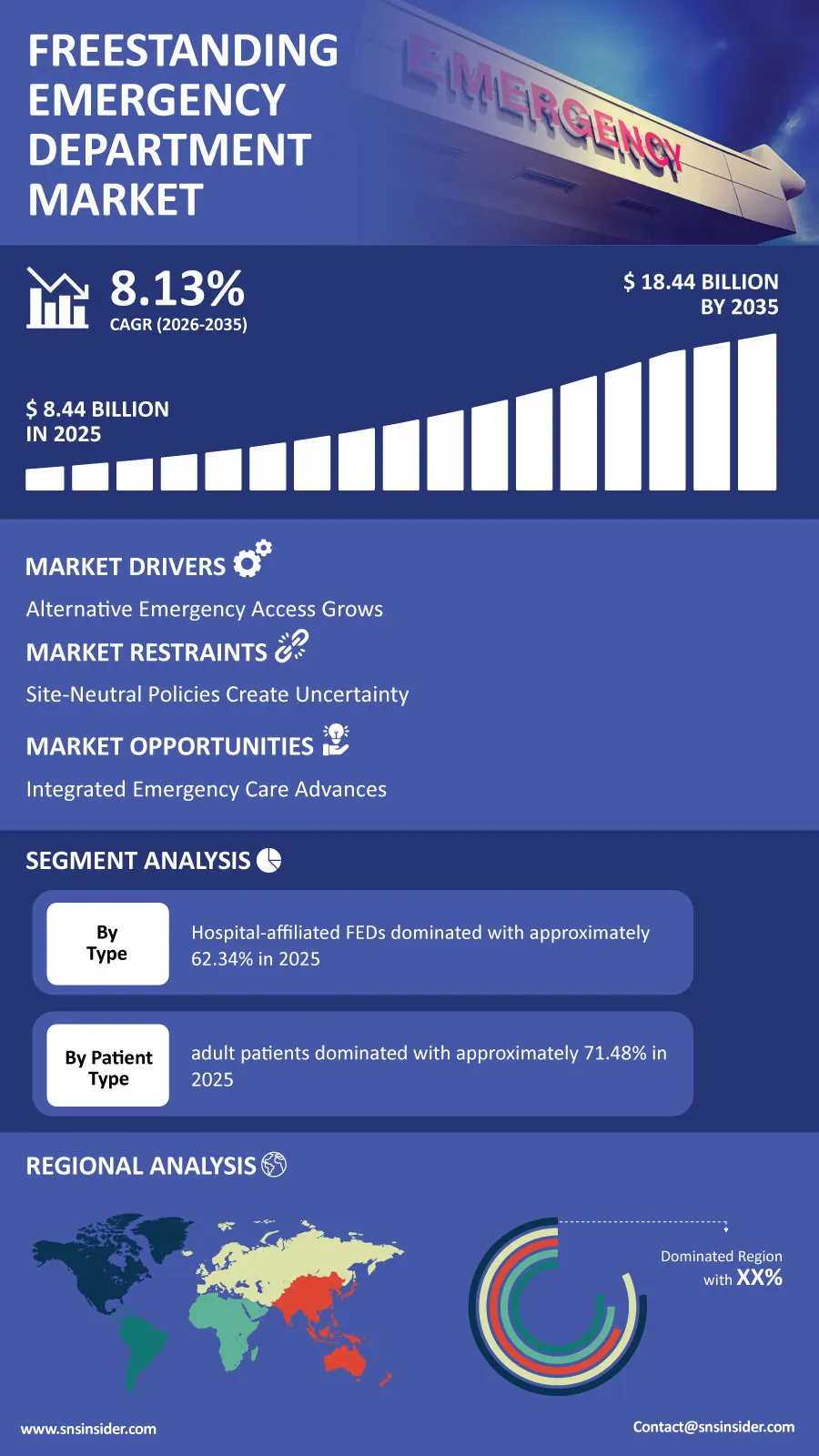
The global Freestanding Emergency Department Market is witnessing strong momentum as healthcare providers expand emergency care access beyond traditional hospital campuses. “According to a recent study by SNS Insider, the global Freestanding Emergency Department Market size valued at USD 8.44 billion in 2025, is anticipated to grow to USD 18.44 billion by 2035, registering a CAGR of 8.13% over the 2026–2035 forecast period.” The growing need for rapid medical attention, increasing patient preference for shorter waiting times, and investments in decentralized healthcare infrastructure continue to strengthen demand across developed and emerging economies.
The healthcare systems around the world are moving towards implementing innovative emergency care concepts that help increase patient accessibility, reducing stress on the overcrowded emergency rooms of the hospitals. The freestanding emergency centers are emerging as an interesting choice owing to their ability to provide complete emergency care, advanced imaging, lab tests, and physician-provided services, right at the doorstep of the people living nearby.
To Get Detailed Insights on the Freestanding Emergency Department Market – Request a Sample Report
Expanding Emergency Access Fuels New Growth Opportunities
In suburban and neglected areas where quick hospital access is still scarce, healthcare professionals are concentrating on extending emergency services. This method improves patient outcomes for time-sensitive medical diseases while enabling quicker diagnosis and treatment.
Growing investments in multi-location emergency care networks by private investors and healthcare organizations are also helping the sector. Providers are able to provide effective emergency services while improving operational performance because to the adoption of telemedicine platforms, digital patient registration systems, and cutting-edge diagnostic technology. These advancements are promoting freestanding emergency rooms' increased acceptability in many healthcare systems.
Key Market Findings Highlight Fast-Growing Segments
Hospital-affiliated freestanding emergency departments remained the largest segment, accounting for 62.34% of total market revenue in 2025 due to their integration with established hospital networks and streamlined patient referral capabilities. Independent facilities are projected to record the fastest growth through 2035, advancing at a 9.26% CAGR as new investments accelerate network expansion.
Emergency care services generated the largest revenue share of 38.42% in 2025, reflecting their central role in providing immediate treatment for acute medical conditions. Diagnostic imaging services are expected to experience the strongest growth, expanding at a 9.84% CAGR as providers invest in CT scanners, MRI systems, ultrasound, and digital imaging technologies.
Adult patients represented the leading patient category with 71.48% of market revenue in 2025, while pediatric emergency services are forecast to expand at a 8.87% CAGR as specialized emergency care for children becomes increasingly available.
Private ownership dominated the industry with a 68.22% revenue share in 2025, supported by ongoing investments in modern emergency care facilities and operational efficiency initiatives.
Technology Integration and Consumer Expectations Reshape Emergency Care
Emergency healthcare services are increasingly using digital transformation as a differentiation. By enabling emergency physicians to work with distant specialists, telemedicine consultations are enhancing clinical decision-making without necessitating on-site specialty support.
In the meantime, healthcare institutions keep making investments in advanced diagnostic tools, electronic health record connectivity, and digital patient interaction systems that streamline the provision of emergency care. Patient confidence in freestanding emergency rooms is being further bolstered by growing public knowledge of convenient emergency care options and open service availability.
By incorporating artificial intelligence-assisted diagnostics, predictive patient management tools, and simplified workflow systems that enhance care quality while decreasing treatment delays, healthcare professionals are also concentrating on operational efficiency.
Regional Markets Continue to Witness Strong Development
With the help of robust private healthcare infrastructure and extensive adoption of freestanding emergency care models, North America continued to hold the top spot in 2025. Due to its large emergency care networks and advantageous healthcare investments, the United States accounted for 87.6% of the North American market revenue.
As healthcare investments in Australia, India, Singapore, and South-east Asia pick up speed, Asia Pacific is expected to experience the fastest regional growth through 2035. Due to the rise of private healthcare and the rising need for easily accessible emergency services, Australia accounted for 34.8% of Asia Pacific revenue in 2025.
Europe continues to strengthen its position through evolving healthcare delivery models, with the United Kingdom accounting for 30.4% of regional revenue. The UAE contributed 33.5% of Middle East & Africa revenue, while Brazil represented 42.3% of Latin American revenue, highlighting growing investments in modern emergency healthcare infrastructure across emerging markets.
Leading Companies Strengthen Competitive Landscape
Industry participants continue expanding facility networks while investing in digital healthcare technologies, diagnostic capabilities, physician recruitment, and strategic partnerships to strengthen service delivery. Continuous innovation in patient care, operational efficiency, and healthcare accessibility remains central to competitive positioning.
Major companies operating in the global Freestanding Emergency Department Market include HCA Healthcare Inc., Ascension Health, CommonSpirit Health, Tenet Healthcare Corporation, CHRISTUS Health, Integra Emergency Physicians, Elite Emergency Medical Services, Adeptus Health, FastMed Urgent Care, NextCare Holdings, Emerus Holdings, U.S. HealthWorks (Optum), CareNow (HCA), Concentra, MedStar Health, Baylor Scott & White Health, Memorial Hermann Health System, Texas Health Resources, Dignity Health (CommonSpirit), and Banner Health.
An SNS Insider analyst Parry Kardani commented, "Healthcare systems are increasingly prioritizing decentralized emergency care models that improve accessibility while reducing pressure on traditional hospital emergency departments. Continued investments in technology, diagnostics, and integrated care delivery will support long-term growth opportunities across the global freestanding emergency department market.
About the Author

Get in touch