
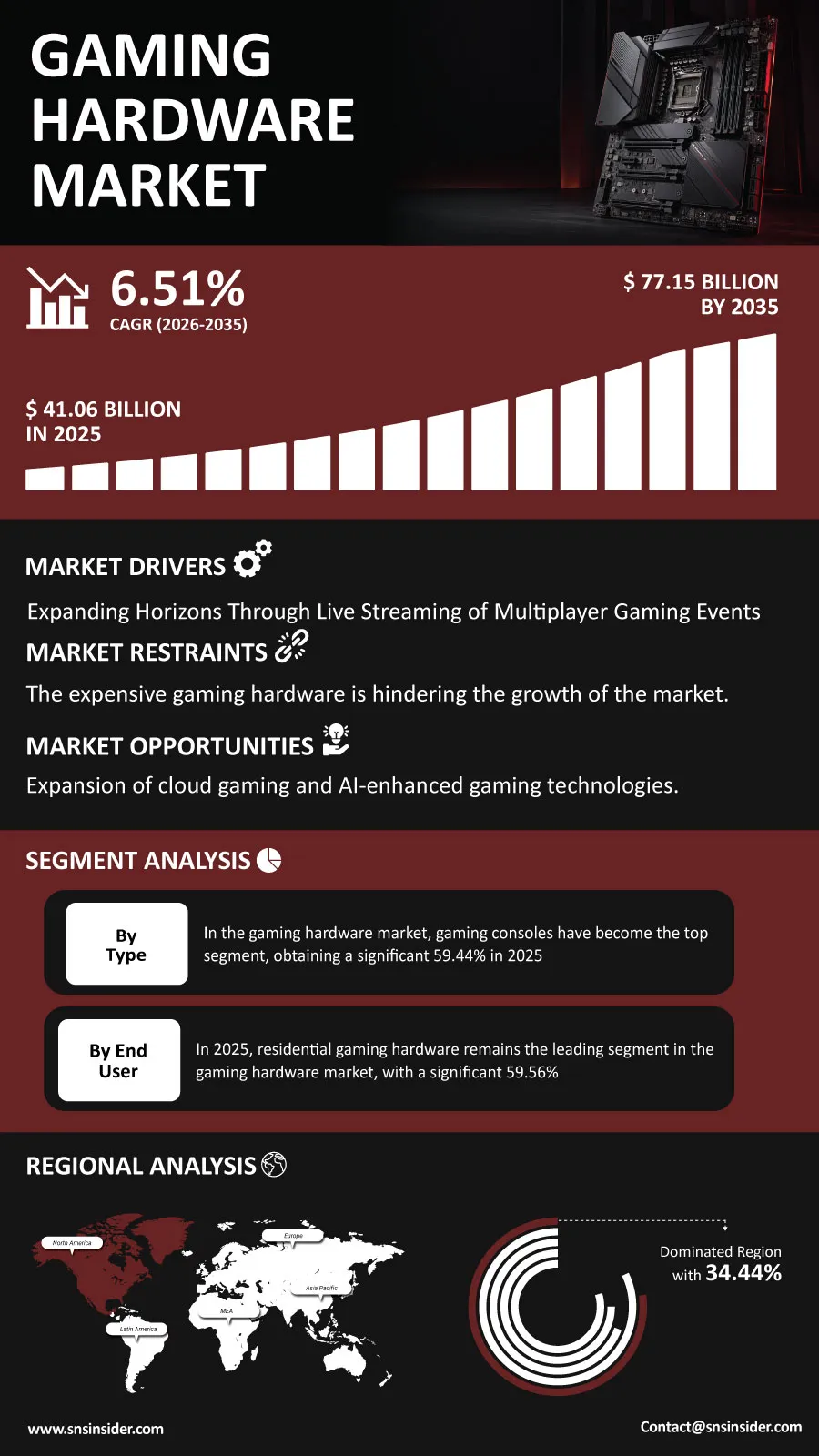
The global Gaming Hardware Market is entering a sustained growth phase as consumers, esports participants, streamers, and content creators demand increasingly capable devices for immersive digital entertainment. According to a recent study by SNS Insider, the global Gaming Hardware Market size valued at USD 41.06 billion in 2025, is anticipated to grow to USD 77.15 billion by 2035, registering a CAGR of 6.51% over the 2026–2035 forecast period.
Growing popularity of competitive gaming, multiplayer online communities and game streaming have made users want to get better consoles, PCs, graphics systems, screens and gaming peripherals. Also, advancements in graphical rendering technology, connectivity and interactivity technology have created higher demands from users on performance and responsiveness.
Hardware used in games can take advantage of development of overall digital entertainment environments. More and more consumers are using gaming devices to communicate with friends, to broadcast their gameplay and to watch media content.
To Get Detailed Insights on the Gaming Hardware Market – Request a Sample Report
Esports and Content Creation Open New Growth Opportunities
The increased professionalization of the industry is driving a strong cycle of demand for quality gaming equipment that ensures high performance. The gamers need to have quality input devices, fast displays, quality processors, good graphics cards, and quality networking capabilities to maintain their performance during the competitions.
In addition to that, the growth of streaming and gaming content creation is expanding the clientele by bringing new consumers into play. They need to buy better computing hardware to ensure that it can be used for playing, streaming, broadcasting, and interacting with the fans at the same time.
Also, cloud gaming is changing the purchases people make as it encourages them to develop better gaming setups despite the fact that more and more computations will be done through the remote infrastructure.
Key Market Insights Highlight Shifting Demand Patterns
By type, gaming consoles are expected to account for 59.44% of global market revenue in 2025, supported by continued hardware innovation, exclusive game ecosystems, and strong consumer demand for accessible home entertainment. Console manufacturers are increasingly combining powerful processing capabilities with subscription services, digital storefronts, and cross-device functionality.
Based on end user, residential gaming is projected to represent 59.56% of market revenue in 2025. Consumers are increasingly building dedicated gaming environments at home, supported by demand for high-resolution displays, specialized input devices, powerful PCs, and next-generation consoles.
The growing popularity of online multiplayer gaming and social entertainment is further encouraging households to invest in equipment capable of delivering smoother graphics, faster response times, and improved audio performance. Meanwhile, esports venues, commercial gaming facilities, and professional users continue creating additional demand for specialized high-performance systems.
Hardware Innovation Continues to Reshape the Gaming Experience
Manufacturers have been focusing on developments in graphical quality, processing effectiveness, portability, and interactivity. Current game consoles are being equipped with new graphics technology, AI features, high-refresh rate screens, immersive audio, and innovative cooling techniques.
The development of hand-held PC gaming devices is opening up new hardware possibilities through the combination of portability with the capability of desktop-level gaming. At the same time, virtual and augmented reality technologies are providing an avenue for developing specialized hardware devices.
However, premium hardware prices, the availability of components, semiconductor supply irregularities, and manufacturing complications are hindering the adoption by cost-sensitive customers. Therefore, manufacturers are trying to balance the two elements to create a wider customer base.
North America Accounts for 34.44% Gaming Hardware Market Share in 2025 as Gaming Communities Expand
North America is forecasted to be the largest regional market and will command a market share of 34.44% of total revenue in 2025. The factors contributing to the growth in the region include robust consumer spending, strong gaming community, good internet infrastructure, and substantial investment by key technology and gaming firms.
The Asia Pacific region is fast becoming the fastest-growing regional market due to a huge gaming population, increase in internet penetration, higher disposable incomes, and growing esports industry. Countries such as China, Japan, and South Korea along with other countries in the region are developing their gaming infrastructure and launching different hardware products.
Europe still stands to gain from its developed PC and console gaming community, growth in esport activity, and enhanced broadband/5G Internet. Latin America and the Middle East & Africa are creating additional opportunities in the region as well due to enhanced digital infrastructure and the growing prominence of gaming.
Industry Participants Focus on Performance and Ecosystem Expansion
Competition remains intense as companies compete for faster CPUs, better graphic cards, more advanced peripherals, portability and overall gaming experience ecosystems. The companies are also focusing on improving partnerships in software, subscription services, cloud computing and esports.
Key companies operating in the global Gaming Hardware Market include Microsoft Corporation, Nintendo Co., Ltd., NVIDIA Corporation, Sony Corporation, Logitech International S.A., Venom UK Ltd., Oculus VR, Linden Research, Sega Games, Corsair Gaming, Inc., Razer Inc., Alienware, ASUS, Acer, HP Inc., SteelSeries, AMD, Valve Corporation, Epic Games, and Tencent Holdings.
An SNS Insider analyst Sushant Kadam commented, “The gaming hardware industry is moving beyond conventional console and PC upgrades as esports, streaming, cloud services, immersive technologies, and portable gaming converge. Companies that combine strong hardware performance with compelling ecosystems and accessible product offerings will be well positioned to capture the next wave of consumer demand.”
About the Author

Get in touch




